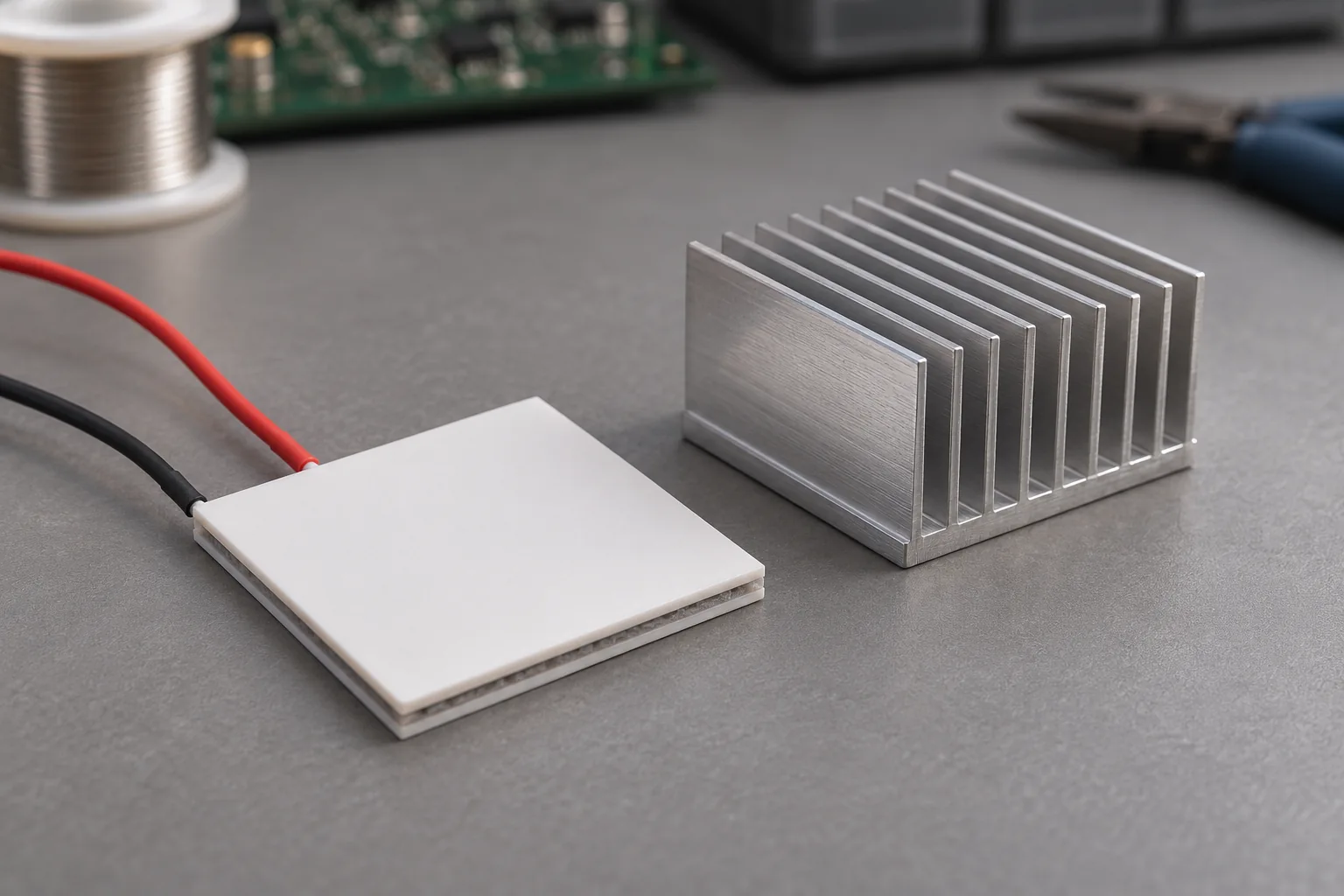
A thermoelectric cooler uses electric current to transfer heat through a solid-state module. In a typical Peltier module, one face absorbs heat while the other rejects it. The cooled object loses heat to the cold face, and a separate heat-removal system carries the rejected heat away from the hot face. [1, 3]
The module does not manufacture a substance called cold. It creates a useful temperature difference by moving thermal energy with an electrical input. Its performance depends on the entire path from the object being cooled to the environment receiving the heat. [3, 7]
What is inside a Peltier module?
Many familiar modules look like thin ceramic sandwiches with two wires. Inside are thermoelectric semiconductor elements. Ferrotec describes commonly used bismuth-telluride materials prepared with different electrical characteristics, conventionally called n-type and p-type. These elements provide the working material for the heat-pumping process. [2]
The elements are connected so electric current passes through a sequence of different material regions. The assembly brings their useful thermal effects together across its two faces. What looks like one simple tile is therefore an organized electrical and thermal structure rather than a block of ordinary insulating ceramic. [1, 2]
Material choice matters because the module must combine useful electrical behavior with thermal properties suited to the intended temperature range. Ferrotec's materials guide discusses several thermoelectric materials, emphasizing that their performance varies with temperature. A material effective in one application is not automatically ideal for all others. [2]
How does electric current move heat?
The Peltier effect describes heat being absorbed or released at a junction of dissimilar conducting materials when current flows. Semiconductor modules use that relationship in a practical arrangement. With the appropriate current direction, the combined effect moves heat from one side of the assembly toward the other. [1]
Reversing the current can reverse the heat-pumping direction. That makes the same kind of device useful for controlled heating as well as cooling. A precision system can change its electrical drive rather than relying on a separate heating mechanism for every change in temperature demand. [4]
Current also encounters electrical resistance, producing heat. Thermoelectric operation therefore involves both the desired heat transfer and unwanted resistive heating. More electrical input does not automatically mean an unlimited increase in useful cooling, especially once the surrounding thermal system becomes a constraint. [1, 5]
Why does the hot side need a heat sink?
The heat taken from the cooled object must go somewhere. In addition, the energy supplied electrically contributes to the heat that must be rejected. A working assembly needs a path capable of removing both contributions, not merely the original load from the object. [3]
This is why an isolated module is different from a complete cooler. A heat sink increases the opportunity to transfer heat to the surroundings, and the wider assembly may use moving air or a liquid-cooling system. Its temperature rise affects what the module can achieve on the other side. [3]
Analog Devices gives a useful illustrative energy balance: a module absorbing twenty-five watts from a target while adding fifty watts through its electrical operation requires the hot-side system to reject seventy-five watts. Those figures are an example, not a universal specification for Peltier modules. [5]
Can it cool below room temperature?
Yes, in a suitable system. Ferrotec distinguishes active thermoelectric cooling from a passive heat sink: the module can lower a target below ambient temperature while a passive sink alone cannot simply keep pulling heat from a colder target into warmer air. [6]
The achievable cold temperature depends on the hot-side temperature, the temperature difference across the module and the amount of heat being absorbed. A nearly unloaded cold face and a face cooling a continuously warm object represent very different operating conditions. [1, 5]
Cooling below ambient can also create additional system requirements. Ferrotec's design guide treats insulation and the surroundings as part of the thermal analysis. Heat leaking in through supports, walls or other paths contributes to the load, even when it is not produced by the target itself. [7]
What does a maximum cooling rating mean?
Datasheet maxima describe specified conditions. Analog Devices explains that maximum heat absorption is associated with zero temperature difference across the module, while the maximum temperature difference occurs when useful heat absorption has fallen to zero. These are different endpoints rather than simultaneous promises. [5]
An application generally operates between them. Asking a module to maintain a larger temperature difference changes the heat load it can handle. Selecting a cooler solely from one impressive maximum can therefore give an unrealistic picture of the finished system. [5, 7]
The temperatures of interest also occur at different places. The object, module face, interface, heat sink and surrounding air need not all share a temperature. Accounting for those differences is part of understanding the thermal path rather than treating a single reading as the whole system. [7]
How is a precise temperature maintained?
A temperature sensor measures the controlled region, and electronics compare that reading with the desired value. The controller adjusts current through the module in response to the difference. Analog Devices describes this feedback loop as the basis of precision thermoelectric control. [4]
The response is not instantaneous. The object and surrounding components have thermal mass, so their temperatures take time to change. A controller must work with that behavior, avoiding the assumption that a rapid electrical change produces an equally rapid and stable temperature change everywhere. [4]
Why use this instead of a compressor?
The solid-state module has no moving mechanical parts or circulating refrigerant inside it. It can be compact and useful for controlling individual temperature-sensitive components. Analog Devices identifies optical and electronic devices among applications where those features are valuable. [4]
Those advantages do not establish universal efficiency superiority. Engineering sources describe thermoelectric cooling as an application-dependent choice. A complete assembly may also include fans or pumps even though the module itself has no moving parts, so the system's behavior must be assessed as a whole. [3, 6]
The useful question is what needs controlling and under which conditions. Thermoelectric modules can offer localized heating and cooling, but the semiconductor tile is only one part of the answer. The heat load, interfaces, heat rejection and electrical control determine whether that promising component becomes an effective cooler. [6, 7]
Keep exploring
Compare semiconductor heat pumping with a refrigerator’s circulating refrigerant and a heat pipe’s phase-change cycle.
Sources and further reading
Thermoelectric operation checked November 17, 2026, against manufacturer engineering guides. Numerical ratings depend on stated test conditions; this explanation is not an assembly or power-supply design procedure.
- Ferrotec — Introduction to Thermoelectric Cooling
- Ferrotec — Basic Principles of Thermoelectric Modules and Materials
- Ferrotec — Heat Sink Considerations
- Analog Devices — How to Control and Compensate a Thermoelectric Cooler
- Analog Devices — Higher-Power Thermoelectric Cooling Using a Peltier Device
- Ferrotec — Applications for Thermoelectric Coolers
- Ferrotec — Thermal System Design Considerations
Keep exploring.
One remarkable idea at a time—nature, science, history and beyond.
Last updated November 17, 2026.

Barnakle Editorial Team
Barnakle Editorial Team is the collective byline used for Barnakle’s editorial articles. The contributor profile explains the team identity and links to the publication’s editorial policies.
More from the editorial team →