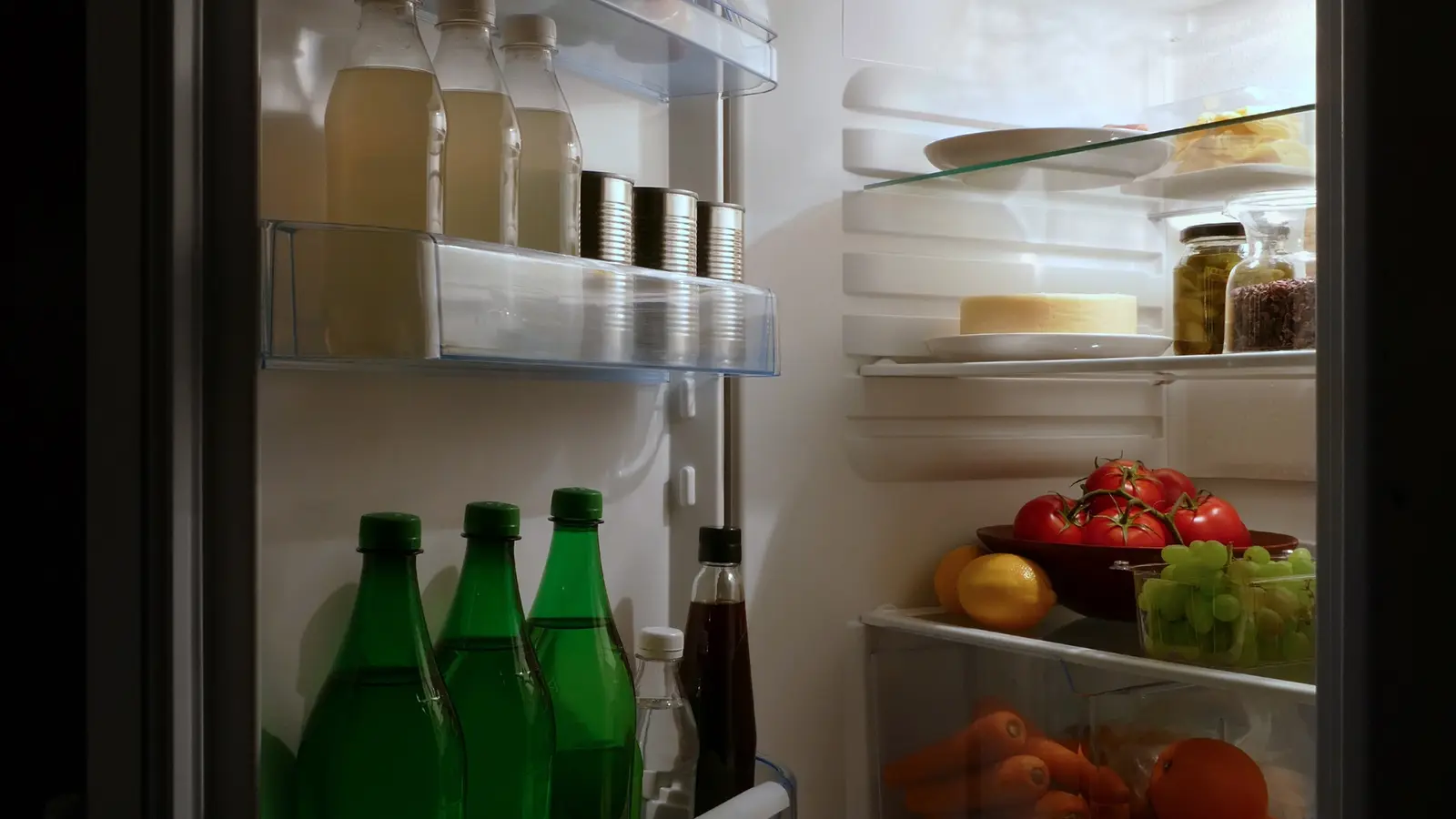
A refrigerator pumps heat from its insulated cabinet into the surrounding room
The short answer
A refrigerator does not manufacture cold. Its sealed vapour-compression system circulates a refrigerant through an evaporator, compressor, condenser and expansion device. The refrigerant absorbs heat as it evaporates at low pressure inside the cabinet, the compressor raises its pressure, and the condenser releases that heat into the room. Insulation and thermostatic controls reduce how often the cycle must run.
The warm coils and air near a working refrigerator reveal its real job: moving energy. The appliance continuously counters heat leaking through walls, entering with food and arriving whenever the door opens.
The evaporator absorbs cabinet heat
Low-pressure refrigerant enters the evaporator and boils at a low temperature. The phase change draws thermal energy from air and surfaces inside the refrigerator.
Understanding The evaporator absorbs cabinet heat means separating the immediate mechanism from the conditions that change its strength, timing or visibility. Researchers measure those variables independently, compare real examples and test whether the explanation predicts new observations. That turns a plausible story into an evidence-based account.
The evidence comes from methods that fail in different ways. Direct observation establishes what occurs, instruments quantify structure or timing, experiments isolate candidate causes and models test whether known physical, chemical or biological rules reproduce the pattern. Agreement among methods is stronger than repetition of one memorable example.
Context also matters. Scale, material, temperature, geometry, environment and measurement limits can change an outcome without overturning the underlying process. Accurate reporting preserves this variation, states uncertainty and avoids turning a useful explanation into a universal rule.
A practical explanation should identify what would change the observation. Following that question reveals the limits of present evidence and the next measurement needed.
This mechanism connects a familiar question with a broader scientific principle. Following matter, energy or information through each stage shows where the explanation is established, where natural variation enters and why a superficially similar event may have another cause.
Scientists also test alternatives rather than stopping at the first plausible account. A strong explanation predicts several linked observations, survives controlled comparison and specifies where it should fail. That approach keeps a clear answer accurate without hiding complexity.
The compressor raises pressure
An electric motor drives a pump that compresses refrigerant vapour. Its pressure and temperature rise, preparing it to reject heat at a temperature above the surrounding room.
Understanding The compressor raises pressure means separating the immediate mechanism from the conditions that change its strength, timing or visibility. Researchers measure those variables independently, compare real examples and test whether the explanation predicts new observations. That turns a plausible story into an evidence-based account.
The evidence comes from methods that fail in different ways. Direct observation establishes what occurs, instruments quantify structure or timing, experiments isolate candidate causes and models test whether known physical, chemical or biological rules reproduce the pattern. Agreement among methods is stronger than repetition of one memorable example.
Context also matters. Scale, material, temperature, geometry, environment and measurement limits can change an outcome without overturning the underlying process. Accurate reporting preserves this variation, states uncertainty and avoids turning a useful explanation into a universal rule.
A practical explanation should identify what would change the observation. Following that question reveals the limits of present evidence and the next measurement needed.
This mechanism connects a familiar question with a broader scientific principle. Following matter, energy or information through each stage shows where the explanation is established, where natural variation enters and why a superficially similar event may have another cause.
Scientists also test alternatives rather than stopping at the first plausible account. A strong explanation predicts several linked observations, survives controlled comparison and specifies where it should fail. That approach keeps a clear answer accurate without hiding complexity.
The condenser releases heat
Hot high-pressure refrigerant flows through coils or tubing outside the cold compartment. It transfers heat to room air and condenses back toward a liquid.
Understanding The condenser releases heat means separating the immediate mechanism from the conditions that change its strength, timing or visibility. Researchers measure those variables independently, compare real examples and test whether the explanation predicts new observations. That turns a plausible story into an evidence-based account.
The evidence comes from methods that fail in different ways. Direct observation establishes what occurs, instruments quantify structure or timing, experiments isolate candidate causes and models test whether known physical, chemical or biological rules reproduce the pattern. Agreement among methods is stronger than repetition of one memorable example.
Context also matters. Scale, material, temperature, geometry, environment and measurement limits can change an outcome without overturning the underlying process. Accurate reporting preserves this variation, states uncertainty and avoids turning a useful explanation into a universal rule.
A practical explanation should identify what would change the observation. Following that question reveals the limits of present evidence and the next measurement needed.
This mechanism connects a familiar question with a broader scientific principle. Following matter, energy or information through each stage shows where the explanation is established, where natural variation enters and why a superficially similar event may have another cause.
Scientists also test alternatives rather than stopping at the first plausible account. A strong explanation predicts several linked observations, survives controlled comparison and specifies where it should fail. That approach keeps a clear answer accurate without hiding complexity.
An expansion device lowers pressure
A capillary tube or valve restricts flow before the evaporator. The pressure drop lowers the refrigerant temperature and restores the conditions needed to absorb heat again.
Understanding An expansion device lowers pressure means separating the immediate mechanism from the conditions that change its strength, timing or visibility. Researchers measure those variables independently, compare real examples and test whether the explanation predicts new observations. That turns a plausible story into an evidence-based account.
The evidence comes from methods that fail in different ways. Direct observation establishes what occurs, instruments quantify structure or timing, experiments isolate candidate causes and models test whether known physical, chemical or biological rules reproduce the pattern. Agreement among methods is stronger than repetition of one memorable example.
Context also matters. Scale, material, temperature, geometry, environment and measurement limits can change an outcome without overturning the underlying process. Accurate reporting preserves this variation, states uncertainty and avoids turning a useful explanation into a universal rule.
A practical explanation should identify what would change the observation. Following that question reveals the limits of present evidence and the next measurement needed.
This mechanism connects a familiar question with a broader scientific principle. Following matter, energy or information through each stage shows where the explanation is established, where natural variation enters and why a superficially similar event may have another cause.
Scientists also test alternatives rather than stopping at the first plausible account. A strong explanation predicts several linked observations, survives controlled comparison and specifies where it should fail. That approach keeps a clear answer accurate without hiding complexity.
Fans and natural convection distribute cooling
Many appliances circulate air across the evaporator and through compartments. Shelf layout, vents and food loading affect temperature uniformity and recovery after door openings.
Understanding Fans and natural convection distribute cooling means separating the immediate mechanism from the conditions that change its strength, timing or visibility. Researchers measure those variables independently, compare real examples and test whether the explanation predicts new observations. That turns a plausible story into an evidence-based account.
The evidence comes from methods that fail in different ways. Direct observation establishes what occurs, instruments quantify structure or timing, experiments isolate candidate causes and models test whether known physical, chemical or biological rules reproduce the pattern. Agreement among methods is stronger than repetition of one memorable example.
Context also matters. Scale, material, temperature, geometry, environment and measurement limits can change an outcome without overturning the underlying process. Accurate reporting preserves this variation, states uncertainty and avoids turning a useful explanation into a universal rule.
A practical explanation should identify what would change the observation. Following that question reveals the limits of present evidence and the next measurement needed.
This mechanism connects a familiar question with a broader scientific principle. Following matter, energy or information through each stage shows where the explanation is established, where natural variation enters and why a superficially similar event may have another cause.
Scientists also test alternatives rather than stopping at the first plausible account. A strong explanation predicts several linked observations, survives controlled comparison and specifies where it should fail. That approach keeps a clear answer accurate without hiding complexity.
Insulation slows heat leakage
Foam insulation and door gaskets resist heat transfer. A damaged seal, thin insulation or frequent opening increases the load and makes the compressor run longer.
Understanding Insulation slows heat leakage means separating the immediate mechanism from the conditions that change its strength, timing or visibility. Researchers measure those variables independently, compare real examples and test whether the explanation predicts new observations. That turns a plausible story into an evidence-based account.
The evidence comes from methods that fail in different ways. Direct observation establishes what occurs, instruments quantify structure or timing, experiments isolate candidate causes and models test whether known physical, chemical or biological rules reproduce the pattern. Agreement among methods is stronger than repetition of one memorable example.
Context also matters. Scale, material, temperature, geometry, environment and measurement limits can change an outcome without overturning the underlying process. Accurate reporting preserves this variation, states uncertainty and avoids turning a useful explanation into a universal rule.
A practical explanation should identify what would change the observation. Following that question reveals the limits of present evidence and the next measurement needed.
This mechanism connects a familiar question with a broader scientific principle. Following matter, energy or information through each stage shows where the explanation is established, where natural variation enters and why a superficially similar event may have another cause.
Scientists also test alternatives rather than stopping at the first plausible account. A strong explanation predicts several linked observations, survives controlled comparison and specifies where it should fail. That approach keeps a clear answer accurate without hiding complexity.
Controls cycle the system
Temperature sensors and electronic or mechanical controls start and stop cooling to maintain a selected range. Modern variable-speed compressors can adjust capacity rather than operate only fully on or off.
Understanding Controls cycle the system means separating the immediate mechanism from the conditions that change its strength, timing or visibility. Researchers measure those variables independently, compare real examples and test whether the explanation predicts new observations. That turns a plausible story into an evidence-based account.
The evidence comes from methods that fail in different ways. Direct observation establishes what occurs, instruments quantify structure or timing, experiments isolate candidate causes and models test whether known physical, chemical or biological rules reproduce the pattern. Agreement among methods is stronger than repetition of one memorable example.
Context also matters. Scale, material, temperature, geometry, environment and measurement limits can change an outcome without overturning the underlying process. Accurate reporting preserves this variation, states uncertainty and avoids turning a useful explanation into a universal rule.
A practical explanation should identify what would change the observation. Following that question reveals the limits of present evidence and the next measurement needed.
This mechanism connects a familiar question with a broader scientific principle. Following matter, energy or information through each stage shows where the explanation is established, where natural variation enters and why a superficially similar event may have another cause.
Scientists also test alternatives rather than stopping at the first plausible account. A strong explanation predicts several linked observations, survives controlled comparison and specifies where it should fail. That approach keeps a clear answer accurate without hiding complexity.
Frost must be managed
Moist air can deposit ice on a cold evaporator, blocking airflow and insulating the coil. Automatic defrost systems periodically melt that frost and route water to a drain pan.
Understanding Frost must be managed means separating the immediate mechanism from the conditions that change its strength, timing or visibility. Researchers measure those variables independently, compare real examples and test whether the explanation predicts new observations. That turns a plausible story into an evidence-based account.
The evidence comes from methods that fail in different ways. Direct observation establishes what occurs, instruments quantify structure or timing, experiments isolate candidate causes and models test whether known physical, chemical or biological rules reproduce the pattern. Agreement among methods is stronger than repetition of one memorable example.
Context also matters. Scale, material, temperature, geometry, environment and measurement limits can change an outcome without overturning the underlying process. Accurate reporting preserves this variation, states uncertainty and avoids turning a useful explanation into a universal rule.
A practical explanation should identify what would change the observation. Following that question reveals the limits of present evidence and the next measurement needed.
This mechanism connects a familiar question with a broader scientific principle. Following matter, energy or information through each stage shows where the explanation is established, where natural variation enters and why a superficially similar event may have another cause.
Scientists also test alternatives rather than stopping at the first plausible account. A strong explanation predicts several linked observations, survives controlled comparison and specifies where it should fail. That approach keeps a clear answer accurate without hiding complexity.
The room receives more heat than the cabinet loses
The condenser releases the heat removed from food plus the electrical energy used by the compressor and fans. Leaving a refrigerator door open cannot cool a closed room overall.
Understanding The room receives more heat than the cabinet loses means separating the immediate mechanism from the conditions that change its strength, timing or visibility. Researchers measure those variables independently, compare real examples and test whether the explanation predicts new observations. That turns a plausible story into an evidence-based account.
The evidence comes from methods that fail in different ways. Direct observation establishes what occurs, instruments quantify structure or timing, experiments isolate candidate causes and models test whether known physical, chemical or biological rules reproduce the pattern. Agreement among methods is stronger than repetition of one memorable example.
Context also matters. Scale, material, temperature, geometry, environment and measurement limits can change an outcome without overturning the underlying process. Accurate reporting preserves this variation, states uncertainty and avoids turning a useful explanation into a universal rule.
A practical explanation should identify what would change the observation. Following that question reveals the limits of present evidence and the next measurement needed.
This mechanism connects a familiar question with a broader scientific principle. Following matter, energy or information through each stage shows where the explanation is established, where natural variation enters and why a superficially similar event may have another cause.
Scientists also test alternatives rather than stopping at the first plausible account. A strong explanation predicts several linked observations, survives controlled comparison and specifies where it should fail. That approach keeps a clear answer accurate without hiding complexity.
Common misconceptions
A refrigerator does not pour cold air into food or destroy heat. It transfers heat outward and adds some compressor energy to the room. Turning the thermostat colder also does not make warm food cool instantly; it mainly changes the control target and run time.
Clear shorthand is valuable only when it preserves the causal chain. It becomes misleading when it substitutes a label for a mechanism, confuses association with cause or extends evidence beyond tested conditions.
How scientists know
Engineers place temperature, pressure and electrical sensors throughout the refrigeration loop, calculate refrigerant enthalpy changes, use calorimeters to measure cooling capacity and test standardized cabinets under controlled ambient temperature, loading and door-opening schedules.
No single measurement carries the conclusion. Observations, experiments, theory and repeated records provide independent checks, while disagreement can reveal an uncontrolled variable or a question requiring a better test.
Frequently asked questions
Why are the sides or back warm?
That is where the appliance releases extracted heat and compressor energy.
Why does food cool faster with space around it?
Open paths improve air circulation and convective heat transfer.
Does an empty refrigerator use less energy?
The answer depends on door openings, thermal mass and controls; heat leakage through the cabinet remains important.
Why does frost form?
Water vapour entering with room air can freeze on surfaces below 0°C.
Can an open refrigerator cool a kitchen?
No. In a closed room it adds net heat because its motor consumes electricity.
Key takeaways
- Refrigerators move heat rather than create cold.
- Evaporation absorbs heat and condensation releases it.
- The compressor supplies the work that drives the cycle.
- Insulation, seals, airflow and controls determine real performance.
Continue exploring
Sources and further reading
Keep exploring.
One remarkable idea at a time—nature, science, history and beyond.
Sources and further reading
Barnakle uses credible primary and authoritative sources wherever possible.
- U.S. Department of Energy — Refrigerator vapour-compression systems
- https://www.energy.gov/sites/default/files/2022-01/mref-pa-tsd.pdf
- U.S. Department of Energy — Next-generation domestic refrigerator
- https://www.energy.gov/cmei/buildings/articles/next-generation-domestic-refrigerator-unprecedented-performance-using
- U.S. Department of Energy — Refrigeration products research
- https://www.energy.gov/cmei/buildings/refrigeration-products
Last reviewed October 14, 2026.

Barnakle Editorial Team
A member of the Barnakle editorial team, exploring remarkable ideas with clarity, curiosity and care.
More from this author →