A suspension bridge carries weight through a connected load path. The roadway transfers load to its supporting deck structure, then to hanging cables, the curved main cables, towers and anchorages. Foundations ultimately transmit the forces to the ground. No single visible part holds up the entire crossing on its own. [1]
The graceful curve is therefore a working structural shape. In a conventional earth-anchored suspension bridge, the main cables pull against anchorages beyond the towers while the towers carry major compressive loads down to their foundations. Pulling and compression work together to support a long span. [1, 2]
What is hanging from what?
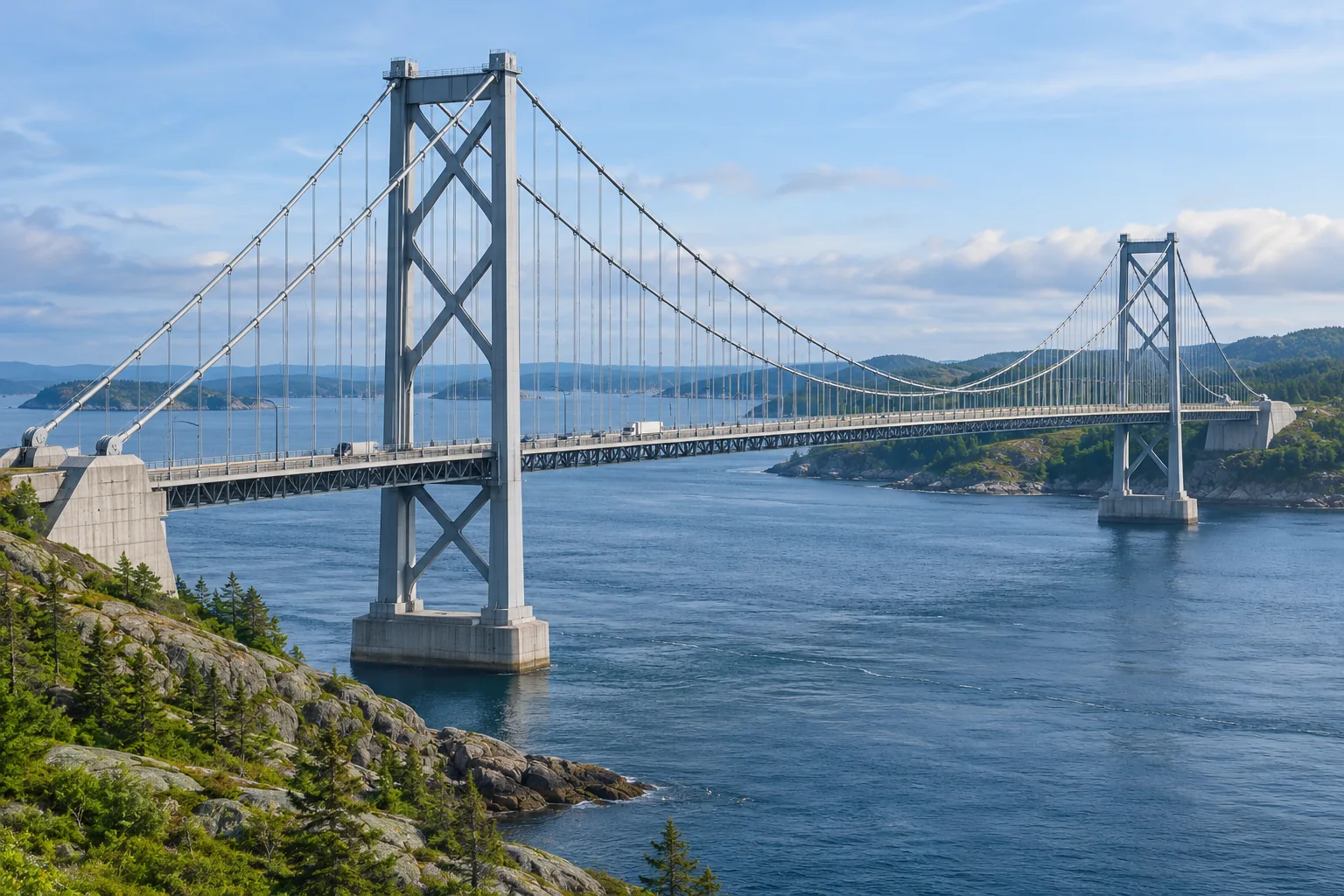
The many slender vertical elements are hangers, also called suspenders. They connect the roadway structure to the main cables above. The main cables follow a broad sagging curve between the towers and continue toward their anchorages at the ends. A hanger and a main cable perform different roles. [7]
This arrangement differs from a single rigid beam stretched across the entire gap. The roadway has support at many hanger locations, even where there is no pier in the water directly underneath. Those support forces are carried through the cable system toward the towers and ends of the bridge. [1]
Following the connections is more useful than asking which object is strongest. A massive cable without a deck connection cannot pick up the roadway's load; a strong hanger without a supported main cable has nowhere to send it. Structural behavior depends on the continuity of the route.
Why do the main cables curve?
A cable is effective in tension: it carries force by being pulled along its length. It does not support a bridge by acting like a stiff column pushed from one end. Under distributed loading, a suspended flexible cable takes a curved form that allows its tension to contribute upward support along the span. [2]
The Golden Gate Bridge operator describes suspension cables as a structural counterpart to an arch. An arch primarily carries its curved load path through compression, while the hanging cable carries tension. The comparison concerns how force travels, rather than claiming that turning any arch upside down automatically creates a complete bridge. [2]
The roadway can remain approximately level even though the main cable curves. Hangers of different lengths connect the two. This separates the shape needed for the cable's structural action from the surface required for vehicles to cross. [7]
What prevents the main cables from pulling inward?
The cable ends need resistance to their pull. In the conventional arrangement described here, large anchorages transfer that tension into the ground. The towers and anchorages do different jobs: the towers support the cable at high points, while the anchorages restrain its ends. [1]
Much of this important work happens away from the middle of the view. A photograph centered on the open span can make the shore structures seem secondary, but removing the end restraint from the explanation leaves out a necessary part of this bridge type. [7]
Other suspension systems can arrange their anchorage differently, so this account is a description of a conventional earth-anchored layout rather than a universal blueprint. A bridge's classification helps identify the broad concept; its actual drawings establish the specific load paths and connections.
Why does the roadway need a stiff structure?
Hanging a flexible surface from cables would not by itself produce a satisfactory road. The deck needs structure that supports local wheel loads and provides stiffness. At the Golden Gate Bridge, longitudinal trusses support roadway beams and help stiffen the deck against wind. [3]
Their triangles are part of the structural arrangement, not decorative trim. The deck structure carries load between hanger locations, while the hangers transfer that load upward. The presence of cables therefore does not eliminate the need for bending resistance and stiffness elsewhere in the bridge. [3]
This explains a useful visual contrast: the main cables are shaped to carry tension, whereas the deck is built to behave as a stable crossing surface. A successful design coordinates both tasks rather than asking a very flexible cable to keep every part of the roadway rigid.
Are the main cables solid steel ropes?
Large bridge cables can be assembled from many individual wires grouped and compacted together. The Golden Gate Bridge provides a documented example: each of its main cables contains 27,572 wires. That number belongs to this bridge, not to suspension bridges in general. [4]
Its builders used aerial cable spinning. Wires were carried from one anchorage over the towers to the other side, secured, and returned in repeated trips. Groups of wires were assembled into strands and compacted to form the finished cables, rather than hoisting each enormous finished cable into place in one operation. [4]
This construction history explains why a cable that looks like one thick line from a distance has a more complicated internal structure. It also shows how the intended final load path can guide the order in which major parts are built.
How is a road built over an empty gap?
Once towers, anchorages and main cables were ready, the Golden Gate roadway could be assembled in suspended sections. Construction proceeded outward from the towers in a balanced sequence. The bridge operator identifies this as an advantage of the suspension system: temporary support did not need to rise from underneath the whole span. [3]
The final appearance hides that sequence. A visitor sees a continuous road, but the completed crossing grew through connected stages. The main cables existed before the road they would ultimately carry, and the deck sections were added to the hanging support system. [3, 4]
Does the bridge move under load?
Yes. A suspension bridge is not perfectly motionless. Load and environmental conditions can change its shape, within the behavior anticipated by its design. The Golden Gate operator publishes deflection information and distinguishes its main span from the bridge's total length, useful reminders that structural dimensions describe different things. [5]
For that bridge, the main span between the towers is 1,280 meters, while the published total length including approaches is 2,737 meters. Comparing bridges requires comparing equivalent measurements. A long overall road connection is not the same quantity as a long unsupported span. [5]
Why is resisting wind different from holding weight?
Static load capacity is only part of bridge behavior. Wind interacts with the shape and motion of a flexible structure, and an unstable interaction can feed energy into movement. The 1940 Tacoma Narrows Bridge collapse is a major example in the history of bridge aerodynamics. [6]
Washington State's account identifies torsional flutter as the primary explanation of the destructive motion. Reducing the event to wind simply matching a bridge's natural frequency misses the importance of the aerodynamic feedback. A structure needs suitable dynamic behavior, not merely enough material to carry its weight at rest. [6]
The full answer therefore joins two questions: how forces reach the ground, and how the structure behaves while those forces change. Deck, hangers, main cables, towers, anchorages and foundations form the load path; stiffness and aerodynamic behavior help make that path a usable crossing.
Keep exploring
Explore two more questions about structural behavior: how some Roman concrete responds around cracks and why aircraft windows avoid sharp corners.
- Why Some Ancient Roman Concrete Becomes More Resilient Around Cracks
- Why Are Airplane Windows Round?
Sources and further reading
Bridge descriptions checked November 16, 2026, against bridge-operator and state transportation sources. Golden Gate figures are named examples; the hero image depicts a generic layout rather than that landmark.
- Golden Gate Bridge, Highway and Transportation District — How the Bridge Spans the Golden Gate
- Golden Gate Bridge, Highway and Transportation District — Facts & Figures About the Bridge
- Golden Gate Bridge, Highway and Transportation District — Hanging the Roadway Deck
- Golden Gate Bridge, Highway and Transportation District — Spinning the Main Cables
- Golden Gate Bridge, Highway and Transportation District — Design & Construction Stats
- Washington State Department of Transportation — Tacoma Narrows Bridge: Lessons from failure
- Washington State Department of Transportation — Tacoma Narrows Bridge history glossary
Keep exploring.
One remarkable idea at a time—nature, science, history and beyond.
Last updated November 16, 2026.

Barnakle Editorial Team
Barnakle Editorial Team is the collective byline used for Barnakle’s editorial articles. The contributor profile explains the team identity and links to the publication’s editorial policies.
More from the editorial team →