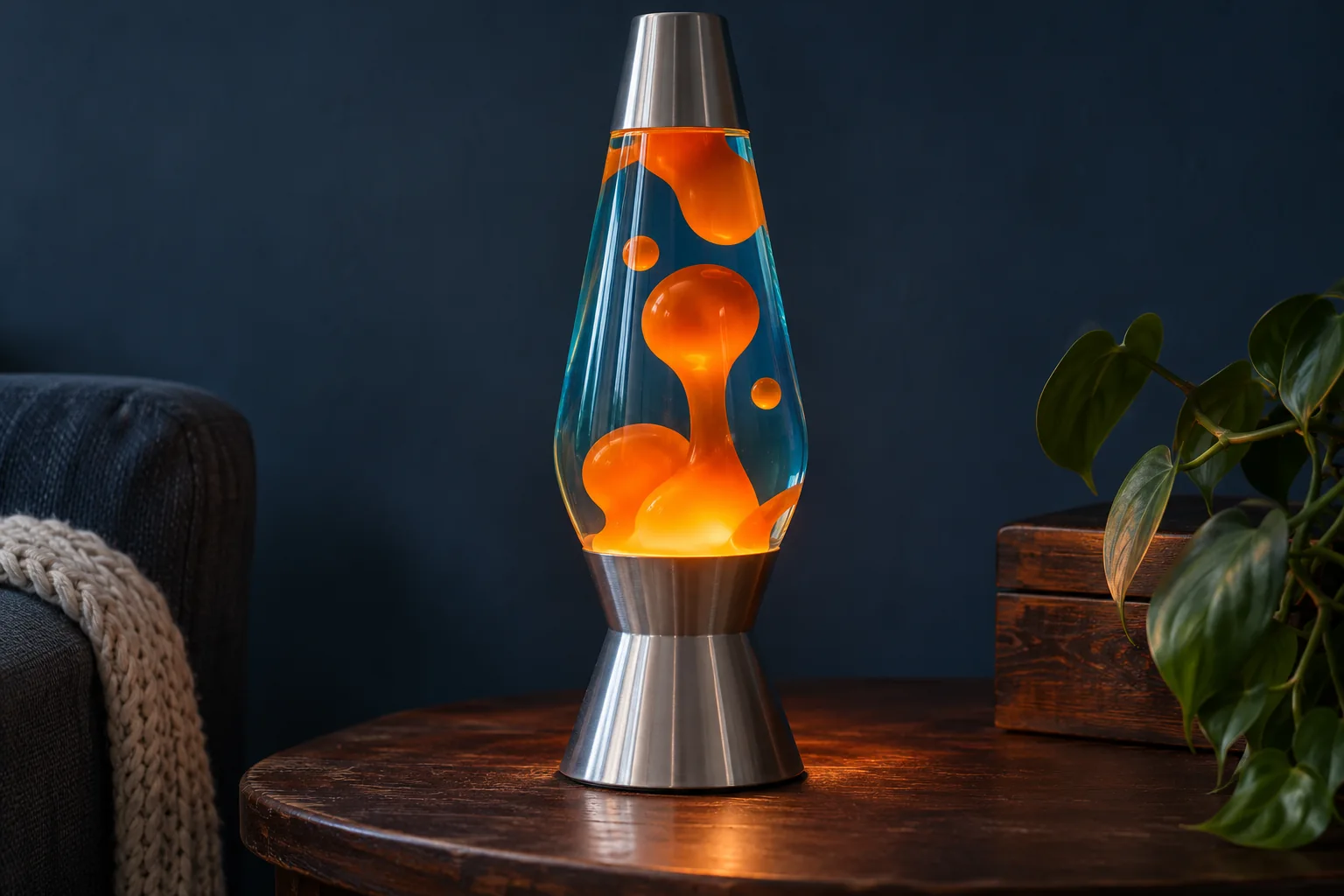
A blob stretches upward, breaks free and drifts through the liquid. Another settles toward the glowing base. A lava lamp can look as though something inside is choosing when to move, yet there is no miniature pump. The lamp repeatedly heats and cools a wax mixture, changing its density enough to make it rise and sink. [1, 2]
The essential trick is a balance between materials. The wax must be denser than the surrounding liquid under one set of conditions and less dense under another. Without that crossover, the lamp would have an interesting colour scheme but very little circulation.
What is inside a lava lamp?
A conventional electric lava lamp contains a wax-based mixture and a separate liquid mixture inside a sealed glass vessel. A bulb beneath the vessel supplies both light and heat. The exact formulas vary by manufacturer and are not generally published; an explanation that names a universal recipe is claiming more than the manufacturers disclose. [1]
The two materials remain distinct rather than turning into one uniform solution. That separation is why individual wax blobs remain visible. The word “lava” describes their appearance: the lamp contains neither molten volcanic rock nor a tiny chemical volcano.
Mathmos describes its surrounding liquid as water-based. That does not mean every commercial lamp contains plain water and ordinary candle wax. Additives and formulation matter because the useful density relationship has to occur within the lamp’s intended operating conditions. [2]
Why does heating make the wax rise?
Density is mass divided by volume. A fixed amount of material becomes less dense if it expands without gaining mass. Thermal expansion is the familiar reason many liquids take up more space as their temperature increases. Different materials expand by different amounts. [3]
For a simplified numerical example, imagine a sealed blob with a mass of 10 grams and a volume of 10 millilitres. Its density is 1 gram per millilitre. If its volume increased to 10.5 millilitres while its mass stayed the same, its density would fall to about 0.95 grams per millilitre. These are invented teaching values, not measurements or a recipe for lamp wax.
Whether that change makes the blob rise depends on the density of the liquid around it. The surrounding liquid also warms, so “the wax expands” is only part of the explanation. The relevant comparison is between both materials at the conditions each encounters. [3, 4]
At the bottom of a working lamp, the wax is heated and melts. When the wax becomes sufficiently buoyant relative to the surrounding mixture, it can rise. Moving a blob through liquid also involves fluid resistance; a density difference does not give it unlimited speed. NASA’s teaching treatment uses the lamp to connect density, buoyancy and drag. [4]
Why does the wax sink again?
The upper part of the vessel is farther from the heat source. Wax arriving there can lose heat, become denser and descend. Returning to the base brings it back toward the heater, allowing the cycle to repeat. [1]
The wax does not need to become solid at the top before it falls. Melting and solidifying are changes of state; floating and sinking depend on the balance of forces and relative density. Treating the two as identical processes obscures what the lamp is demonstrating.
It is helpful to follow one blob rather than the entire display. Its journey includes time spent warming, rising, cooling and descending. Other blobs are at different stages of the cycle, so the display can continue while no single blob moves continuously upward.
Is a lava lamp an example of convection?
Yes: motion carries heat through the system. The heater provides an ongoing energy input, while the lamp also transfers energy to its surroundings. The continuing movement is therefore not perpetual motion. Switching off the heat source eventually removes the conditions sustaining the display. [4, 5]
In a 2009 laboratory study, researchers investigated a related two-fluid system heated below and cooled above. They identified different modes of circulation, including behaviour limited by viscosity. The abstract also cautioned against treating a lava lamp as a faithful model of accepted mantle-convection mechanisms. [5]
That distinction matters. An analogy can illustrate one shared principle while failing to reproduce the temperatures, materials, timescales and geometry of another system. A lamp is a useful invitation to think about moving heat; it is not a complete model of Earth’s interior.
Why does a new lamp take time to start?
The wax begins in a different condition from the flowing blobs seen after warm-up. Heat must reach the contents, and the wax must melt and establish its circulation. Temporary columns and irregular shapes can appear during this transition. The time required depends on the model and conditions rather than a universal countdown. [1, 2]
A useful distinction is between a lamp still warming and one operating outside its intended conditions. Watching the first few minutes does not establish that its mechanism has failed. Equally, adding more heat is not a sound general remedy for poor flow.
For a conventional heat-driven model, a bulb’s thermal output matters alongside its brightness. Mathmos specifically warns that an incorrect bulb can stop flow or overheat the bottle, and that LED substitutions do not supply the intended heat in its lamps. Follow the specifications for the particular model. [2]
Do homemade fizzy “lava lamps” work the same way?
Many classroom versions look similar but use gas rather than a powered heating-and-cooling cycle. In ANU’s oil-and-vinegar demonstration, a reaction with bicarbonate produces carbon dioxide. Gas bubbles carry coloured liquid upward; when the gas escapes, the droplets lose that assistance and sink. [6]
The shared visual effect can make the difference easy to miss. One system depends on a reaction producing bubbles. The conventional electric lamp depends on a continuing heat supply and a specially balanced wax-and-liquid combination. A successful tabletop demonstration is not a formula for refilling a commercial lamp.
Can you shake, open or modify a lava lamp?
Keep its sealed contents intact and use the manufacturer’s instructions. LAVA warns against removing the cap and against moving or shaking a warm lamp, which can damage the display. A lamp that looks cloudy after rough treatment is not evidence that its wax has stopped obeying buoyancy. Its materials have been disturbed. [1]
Running limits and cooling requirements also differ between models. Use the instructions supplied with yours rather than extending a time limit from another lamp. The scientific explanation tells us why heat matters; it does not replace the product’s operating guidance.
Once that distinction is clear, the display becomes easier to read: the blobs are visible traces of a continuing exchange of heat, with each rise and fall depending on the material around them.
Keep exploring
Explore two more ways heat changes the behaviour of everyday objects:
Sources and further reading
Lava-lamp materials and operating guidance checked November 16, 2026. The convection paper is used at abstract level; its laboratory system is distinguished from a household lamp.
- LAVA — FAQ: operating principle, formulation and lamp care
- Mathmos — Help, Support and FAQs: heat source, flow and model-specific care
- OpenStax, College Physics 2e — Thermal Expansion of Solids and Liquids
- NASA PUMAS — “Lava Lamp,” Dan Miller: density, buoyancy and drag teaching example
- Gyüre and Jánosi (2009) — Basics of lava-lamp convection; abstract, Physical Review E
- Australian National University — How to make your own lava lamp: gas-driven demonstration
Keep exploring.
One remarkable idea at a time—nature, science, history and beyond.
Last updated November 16, 2026.

Barnakle Editorial Team
Barnakle Editorial Team is the collective byline used for Barnakle’s editorial articles. The contributor profile explains the team identity and links to the publication’s editorial policies.
More from the editorial team →