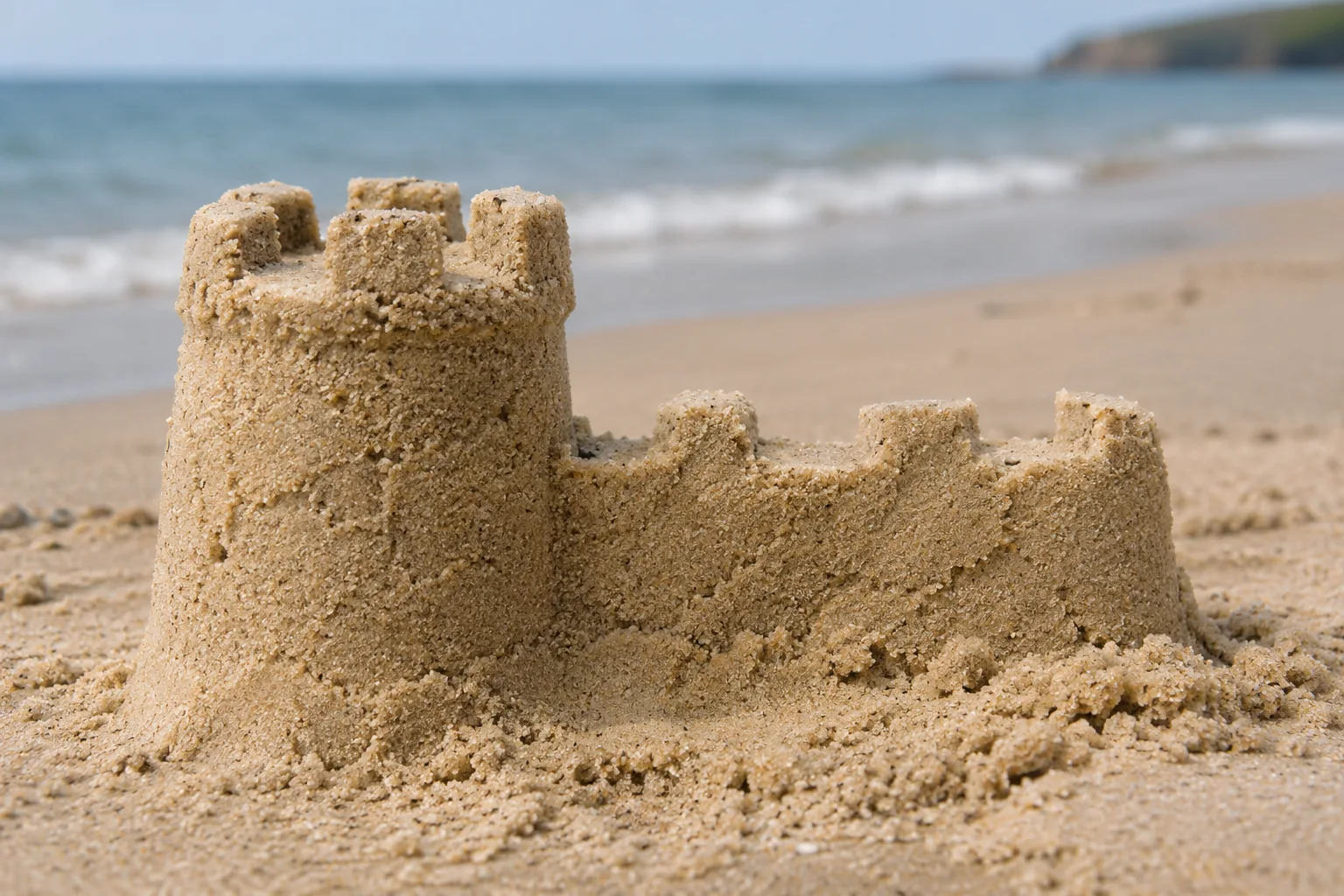
Dry sand runs through your fingers, while slightly damp sand can keep the shape of a bucket. The added water forms tiny bridges between neighbouring grains. Forces associated with those liquid bridges pull grains together, giving the collection a cohesion that dry grains largely lack. [1, 2]
The difference is not that water turns each grain into a sticky new substance. The grains remain solid particles. What changes is the network of connections between them, and therefore the way the whole material resists being pulled, bent or rearranged.
What is a capillary bridge?
When a small amount of water wets neighbouring grains, liquid can gather near their contact. A narrow connection of liquid spans the gap between the solid surfaces. Researchers call this a capillary bridge. Its shape depends on the surfaces, the amount of liquid and the separation between the grains. [2]
A sandcastle contains an enormous collection of such contacts rather than one continuous lump of glue. The bridges connect a granular framework. That framework is why a modest change in water content can produce a dramatic change in what your hand can mould.
Thinking at the grain scale also explains why “sand plus water” is not one material with a single fixed strength. Change the distribution of contacts or the liquid at them, and the collection can behave differently.
How does water pull the grains together?
Surface tension is associated with the cohesive behaviour of molecules at a liquid’s surface. A liquid interface resists an increase in its area. In the curved surfaces of a bridge, surface tension and the pressure difference across the interface contribute to an attractive force between the grains. [2, 3]
The curved boundary is often called a meniscus. You may have seen a meniscus where water meets the side of a glass, but between sand grains it occurs on a much smaller scale. Here, the shape of that interface contributes to the mechanical connection.
Water is therefore doing more than adding weight. Adding an inert weight to dry sand would not create the same network of attractive contacts. The distinctive result depends on interfaces between liquid, grains and surrounding air.
Why can a little water make such a large difference?
Dry grains can press against one another and resist sliding, yet a steep unsupported edge can fail as particles move apart or rearrange. Water bridges add connections that oppose separation. Many small connections acting through the packed grains allow damp sand to hold sharper edges and taller features. [1, 2]
The effect is collective. One bridge does not have to carry the entire tower. Loads are transmitted through a network, and the network changes when grains shift. A visible crack is the large-scale result of numerous local contacts failing or moving.
This also explains why a castle can seem solid while still being easy to destroy. Stability under its own weight does not establish resistance to every added force. A light touch may rearrange grains at exactly the places on which a thin feature depends.
Why doesn’t adding more water always help?
At low water contents, separate liquid bridges can strengthen the sand. As water content increases, the arrangement changes: bridges can merge, and eventually the spaces among grains become saturated. More liquid does not simply create endlessly stronger versions of the same small bridges. [4]
Experiments on sliding over sand found that an intermediate addition of water increased stiffness and reduced the resistance to a dragged load. With too much water, bridges coalesced and the measured stiffness fell again. These results concern a particular experimental arrangement, rather than a universal wetness scale for all soils. [4]
Fully submerged ordinary sand is therefore a different case from a damp castle standing in air. Water has not disappeared, but the relevant liquid-air interfaces and the forces they supported have changed. “Wet” describes a wide range of arrangements, not one physical state. [2]
Is there a perfect sand-to-water ratio?
A 2012 sand-column study found its greatest stiffness at a small liquid fraction, around one percent under its experimental conditions. That result is sometimes turned into a universal beach recipe, but the experiment used specified sand, preparation and measurements. [1]
The grain sizes, shapes, surface properties and packing at a particular beach need not match the laboratory system. A percentage also needs a definition: a volume fraction is not automatically the same as a mass percentage or a casual kitchen measure.
The useful lesson is that small amounts can be effective, while excess water changes the structure of the material. It is not that every bucket of beach sand has one identical numerical target. The university’s account likewise emphasised the small amount of water needed to create strong contacts. [6]
What limits a sandcastle’s height?
Strength is only part of the answer; geometry matters too. The 2012 researchers studied cylindrical columns and found that sufficiently tall ones became unstable to buckling under their own weight. A wider column could support a greater height than a narrow one in the same material. [1]
That is why predicting a universal maximum castle height from water content alone misses an essential variable. A broad, compact structure and a slender turret can be made from similar damp sand yet face different mechanical demands.
The laboratory columns also should not be confused with every elaborate beach sculpture. A real sculpture can include overhangs, thin walls and uneven compaction. Its weakest local feature may fail before the entire structure resembles the idealised column used in a model.
What happens when you squeeze or stir wet sand?
The bridges have finite strength. Grains can separate far enough for bridges to rupture, while new contacts can form elsewhere. Work on model wet granular materials links this contact behaviour to changes between more solid-like and flowing states under an applied shear force. [2, 5]
A numerical study is not a direct measurement of every scoop of beach sand. It provides a controlled way to test how simplified interactions can produce collective behaviour. Comparing such models with experiments helps identify which features are essential and which depend on the details of the sample.
A simple comparison to notice
For a qualitative observation, compare how the same small mould releases dry sand, lightly dampened sand and a much wetter sample. Keep the sand source and mould similar, and notice whether an edge remains after release. This is a suggested comparison, not a claim that Barnakle performed a controlled experiment.
The important observation is the change in shape retention, rather than declaring a winner from one attempt. Packing and handling can change the result alongside water content. A fair comparison needs those factors considered as well.
The familiar sandcastle works because liquid bridges make a loose collection of grains act together. Its walls are held by many small interfaces, and its limits emerge from how those contacts, the water distribution and the structure’s own weight interact.
Keep exploring
Follow the behaviour of grains and water into two more everyday explanations:
Sources and further reading
Wet-sand research checked November 16, 2026. Abstract-level records are labelled. Laboratory optima are not presented as a universal recipe for every beach.
- Pakpour et al. (2012) — How to construct the perfect sandcastle, Scientific Reports; accessible indexed article text
- Kohonen et al. (2004) — On capillary bridges in wet granular materials, Physica A; abstract and accessible introduction
- U.S. Geological Survey — Surface Tension and Water
- Fall et al. (2014) — Sliding Friction on Wet and Dry Sand; University of Amsterdam publication record and abstract
- Fluidization of wet granulates under shear (2011); PubMed abstract of a numerical-model study
- University of Amsterdam (2012) — Sandcastle building is no child’s play, say physicists; university release
Keep exploring.
One remarkable idea at a time—nature, science, history and beyond.
Last updated November 17, 2026.

Barnakle Editorial Team
Barnakle Editorial Team is the collective byline used for Barnakle’s editorial articles. The contributor profile explains the team identity and links to the publication’s editorial policies.
More from the editorial team →