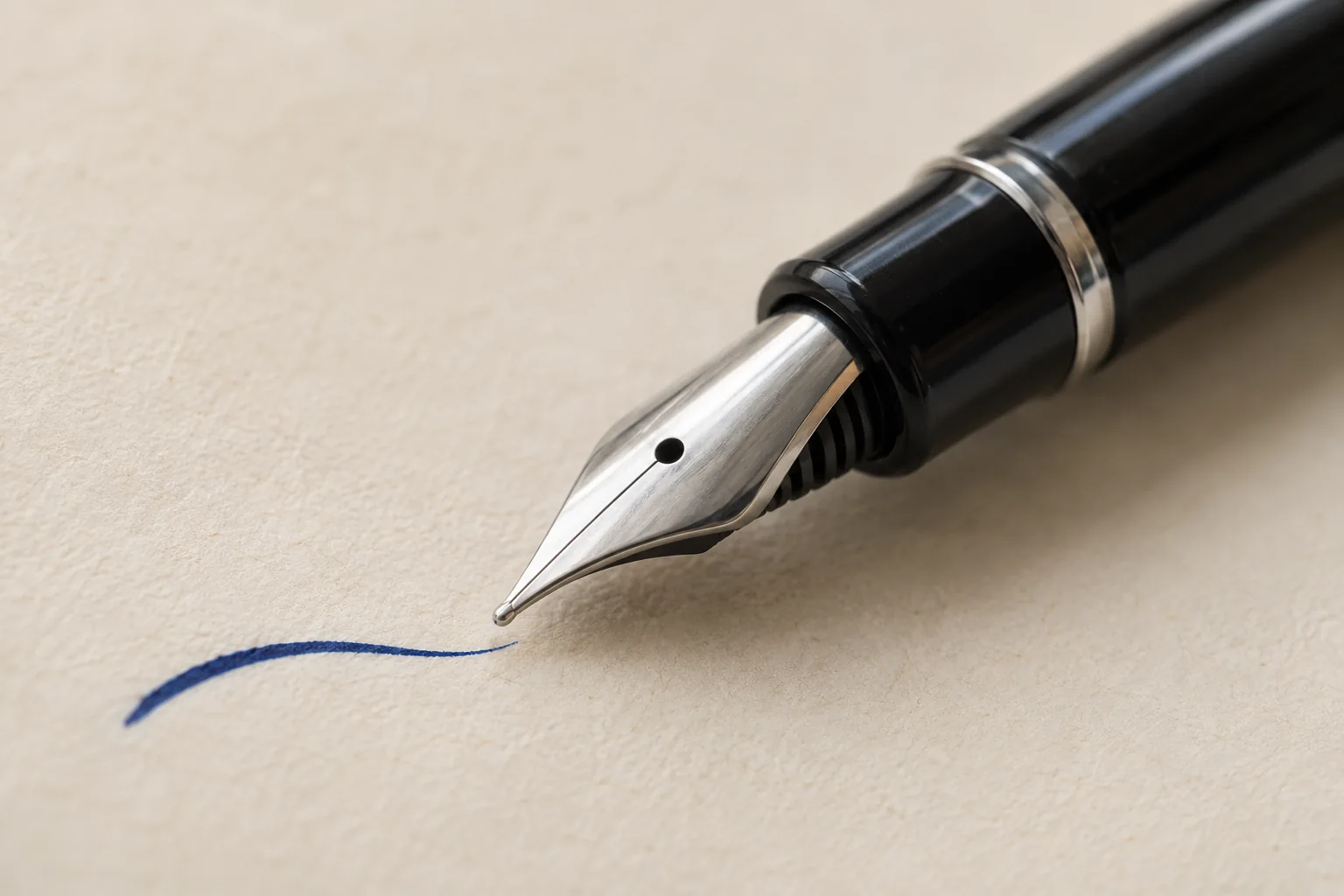
A fountain pen keeps ink moving through a balance of capillary action, pressure and air exchange. Ink travels from a reservoir through a feed toward the nib. When the nib contacts paper, a small amount transfers to the page, while air must replace the liquid leaving the reservoir. [1, 2, 3]
The pen is therefore more than a container with a hole at one end. Its narrow passages regulate the exchange between liquid and air, and the writing surface becomes part of the process. The challenge is supplying enough ink for a line without allowing the whole reservoir to drain. [3, 4]
What are the reservoir, feed and nib?
The reservoir stores the ink. The feed sits between that supply and the metal nib, carrying ink through carefully formed passages. The nib makes contact with the writing surface and presents the ink at its tip. The parts have different jobs, even though their behavior is closely connected. [1]
A reservoir can be a replaceable cartridge, a removable converter or part of the pen's built-in filling system. LAMY describes cartridge and piston arrangements, along with converters that allow compatible cartridge pens to use bottled ink. The supply method can change without abandoning the basic need to regulate flow toward the nib. [5]
Pelikan's explanation likewise separates the filling system from the ink regulator. Filling puts ink into storage; the fine pathways between storage and the writing tip determine how that ink becomes available during use. A larger reservoir does not by itself explain a better-controlled line. [4]
How does capillary action help?
Capillary action arises from the behavior of a liquid at narrow passages and surfaces. Adhesive interactions between the liquid and the material, together with cohesion within the liquid, influence wetting and the shape of its surface. The outcome depends on both the liquid and the surfaces it touches. [6]
This is why a tiny passage behaves differently from an open drainpipe. Surface effects become important on a small scale. Depending on the materials and geometry, a liquid can move along a narrow channel rather than simply following the direction gravity would suggest for a freely falling drop. [6]
PILOT describes ink passing through the feed's channel toward the nib, with capillary action continuing as paper takes up ink. The feed's fins help regulate the available flow. Those fine features are functional parts of a liquid-delivery system, not merely decoration beneath the shiny nib. [1]
Why does air have to enter the pen?
As ink leaves a reservoir, the space it occupied cannot simply disappear. Air exchange affects the pressure balance, helping determine whether more ink can leave. Platinum's explanation explicitly links the amount of ink transferred to paper with air entering the ink tube. [2]
Researchers examining fountain-pen flow have studied that balance in detail. A 2020 paper focused on capillary pressure and the air-holding pressure within a cartridge. Its abstract identifies the feed and its connection to the reservoir as important to maintaining the required ink-air exchange. [3]
The pen does not need a motor continuously pushing ink toward the page. Its geometry and fluid interfaces provide a passive regulating system. Describing the mechanism only as gravity feeding a tube misses the role of incoming air and the pressure changes associated with it. [2, 3]
What happens where the nib touches paper?
Paper is not an impermeable surface. Its fibers and the small spaces between them interact with liquid. Platinum uses this fibrous structure to explain why the capillary mechanism continues at the writing surface, drawing ink where the tip is applied. [2]
That gives the contact point a special role. Ink is being removed from the tip as the line is made, and the pen supplies more through its narrow pathways. The rate of writing and the behavior of the paper influence the demand placed on the feed. [1, 2]
Wetting depends on the particular combination of liquid and solid. OpenStax's treatment of surface tension explains why changing a surface or liquid can change capillary behavior. The familiar phrase capillary action describes a physical relationship, not a guarantee that every liquid will behave identically in every pen. [6]
Why are there different nib widths?
The nib also shapes the mark. LAMY describes narrow, broad, rounded and oblique nib options, with broad calligraphy nibs producing strokes of different widths according to orientation. The visible line reflects the geometry of the writing surface as well as the supply of ink. [5]
Changing a nib's shape does not remove the need for a working feed. The pen still needs enough ink at the contact point to sustain the intended mark. A nib, reservoir and ink regulator are therefore interacting components rather than independent choices that never affect one another. [1, 4]
Why can a pen dry out or start poorly?
Evaporation changes what is left in the fine passages. Pelikan's care explanation describes the watery carrier evaporating and leaving thicker material or deposits in capillary grooves. A pathway that worked with freely flowing ink can behave differently after material has accumulated inside it. [7]
This is one reason the cap has a practical role beyond protecting the nib from knocks. Leaving the pen open can speed evaporation at exposed parts. Pelikan also distinguishes care for different ink formulations and patterns of use, so one broad cleaning rule should not be assumed to fit every pen. [7]
The mechanism explains the symptom without diagnosing every individual case. A poor start may involve the condition of the ink, feed, nib or their connection. Model-specific manufacturer guidance remains more useful than treating all flow problems as proof of one universal fault. [4, 7]
Is a filling mechanism pumping ink while you write?
Ordinarily, the filling system's task is to replenish the supply, not to make a pumping stroke for each written letter. Cartridge replacement and drawing bottled ink into a converter are different ways of preparing the reservoir for the same general writing process. [4, 5]
During writing, liquid transfer and air exchange must remain balanced. The 2020 study's focus on the feed-reservoir connection underscores why a pen can have plenty of ink yet still fail to deliver it smoothly. Available volume and usable flow are separate requirements. [3]
The fine channels, wetting surfaces, air route and paper contact work together at a scale easily missed by the eye. That coordination allows a reservoir of liquid to become a controlled line, rather than an uncontrolled drop, each time the nib meets the page. [2, 6]
Keep exploring
Compare the fountain pen’s liquid pathways with a ballpoint’s rolling tip, then explore how paper fibers draw in water.
Sources and further reading
Fountain-pen operation checked November 17, 2026, using manufacturer explanations, fluid physics and the abstract of a 2020 ink-air flow study. Filling and care arrangements vary by model; no individual pen or ink is being recommended.
- PILOT Australia — How Do Fountain Pens Work? Understanding the Mechanics
- Platinum Pen — Fountain-pen mechanism and capillarity
- Nikolov and colleagues — How capillarity and ink-air flow govern fountain-pen performance (2020 abstract)
- Pelikan — Frequently asked questions: ink regulator and filling systems
- LAMY — Frequently asked questions: nibs and fountain-pen filling systems
- OpenStax, College Physics 2e — Surface Tension and Capillary Action
- Pelikan — Filling and Maintenance Service
Keep exploring.
One remarkable idea at a time—nature, science, history and beyond.
Last updated November 17, 2026.

Barnakle Editorial Team
Barnakle Editorial Team is the collective byline used for Barnakle’s editorial articles. The contributor profile explains the team identity and links to the publication’s editorial policies.
More from the editorial team →