The working end of an everyday pen is a tiny moving surface, fitted closely enough to deliver ink a thin film at a time.
Quick answer
A ballpoint pen holds a small rotating ball in a precision tip. Ink coats the ball on the inside; contact and movement against paper rotate it and transfer ink onto the writing surface. The ball, its seat, the ink and the paper must work together. A retractable button changes the tip’s position, rather than pumping the ink with each click.
A ballpoint can spend most of its life in a drawer and then draw a line with a movement of the hand. The familiar plastic barrel makes the mechanism seem simple. The important engineering is concentrated in a much smaller area: the metal tip that touches the page.
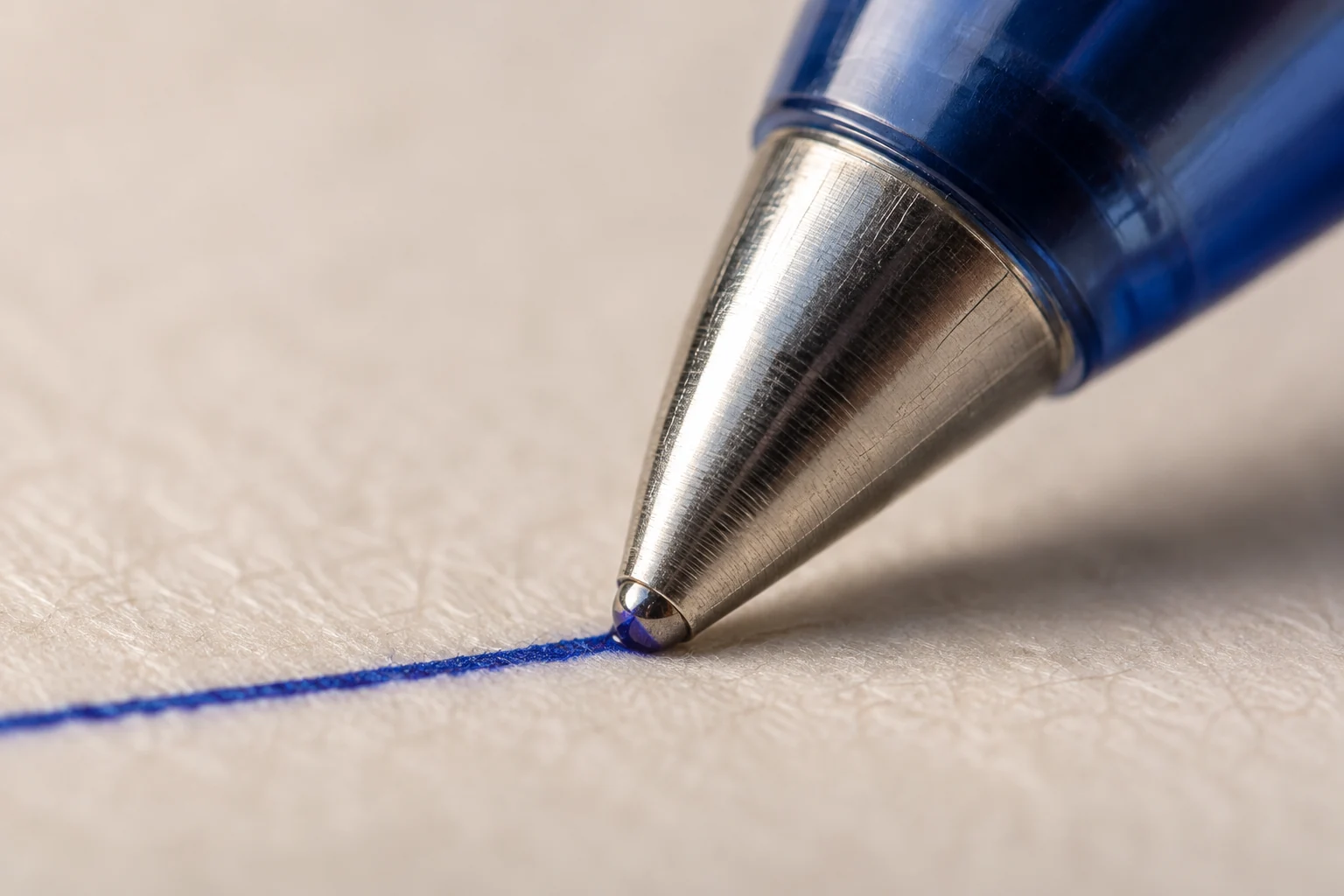
Look closely at that point and the name becomes literal. There is a ball at the end. The pen writes by making that surface roll, pick up ink and meet fresh paper, over and over along the stroke.
The ball transfers ink rather than scraping off a solid pigment
PILOT describes the basic sequence: the small ball rotates against paper and transfers ink carried on its surface. Unlike a pencil, which deposits material worn from a solid core, the pen brings a liquid formulation from an internal supply to the page. [1]
Imagine marking a surface with a tiny inked roller. The roller has to receive ink, rotate and contact the destination. A ballpoint carries out an analogous transfer, but its sphere can roll in different directions as handwriting changes course.
The comparison also explains why a ball is useful for curves. The writing point is not a wheel fixed to travel only along one axis. The spherical contact can follow letters, loops and changes of direction within the constraints of its seat.
The socket has to hold the ball without immobilizing it
The tip retains the ball while allowing rotation and access to ink. The Japan Writing Instruments Manufacturers Association describes micron-scale precision in the tip and a seat shaped to support the ball. The tolerances contribute to consistent lines and a smooth feel. [2]
A loose-fitting assembly would not reliably meter a thin film. An overly restrictive one could resist rotation or fail to replenish ink. The useful design sits between unrestricted leakage and an effectively sealed, motionless point.
This is a general engineering challenge: one interface must perform competing jobs. It retains a moving component, carries contact forces and permits controlled material transfer. Describing the ball as a simple plug leaves out most of the interesting work.
Why the ink matters as much as the metal
Viscosity describes resistance to flow. Zebra’s technical explanation distinguishes the relatively viscous, often oil-based inks associated with conventional ballpoints from lower-viscosity formulations common in rollerball and gel products. These are broad categories, with considerable variation among actual inks. [3]
A formulation that is too reluctant to move would not supply the contact region effectively. One that flows too freely for the tip could produce unwanted deposits. The ink must also wet the moving surfaces and leave a useful mark on the selected paper.
Think of the pen as a matched system rather than a container with any coloured liquid poured inside. Changing the fluid can change the required flow control. A familiar barrel shape does not mean different refills have identical internal behaviour.
How ink reaches the writing point
The reservoir supplies ink to the interior of the tip. Hitachi High-Tech’s microscopic stationery guide illustrates the small ball and describes ordinary ballpoint ink moving toward the tip with gravity’s assistance before transfer to paper. The complete feed arrangement depends on the pen design. [6]
The ball’s rotation continually exposes inked surface to the page and returns another part inward. The visible line therefore represents repeated film transfer along the path, not a long thread being pulled intact from the refill.
That distinction helps explain why a large remaining ink supply does not guarantee a good line. The reservoir can still contain ink while delivery fails at the tip. Capacity and transfer are different parts of the problem.
Why writing angle changes the result
The paper must contact the ball in a way that permits it to turn. Mitsubishi Pencil explains that very shallow angles can interfere with rotation and bring the surrounding tip into unwanted contact with paper, potentially affecting ink delivery or collecting fibres. Different tip arrangements can have different usable angles. [4]
This is not simply a question of pushing harder. The direction and location of the contact matter. More force applied through an unfavourable geometry does not automatically restore the intended rolling interface.
An everyday analogy is moving a wheeled object while its frame drags against the floor. The presence of wheels does not guarantee that they are the parts actually carrying the contact. In a pen, the corresponding distinction happens at a much smaller scale.
Why a nominal tip size is not the exact line width
The number printed on a pen commonly identifies the ball diameter. The writing-instruments association notes that the resulting line also depends on writing angle, pressure, paper and ink transfer. Two pens with the same ball size can produce different marks. [2]
The useful comparison is between a tool dimension and its output. A brush’s width does not uniquely specify every stroke it can make; likewise, the geometry of a ball is only one input into a liquid mark that spreads and dries on a particular surface.
This is why evaluating a line on paper provides information that a tip-size label cannot. The label describes part of the mechanism, while the writing sample captures the interaction of the entire system.
Why ballpoints sometimes skip or leave blobs
Skipping means the line has lost continuity. Inadequate rotation, disrupted feed or an unsuitable contact surface can interrupt transfer even when ink remains. A blob is a different failure mode: excess ink collects and is later transferred together, rather than as the intended thin film.
The writing-instruments association specifically describes untransferred ink accumulating around the retaining region and eventually depositing as a larger mark. A gap in the line and a blot therefore need not have the same underlying cause. [2]
The page is part of the experiment too. Smooth coatings, rough fibres and absorbent surfaces present different contact and spreading conditions. A pen that behaves differently on two papers has not necessarily changed internally between the tests.
Why such a cheap object requires precise manufacture
BIC identifies a precision-engineered tungsten-carbide ball, formulated ink and controlled assembly as elements of its M10. That is an example of one manufacturer’s implementation, rather than a claim that every pen uses exactly the same materials. [5]
Low retail cost and low technical precision are not equivalent. Repeating a tightly controlled process at scale can make a sophisticated interface inexpensive per unit. The small size of the ball also says little about how closely its shape and support must be controlled.
What the click mechanism actually changes
In a retractable pen, the user’s button operates a mechanism that exposes or withdraws the writing tip. It does not replace the rolling-ball transfer process. A capped pen and a retractable pen can therefore share the same basic writing principle while using different methods of protecting the point.
Separate the two jobs: one mechanism presents the tip, and another interface delivers the line. Confusing them can make it seem that clicking repeatedly should fix any ink problem, even though the fault may be at the contact surface.
Frequently asked questions
Is a ballpoint the same as a rollerball?
Both use a rolling ball to transfer ink. In ordinary product terminology, their ink formulations and flow arrangements differ, with rollerballs commonly using more fluid water-based ink. [3]
Does the metal tip itself leave the blue mark?
No. The visible colour comes from the ink transferred to the page. The tip supports and delivers that ink rather than supplying the colour by being worn away.
Can a pen have ink left and still fail to write?
Yes. The supply in the reservoir and successful transfer at the point are separate requirements. A disrupted contact or feed can break the line without emptying the refill.
Why is there a ball instead of a sharp hole?
The moving sphere provides a controlled transfer surface that can follow strokes in different directions. A bare opening would not provide the same rolling and metering action.
Keep exploring
Sources and further reading
- PILOT — The ballpoint pen’s rolling tip
- Japan Writing Instruments Manufacturers Association — Ballpoint structure and writing mechanism (Japanese)
- Zebra Pen Canada — Ink types and viscosity
- Mitsubishi Pencil — Writing angle and ballpoint performance
- BIC — Precision ball and ink in the M10
- Hitachi High-Tech — Microscopic views of writing instruments
Reference review: November 10, 2026.
Keep exploring.
One remarkable idea at a time—nature, science, history and beyond.
Last updated November 12, 2026.

Barnakle Editorial Team
Barnakle Editorial Team is the collective byline used for Barnakle’s editorial articles. The contributor profile explains the team identity and links to the publication’s editorial policies.
More from the editorial team →