
What cracks reveal about Roman materials and modern durability
What to know
- Roman concrete was a family of recipes adapted to materials and purpose.
- Hot mixing can preserve reactive lime clasts in the hardened material.
- Water moving through a crack can trigger mineral precipitation.
- Surviving monuments are an informative but strongly selected sample.
There was no single Roman recipe
Roman builders used lime binders with aggregates and reactive volcanic or ceramic materials, adjusting mixtures to local supply and purpose. The important mechanism is different raw materials produce different reaction products, pore networks and long-term behavior. Researchers test that account through chemical, mineralogical and microscopic analysis of dated structures and ancient texts. That combination matters because a striking observation is not enough on its own: the proposed process must also predict what should happen under a different condition.
The evidence has limits. A sample from one harbor or wall cannot represent the entire empire. A careful interpretation therefore separates what was directly measured from what is inferred. Claims should specify the structure, period and material tested. This is why the strongest explanation joins several independent measurements, reports uncertainty and remains open to revision when better data arrive.
Concrete and cement are not synonyms
Concrete is a composite; cement is the binding component that hardens between aggregate particles. The important mechanism is Roman lime–pozzolan binders and modern Portland cement form different suites of hydration products. Researchers test that account through comparing phase chemistry, strength development and pore structure. That combination matters because a striking observation is not enough on its own: the proposed process must also predict what should happen under a different condition.
The evidence has limits. Simple ancient-versus-modern comparisons ignore specialized modern concretes. A careful interpretation therefore separates what was directly measured from what is inferred. Clear terminology prevents durability from being confused with initial strength. This is why the strongest explanation joins several independent measurements, reports uncertainty and remains open to revision when better data arrive.
Pozzolanic reactions
Silica- and alumina-rich volcanic ash or crushed ceramic can react with lime and water. The important mechanism is the reaction forms binding phases that fill space and connect particles. Researchers test that account through X-ray diffraction, electron microscopy and chemical mapping. That combination matters because a striking observation is not enough on its own: the proposed process must also predict what should happen under a different condition.
The evidence has limits. Reaction products change over time and vary with source geology. A careful interpretation therefore separates what was directly measured from what is inferred. Local materials were active ingredients, not merely inert filler. This is why the strongest explanation joins several independent measurements, reports uncertainty and remains open to revision when better data arrive.
What lime clasts are
Many ancient samples contain pale millimetre-scale fragments rich in calcium compounds. The important mechanism is these clasts may preserve less-completely reacted lime created by mixing conditions. Researchers test that account through element maps, textures and spectroscopy across clast boundaries. That combination matters because a striking observation is not enough on its own: the proposed process must also predict what should happen under a different condition.
The evidence has limits. Not every white inclusion has the same origin or reactivity. A careful interpretation therefore separates what was directly measured from what is inferred. Identification requires chemistry and microstructure, not appearance alone. This is why the strongest explanation joins several independent measurements, reports uncertainty and remains open to revision when better data arrive.
The hot-mixing hypothesis
Recent work argues that adding quicklime directly during mixing created high temperatures and distinctive clasts. The important mechanism is heat can accelerate reactions and produce brittle, reactive inclusions with characteristic textures. Researchers test that account through ancient samples, historical reasoning and laboratory replicas made under controlled recipes. That combination matters because a striking observation is not enough on its own: the proposed process must also predict what should happen under a different condition.
The evidence has limits. Reconstruction cannot prove every Roman crew followed one sequence. A careful interpretation therefore separates what was directly measured from what is inferred. It offers a testable route linking manufacturing to later crack response. This is why the strongest explanation joins several independent measurements, reports uncertainty and remains open to revision when better data arrive.
When a crack meets a clast
A narrow crack may expose a lime-rich inclusion to infiltrating water. The important mechanism is calcium-bearing material dissolves, moves a short distance and can precipitate as new carbonate or other phases. Researchers test that account through microscopy of ancient cracks and flow tests in replica mortars. That combination matters because a striking observation is not enough on its own: the proposed process must also predict what should happen under a different condition.
The evidence has limits. Visible filling does not show that original tensile strength has returned. A careful interpretation therefore separates what was directly measured from what is inferred. Reduced flow and partial closure are more defensible terms than complete healing. This is why the strongest explanation joins several independent measurements, reports uncertainty and remains open to revision when better data arrive.
Water is both helper and hazard
Moisture can enable beneficial precipitation but also transport salts, drive freeze–thaw damage or support other deterioration. The important mechanism is the outcome depends on chemistry, temperature, crack width and exposure cycles. Researchers test that account through long-term immersion, wet–dry cycling and permeability measurements. That combination matters because a striking observation is not enough on its own: the proposed process must also predict what should happen under a different condition.
The evidence has limits. A mechanism seen in one controlled solution may behave differently outdoors. A careful interpretation therefore separates what was directly measured from what is inferred. Durability comes from the interaction of material and environment. This is why the strongest explanation joins several independent measurements, reports uncertainty and remains open to revision when better data arrive.
Marine concrete follows another story
Roman harbor structures interacted with seawater and volcanic ash for centuries. The important mechanism is slow mineral growth within pores and aggregate interfaces can alter the composite over time. Researchers test that account through cores from marine structures, mineral analysis and seawater reaction experiments. That combination matters because a striking observation is not enough on its own: the proposed process must also predict what should happen under a different condition.
The evidence has limits. Marine chemistry should not be transferred automatically to a dry dome or wall. A careful interpretation therefore separates what was directly measured from what is inferred. The category “Roman concrete” contains multiple durability mechanisms. This is why the strongest explanation joins several independent measurements, reports uncertainty and remains open to revision when better data arrive.
The Pantheon as evidence and symbol
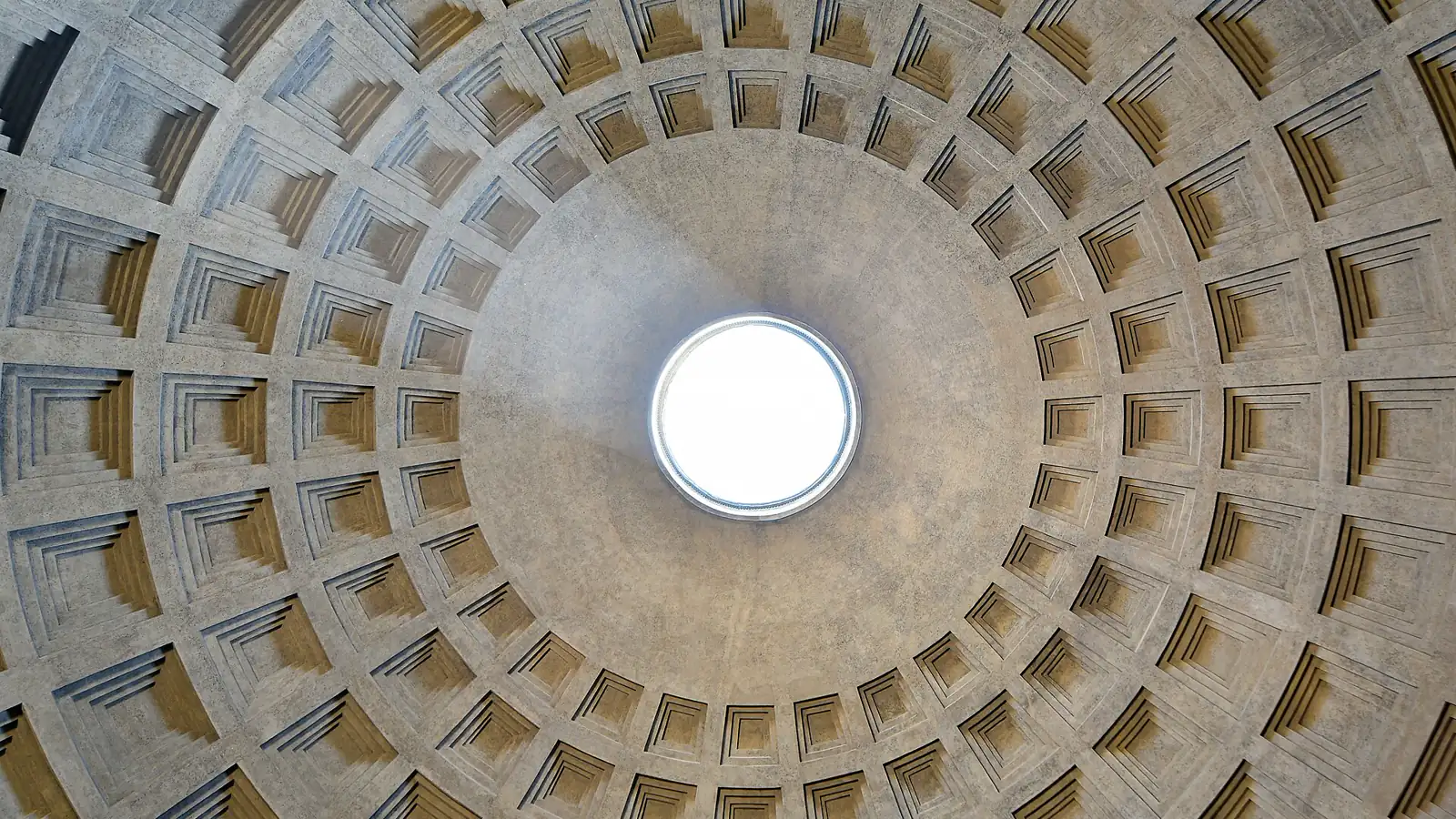
The Pantheon’s unreinforced dome demonstrates exceptional design, graded aggregate and durable construction. The important mechanism is builders reduced weight upward and managed forces through geometry as well as material choice. Researchers test that account through architectural survey, structural analysis and material sampling where possible. That combination matters because a striking observation is not enough on its own: the proposed process must also predict what should happen under a different condition.
The evidence has limits. Its survival cannot isolate one chemical ingredient as the cause. A careful interpretation therefore separates what was directly measured from what is inferred. Engineering form and material performance must be interpreted together. This is why the strongest explanation joins several independent measurements, reports uncertainty and remains open to revision when better data arrive.
Survivorship bias
Visitors encounter Roman buildings that remain, not the many structures that collapsed, were quarried or disappeared. The important mechanism is historical selection enriches the visible sample for favorable design, environment and maintenance. Researchers test that account through archaeological records of failures, repairs and regional building practice. That combination matters because a striking observation is not enough on its own: the proposed process must also predict what should happen under a different condition.
The evidence has limits. The lost population can never be counted perfectly. A careful interpretation therefore separates what was directly measured from what is inferred. Survival is evidence of possibility, not a universal failure rate comparison. This is why the strongest explanation joins several independent measurements, reports uncertainty and remains open to revision when better data arrive.
Strength is not durability
A material can carry a high early load yet deteriorate quickly in a particular environment; another can gain strength slowly and remain serviceable. The important mechanism is different chemical and pore structures control transport, cracking and mechanical response over time. Researchers test that account through compressive tests, fracture tests, permeability and accelerated aging. That combination matters because a striking observation is not enough on its own: the proposed process must also predict what should happen under a different condition.
The evidence has limits. Short laboratory tests cannot reproduce two millennia directly. A careful interpretation therefore separates what was directly measured from what is inferred. Multiple performance measures are needed for fair comparisons. This is why the strongest explanation joins several independent measurements, reports uncertainty and remains open to revision when better data arrive.
What replicas can test
Researchers can reproduce selected ingredients and mixing sequences to isolate causal variables. The important mechanism is matched samples reveal whether lime clasts or curing conditions change crack closure and water flow. Researchers test that account through controls that omit one ingredient while holding others constant. That combination matters because a striking observation is not enough on its own: the proposed process must also predict what should happen under a different condition.
The evidence has limits. Modern raw materials are not perfect copies of ancient sources. A careful interpretation therefore separates what was directly measured from what is inferred. Replicas test mechanisms; ancient samples establish historical relevance. This is why the strongest explanation joins several independent measurements, reports uncertainty and remains open to revision when better data arrive.
What self-healing should mean
The phrase can describe visible closure, reduced permeability or recovery of a mechanical property, which are not equivalent. The important mechanism is precipitated minerals may block a pathway without restoring the original continuous matrix. Researchers test that account through before-and-after imaging, flow tests and mechanical loading. That combination matters because a striking observation is not enough on its own: the proposed process must also predict what should happen under a different condition.
The evidence has limits. Headlines often use the broadest term while experiments measure one outcome. A careful interpretation therefore separates what was directly measured from what is inferred. Reports should name the property that recovered and the size of crack tested. This is why the strongest explanation joins several independent measurements, reports uncertainty and remains open to revision when better data arrive.
Lessons for lower-impact concrete
Longer service life and alternative binders could reduce the environmental cost of repeated replacement. The important mechanism is durability-focused design may combine reactive mineral additions with modern quality control. Researchers test that account through life-cycle assessment, field exposure and standardized performance tests. That combination matters because a striking observation is not enough on its own: the proposed process must also predict what should happen under a different condition.
The evidence has limits. Ancient ingredients are not automatically scalable, safe or lower carbon. A careful interpretation therefore separates what was directly measured from what is inferred. The useful lesson is to test mechanisms within modern requirements rather than copy a recipe blindly. This is why the strongest explanation joins several independent measurements, reports uncertainty and remains open to revision when better data arrive.
An evolving materials history
Archaeological science connects texts, quarries, construction practice and microscopic evidence. The important mechanism is each scale answers a different part of how builders selected and transformed materials. Researchers test that account through interdisciplinary studies with transparent provenance and sampling. That combination matters because a striking observation is not enough on its own: the proposed process must also predict what should happen under a different condition.
The evidence has limits. Sampling monuments is limited and must protect cultural heritage. A careful interpretation therefore separates what was directly measured from what is inferred. Careful research replaces the myth of a lost miracle formula with a richer story of experimentation and adaptation. This is why the strongest explanation joins several independent measurements, reports uncertainty and remains open to revision when better data arrive.
What a modern durability test must measure
A photograph of a filled crack does not establish that a concrete has recovered every useful property. Researchers can measure how much water still passes through the crack, whether the two faces transfer load again, how the filling survives repeated wetting and drying, and whether nearby material has weakened. Crack width matters because a reaction that bridges a hairline opening may be ineffective across a larger fracture.
Long-term comparisons also need realistic controls. A replica made with hot mixing should be compared with an otherwise similar mixture made without that step, then exposed to the same water chemistry, temperature and loading history. Mineral analysis can identify what formed inside the crack, while permeability and mechanical tests reveal what that material actually accomplished. Those distinctions turn the appealing phrase “self-healing concrete” into a set of measurable claims that engineers can evaluate.
How to read the evidence
This feature treats why some ancient roman concrete becomes more resilient around cracks as a question that can be investigated, not as a collection of impressive claims. A result is strongest when observations, a plausible mechanism and independent replication point in the same direction. Laboratory work can isolate a process; field evidence shows whether it matters under realistic conditions; models connect measurements that cannot be observed directly.
Dates, sample sizes, instruments and definitions also matter. A measurement may be precise without answering every version of the question. Researchers therefore compare alternative explanations, calibrate instruments, publish methods and allow other teams to challenge the result. Barnakle’s specialist-review flag remains open until an appropriately qualified reviewer checks the interpretation against the cited literature.
What remains uncertain
Scientific uncertainty is not the same as ignorance. It identifies the range within which an explanation is reliable and the conditions under which it may fail. The sources below include primary research and institutional background. They do not all carry equal weight, and later work can refine earlier conclusions. Readers should follow the linked records for methods, samples and qualifications that cannot be reproduced in a general-audience article.
Sources and further reading
- Seymour et al., Hot mixing and the durability of ancient Roman concrete
- MIT News, Riddle of ancient Roman concrete solved
- Jackson et al., Phillipsite and Al-tobermorite mineral cements in Roman marine concrete
- U.S. National Park Service, historic concrete preservation guidance
How Barnakle selects and verifies sources · Corrections and updates
Keep exploring.
One remarkable idea at a time—nature, science, history and beyond.
Sources and further reading
Barnakle uses credible primary and authoritative sources wherever possible.
- Seymour et al., Hot mixing and the durability of ancient Roman concrete
- https://doi.org/10.1126/sciadv.add1602
- MIT News, Riddle of ancient Roman concrete solved
- https://news.mit.edu/2023/roman-concrete-durability-lime-casts-0106
- Jackson et al., Phillipsite and Al-tobermorite mineral cements in Roman marine concrete
- https://doi.org/10.2138/am-2017-5993CCBY
- U.S. National Park Service, historic concrete preservation guidance
- https://www.nps.gov/orgs/1739/upload/preservation-brief-15-concrete.pdf
Last reviewed September 19, 2026.

Barnakle Editorial Team
A member of the Barnakle editorial team, exploring remarkable ideas with clarity, curiosity and care.
More from this author →