
When molecules become evidence about movement
What to know
- Ancient DNA is fragmented, chemically damaged and easily contaminated.
- Population clusters are analytical patterns, not fixed ancient identities.
- Migration is inferred from changes across time, geography and ancestry models.
- Community consultation and respectful treatment of remains are central research responsibilities.
Human movement rarely leaves a single kind of evidence. Tools, pottery, burials, languages, isotopes and written records can each reveal part of a journey. Ancient DNA adds another line: fragments of genetic material preserved in people, animals and sediments from the past. When samples are securely dated and compared, they can reveal ancestry changes that suggest migration and mixture.
The method is powerful precisely because it is difficult. DNA breaks into short pieces, undergoes chemical damage and can be overwhelmed by modern contamination. Samples come from real people whose remains carry cultural and ethical significance. A responsible result therefore depends on archaeology, clean-room procedures, statistical models, documentation and community engagement—not sequencing alone.
Where ancient DNA survives
Cold, dry and stable environments often preserve DNA better than warm, wet ones, but preservation varies within sites and individuals. Dense parts of the skeleton can protect molecules. The petrous portion of the temporal bone has yielded high amounts of human DNA, while teeth also provide useful material. Researchers increasingly balance scientific yield against the destructive nature of sampling.
DNA can also survive in sediments, revealing organisms present even when recognizable remains are absent. Sedimentary DNA adds environmental context but can move between layers, so stratigraphy and contamination controls are essential.
Clean rooms and contamination
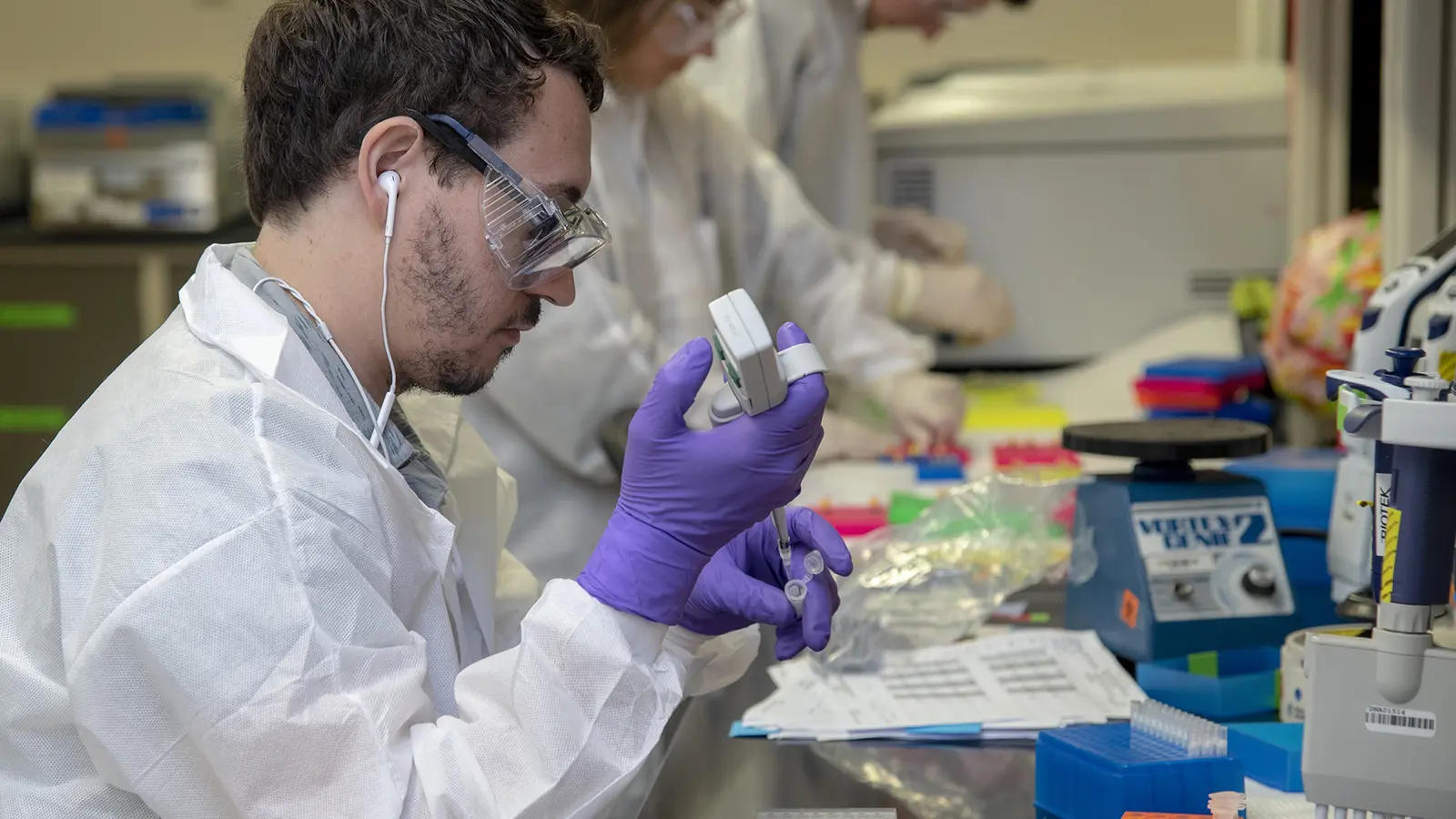
Modern human DNA is everywhere in a laboratory and can easily dominate an ancient sample. Dedicated facilities use controlled airflow, protective clothing, surface decontamination, separated work areas and blank controls. Researchers often remove an outer surface before sampling protected material.
Contamination is assessed rather than merely assumed away. Negative controls reveal DNA introduced by reagents or handling. Sex-chromosome patterns and mitochondrial variation can help estimate modern human contamination in suitable samples. Independent replication and transparent laboratory records strengthen confidence.
Characteristic molecular damage
Ancient fragments tend to be short and carry predictable chemical changes, especially near their ends. Cytosine deamination can cause characteristic apparent substitutions during sequencing. These patterns help authenticate old molecules, although preservation conditions and laboratory treatment affect them.
Researchers may use enzymes to reduce some damage while retaining enough signal for authentication. Computational tools model fragment length and end damage. No single sign is decisive; age, context, contamination estimates and consistency across libraries form the case.
From fragments to a genome
Extracted molecules are converted into sequencing libraries by attaching known adapters. Shotgun sequencing reads whatever DNA is present, including microbial and environmental material. Targeted capture enriches selected positions, allowing researchers to compare many individuals economically even when endogenous human DNA is scarce.
Reads are aligned to a reference genome and filtered for quality. Low coverage means a site may be represented by only one fragment, so ancient-genome methods often sample one observed allele rather than pretending to know a complete diploid genotype. Uncertainty should travel through the analysis.
Radiocarbon dates and archaeological context
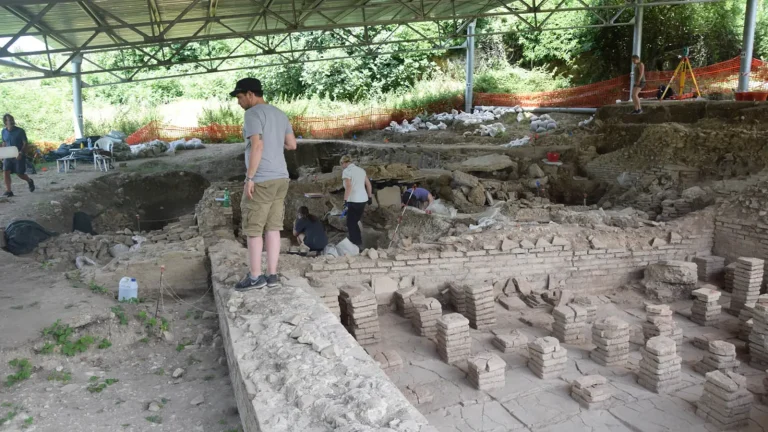
A genetic sample becomes historically useful only when placed in time and place. Direct radiocarbon dating is valuable, though reservoir effects and calibration must be considered. Stratigraphy, associated objects and site formation add context. Mixing remains from different periods can manufacture a false population pattern.
Archaeologists also examine burial practice, diet, mobility isotopes and settlement history. Genetics can suggest that ancestry changed; archaeology helps explain how that change related to communities, economies and cultural practice.
Principal components and visual clusters
Principal component analysis reduces genetic variation to axes that can be plotted. Ancient individuals are often projected onto axes defined by present-day or other reference populations. Nearby points share patterns under that analysis, but a cluster is not an ancient tribe or nation.
The plot depends on included samples and mathematical choices. Labels are conveniences, not identities encoded in DNA. Responsible interpretation describes statistical affinity and sampling limits instead of turning colored dots into fixed peoples.
Shared drift and f-statistics
Researchers use families of statistics to test whether populations share more genetic drift with one group than another and whether simple branching histories fit the data. These tests can identify asymmetry inconsistent with an unadmixed tree. They are especially useful because they can work with incomplete ancient genomes.
A significant statistic does not narrate a migration by itself. Investigators compare dates and locations, test alternative population combinations and build models that account for mixture. Different historical scenarios can sometimes fit the same broad pattern.
Admixture models
Many studies model a target population as deriving ancestry from two or more source-related groups. The word source usually means sampled populations that approximate branches in a model, not necessarily the exact communities that migrated. Unsampled “ghost” populations may have contributed.
Proportions are estimates conditional on the model. Adding older samples can change them by providing a closer reference. A visually precise percentage should never be mistaken for a complete account of family, culture or identity.
Dating mixture
When populations mix, ancestry segments are initially long. Recombination breaks them into shorter pieces over generations. The distribution of ancestry covariance can therefore estimate when mixture occurred. Low-coverage data and ancient damage complicate the process, but specialized methods can recover broad time ranges.
The genetic date should be compared with archaeological transitions rather than forced to match them. A migration may unfold over centuries, and sampled cemeteries may capture only one phase.
Kinship changes the scale
Ancient genomes can identify close relatives within a cemetery and reveal broader biological relationships. Kinship analysis prevents a family group from being counted as many independent representatives of a population. It can also illuminate residence patterns when combined with isotopes and burial context.
Biological kinship is only one form of social relation. Communities organize belonging through adoption, marriage, status and shared practice. Genomes cannot recover every bond that mattered.
Famous migrations and what they show
Large European data sets revealed major ancestry changes associated with the spread of early farmers from Anatolia and later movements related to Pontic-Caspian steppe populations. These results transformed debates by showing demographic movement alongside cultural transmission. They did not prove that every artifact style was carried by one genetically uniform people.
Elsewhere, ancient DNA has traced movements across the Pacific, population histories in the Americas, interactions across Africa and gene flow between modern humans and archaic groups. Coverage remains geographically unequal because preservation, resources and research histories differ.
Neanderthal and Denisovan ancestry
Comparisons with archaic genomes showed that ancestors of many living people interbred with Neanderthals and that Denisovan-related ancestry contributes to populations in parts of Asia and Oceania. These discoveries replaced a simple branching tree with a network containing separation and renewed contact.
The exact number, location and timing of interactions remain active questions. New archaic and early modern human genomes continue to refine the picture. Broad ancestry patterns do not determine an individual’s abilities or worth.
Genes are not languages or cultures
A population can adopt a language without large-scale migration, or migrants can adopt local practices. Genetic ancestry, material culture and language may travel together, separately or at different speeds. Treating one as a direct proxy for another creates circular arguments.
Stronger studies ask whether independent evidence converges. If genomes, isotopes, dates and settlement changes point toward movement, the case is richer. If they disagree, the disagreement may reveal social processes that a single archive misses.
Ethics and stewardship
Human remains are not simply data sources. Descendant and Indigenous communities may have rights, responsibilities and knowledge connected to them. Consultation should begin before sampling, shape research questions and continue through interpretation, data governance and communication.
Legal permission alone may not equal ethical legitimacy. Frameworks differ across regions, and repatriation obligations matter. Researchers must explain destructive methods, benefits, risks and future data uses. Community partners should not be added only after conclusions are written.
Sampling bias
A cemetery is not a random census. Burial access may reflect age, status, religion, violence, mobility or preservation. Published genomes are further filtered by excavation history, permissions, laboratory success and funding. A few individuals can transform a model while still representing a narrow slice of the past.
Maps should therefore show sample locations and dates, not paint huge territories as genetically uniform. Conclusions should be scaled to the evidence and revised when denser sampling changes the pattern.
Why headlines oversimplify
Headlines often say a people “replaced” another or that DNA “solved” an origin. Genetic turnover can result from migration, unequal reproduction, repeated mixture and sampling gaps. Words such as invasion carry historical claims that genetics alone cannot establish.
Good reporting names the samples, date range and modeled ancestry change. It separates direct evidence from the historical scenario proposed to explain it. It also avoids mapping ancient statistical labels onto modern political identities.
A molecular archive among archives
Ancient DNA has made lost movements visible and connected relatives separated by centuries and continents. Its best contribution is not a replacement story in which genetics defeats archaeology. It is a new archive that can be compared with objects, landscapes, texts, bodies and community knowledge.
The field will improve through broader geographic representation, less destructive sampling, stronger ethical partnership and models that admit uncertainty. Every ancient genome belonged to one person. Reconstructing migration begins by respecting that individual scale even while using many lives to understand population history.
Sources and further reading
- Max Planck Institute, Archaeogenetics
- Smithsonian Human Origins Program
- Pääbo et al. (2004), Genetic analyses from ancient DNA
- Orlando et al. (2021), Ancient DNA analysis
- Reich (2018), Who We Are and How We Got Here
- Claw et al. (2018), Framework for enhancing ethical genomic research with Indigenous communities
How Barnakle selects and verifies sources · Corrections and updates
Keep exploring.
One remarkable idea at a time—nature, science, history and beyond.
Last reviewed September 15, 2026.

Barnakle Editorial Team
A member of the Barnakle editorial team, exploring remarkable ideas with clarity, curiosity and care.
More from this author →