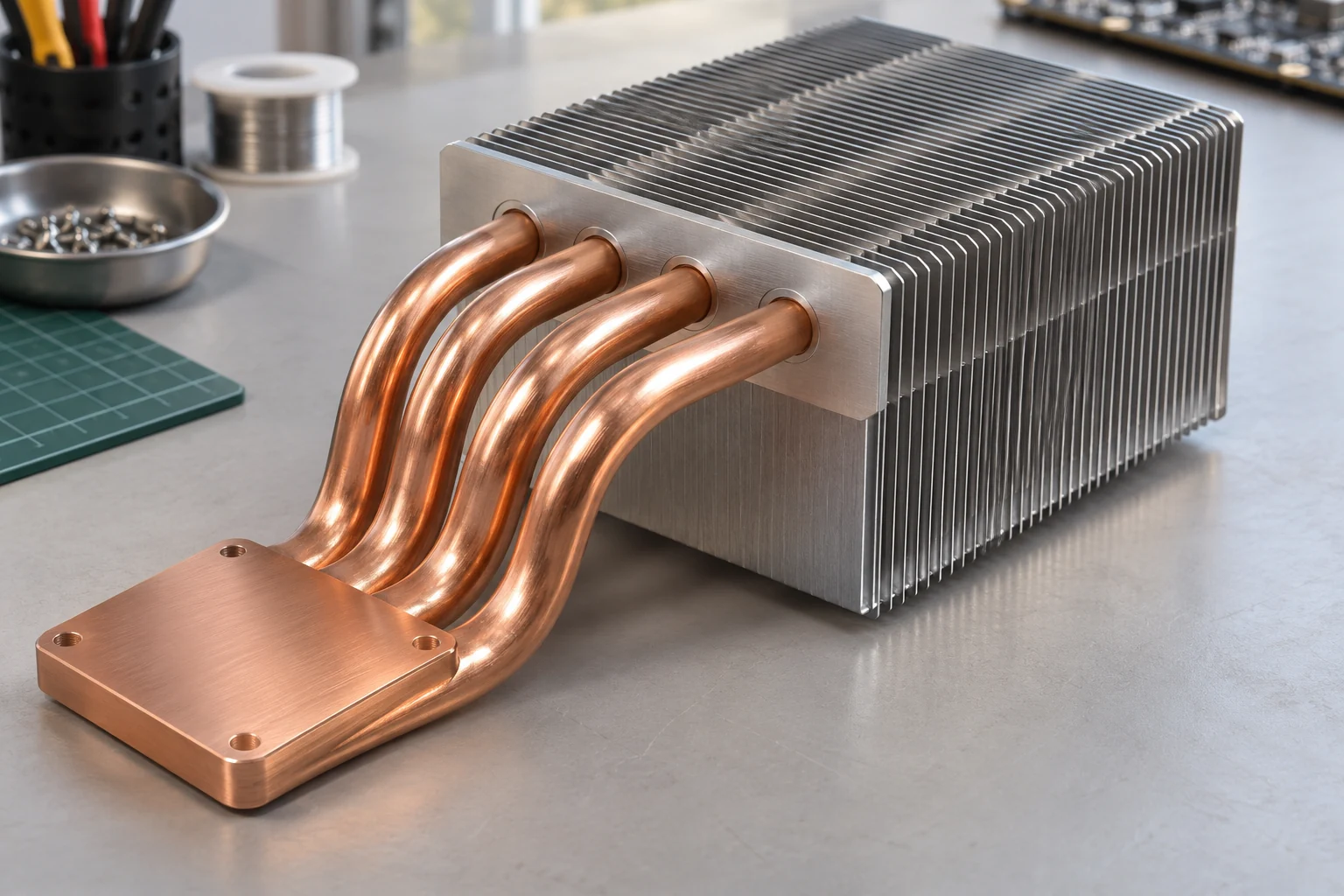
The copper tubes in an electronics cooler can hide a two-phase transport system. A small quantity of sealed working fluid repeatedly evaporates and condenses, moving heat without an ordinary mechanical pump.
How do heat pipes move heat? Heat entering the evaporator turns some working liquid into vapour. The vapour travels toward a cooler condenser, where it releases energy as it becomes liquid again. In a conventional wicked heat pipe, capillary action returns the condensate to the warm region so the cycle can continue. [1]
The sealed tube contains more than metal
A conventional heat pipe has an envelope, a working fluid and an internal wick. The envelope retains the fluid and its vapour. The wick provides a connected porous path for the returning liquid, while space inside the pipe allows vapour to travel toward the condenser.
NASA’s thermal-control guide describes this as a passive heat-transfer device that can link a heat-producing component to a colder surface. Its outer shape can vary, and heat-pipe arrangements are not limited to the straight cylindrical form that first comes to mind. [2]
Metal conduction remains part of the system: energy crosses the envelope and interfaces at each end. The distinctive feature is that a fluid circulation and phase-change process supplements what the metal alone would do.
Evaporation carries energy away from the hot region
Changing liquid into vapour requires energy. At the evaporator, input heat supplies that energy to the working fluid. The vapour then moves toward the cooler part of the device. This transports energy associated with the phase change rather than relying solely on heating one long piece of metal from end to end.
The condenser completes the complementary step. Vapour becomes liquid and releases the energy associated with condensation into the receiving surface. Advanced Cooling Technologies describes this connected evaporation–condensation cycle and the return of liquid through the wick. [1]
The fluid is not normally consumed. It stays inside the sealed device and changes phase repeatedly. This is an important difference from a puddle cooling by evaporation into the room: a heat pipe has to recover and return its working liquid.
The wick closes the liquid circuit
A wick contains small pores or channels in which curved liquid surfaces can develop capillary pressure. That pressure can help return condensate from the condenser to the evaporator. NASA’s reliability guidance identifies the wick both as a place where the liquid interfaces generate pumping action and as the route carrying liquid back. [3]
The familiar comparison is water spreading through an absorbent material, although a working heat pipe has a carefully designed closed flow path. Capillary action does not mean the wick can overcome any distance or elevation. It supplies a finite pressure difference that has to compete with the resistance to flow.
A visible bend in a copper tube does not reveal whether its internal return path is suitable for a particular task. Envelope shape, wick structure and operating conditions all affect the complete system.
Why orientation can matter
Gravity can assist liquid returning from a high condenser to a lower evaporator. A thermosyphon uses that assistance rather than relying on the same kind of capillary return as a wicked heat pipe. Its intended orientation is therefore part of its operating principle. [5]
A wick can support arrangements in which gravity alone would not return liquid to the warm region. That does not make performance independent of gravity. Raising the evaporator above the condenser uses some of the available capillary pressure to oppose the elevation difference.
The distinction helps explain why two similar-looking tubes need not behave identically when rotated. A statement about a gravity-assisted thermosyphon is not automatically a statement about a capillary heat pipe, and neither should be generalized to every two-phase cooling design.
How can it operate in microgravity?
Capillary pumping offers a way to return liquid without using its weight as the driving mechanism. This makes heat pipes useful in spacecraft thermal control, where simply letting condensate drain downward is not a general solution.
Ollendorf’s NASA technical record describes heat-pipe operation and the challenge of predicting performance in space from tests on Earth. Its discussion of zero-gravity experiments is a useful reminder that removing gravity changes the operating environment and must be tested, not merely assumed away. [6]
The absence of an ordinary motor does not make the system simple in every respect. A passive device still has a design envelope, and its behaviour has to be understood under the conditions where it will be used.
Why a heat pipe has a maximum capacity
The evaporator needs enough returning liquid to remain supplied. If the available capillary pressure cannot overcome the combined pressure drops, the return flow becomes inadequate. Fraunhofer identifies this capillary limit alongside other constraints related to vapour flow, entrainment and local boiling. [4]
Dryout is therefore more than a claim that the tube contains too little fluid in total. A device can contain working liquid while failing to deliver enough of it to the region where evaporation is occurring. Distribution and flow are as important as total inventory.
These limits explain why heat-transfer capability is a rated operating property rather than an unlimited consequence of the word “heat pipe.” The fluid, geometry and temperature range have to match the task. An effective design works within those constraints.
The heat still needs somewhere to go
Moving energy to the condenser does not make it disappear. A complete cooling system needs a receiving surface that can reject that energy onward. The European Space Agency distinguishes heat collection and transport from rejection to an appropriate heat sink. Transporting energy is one sub-function of a complete thermal-control system. [7]
In an illustrative electronics cooler, pipes can carry heat from a compact contact plate to a larger fin assembly. The fins then exchange energy with their surroundings. If the receiving side warms until it can no longer accept the required heat flow, an excellent transport link cannot solve that bottleneck by itself.
This separates heat transport from heat rejection. Both are necessary, and improving one does not automatically remove every limitation in the other.
Is a heat pipe the same as a refrigerator?
A conventional passive heat pipe transports heat from a warmer region toward a cooler one. It does not supply the external work used by a refrigeration system to move heat against the overall temperature difference. A connected condenser is not a source of unlimited cold.
The practical achievement is efficient transport with a relatively small temperature difference under suitable conditions. Its usefulness comes from the combination of evaporation, vapour movement, condensation and liquid return—not from bypassing the need for a thermal gradient.
Frequently asked questions
Is the liquid used up?
No. In normal operation it circulates within the sealed device, repeatedly changing between liquid and vapour.
Do all heat pipes need gravity?
No. Capillary return allows conventional wicked designs to operate where gravity alone would not provide a liquid return path.
Does passive mean there is no energy input?
No. Heat from the source drives the process. Passive refers here to the lack of an ordinary powered circulation pump.
Can a larger heat pipe cool something indefinitely?
No. Flow limits, the temperature gradient and the receiving system all constrain performance. [4]
Keep exploring
Sources and further reading
- Advanced Cooling Technologies — Heat Pipes 101
- NASA — Small spacecraft thermal control, heat-pipe section
- NASA reliability practice — Heat pipes and capillary pumping
- Fraunhofer IPM — Heat-pipe function and operating limits
- Advanced Cooling Technologies — Gravity-driven thermosyphons
- Ollendorf (1978), NASA technical record — Heat pipes in space and on earth; abstract
- European Space Agency — Thermal control: collection, transport and heat rejection
Reference review: November 11, 2026.
Keep exploring.
One remarkable idea at a time—nature, science, history and beyond.
Last updated November 12, 2026.

Barnakle Editorial Team
Barnakle Editorial Team is the collective byline used for Barnakle’s editorial articles. The contributor profile explains the team identity and links to the publication’s editorial policies.
More from the editorial team →