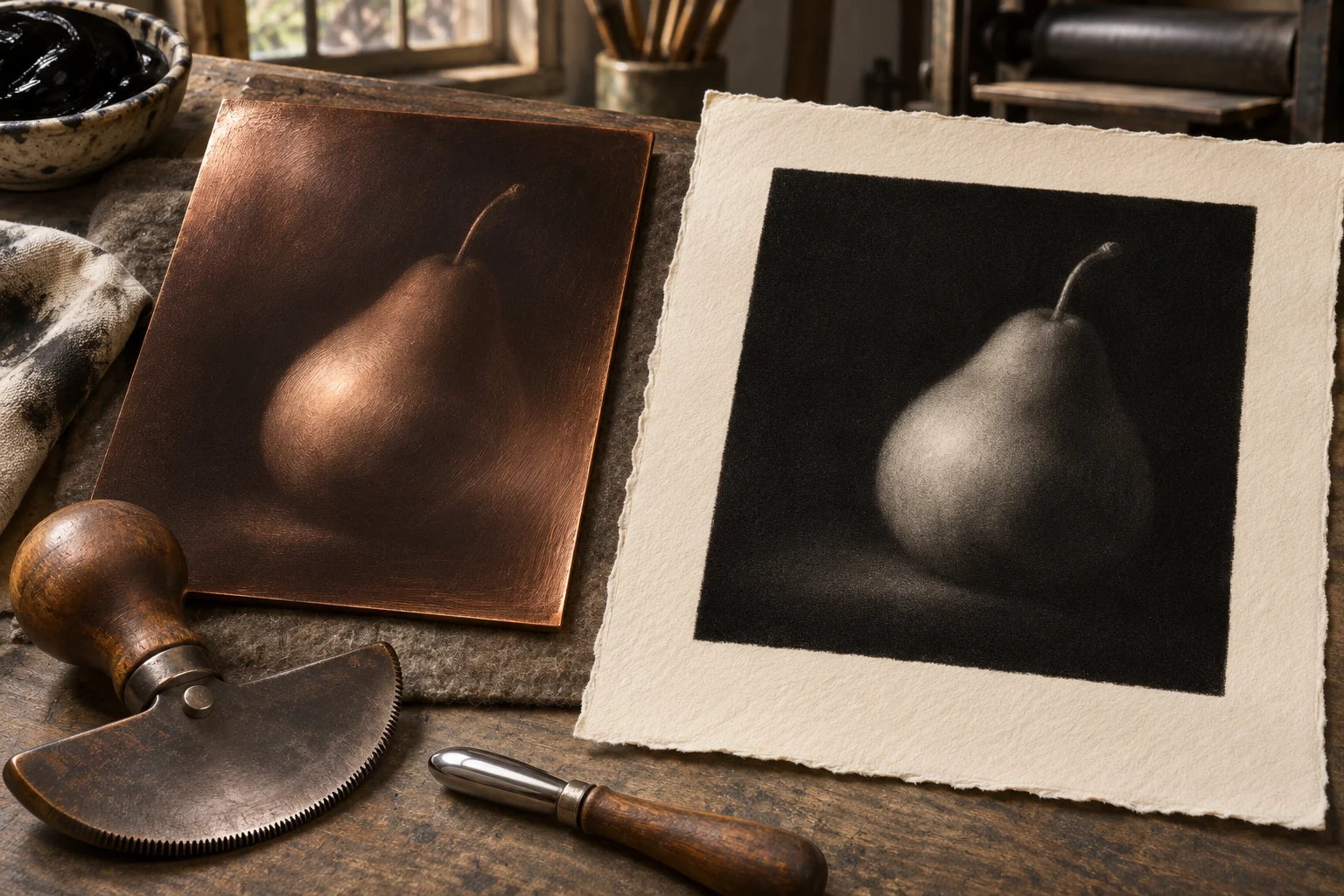
A round patch of daylight seems to sit on the surface of a dewdrop in a print by M. C. Escher. The printmaker had no need for white ink to put it there. In a mezzotint the paper itself can supply the strongest light, while one dark ink supplies a roomful of intermediate tones. The work begins, in the traditional dark-to-light method, with a copper plate so thoroughly roughened that an impression pulled from it would print black from edge to edge.[1, 5]
That order of operations gives the printmaker an unusual job. On a clean sheet of paper you can draw a shadow by adding marks. On a prepared mezzotint plate the capacity to print shadow is already everywhere. To make the light fall across a cheek, a glass vessel or a drop of water, you have to take some of that capacity away. A change too slight to resemble a picture on the metal can become a distinctly lighter patch when the plate is inked, wiped and printed.[1, 2]
Why make a blank plate rough?
The traditional tool for preparing the surface is called a rocker. Its curved cutting edge carries fine teeth. Rocking it across the copper raises a multitude of tiny ridges or burrs. The printmaker works repeatedly over the plate from different directions to establish an even texture. That uniformity is an achievement in itself. An underworked strip might hold less ink and print as a stray light streak through a sky that was supposed to be dark from one corner to the other.[1, 2]
Inking reveals what those minute irregularities do. Ink is worked into the rough surface, then excess ink is wiped from the plate. Where the copper is smooth the wiping can remove nearly all of it. On a rough passage a great many tiny pockets and edges retain ink. Pressure in the press allows the paper to pick it up. What appears from a few steps away to be a continuous field of black is the combined impression of a closely worked surface.[1, 3]
Scraping out the light
Two tools give the artist different kinds of control. A scraper cuts down the roughness. A burnisher, with a smooth rounded working end, presses and polishes it. Where the artist has only partly reduced the grain, enough texture survives to print grey. Where the plate has been worked almost smooth, very little ink remains after wiping. A single plate thus carries both the deepest shadow and the palest highlight, with many intermediate degrees of ink retention between them.[1, 2]
Suppose the subject is a pear lit from a window on the left. The artist might leave the deepest part of the cast shadow nearly untouched. Across the broad side of the fruit, each small neighbouring patch could receive a different amount of scraping and burnishing. The gradient on the paper would then turn gently around the pear without a black outline announcing where its surface curves. At the tiny highlight, a more thoroughly polished patch would let the paper through with striking force.[1, 3]
The edge of a highlight is as important as its centre. A polished spot surrounded by rough grain gives an abrupt jump from pale to dark. Blend the working outwards through a wider band of partly reduced grain and the transition softens. That difference is enough to distinguish the sharp reflection of a lamp on glass from light spread across skin. The artist works in the same metal with the same ink for both surfaces. It is the geometry of the transition that changes.[1, 4]
A candlelit room translated into black ink
In 1769 Valentine Green produced a mezzotint after Joseph Wright of Derby’s painting of a demonstration with an air pump. The figures gather round a table, their faces catching different amounts of light. An inscription or catalogue can identify the subject and the people who made the painting and print. What rewards a slower look is the travel of the eye between faces. One forehead emerges clearly against the room. Elsewhere an edge almost disappears into darkness as the illumination falls away.[4]
A print after a painting presents a particular problem. Two passages differentiated by colour in paint might come out as the same grey on paper. The printmaker has to choose how to translate their relationship into tone. Mezzotint gave artists a means of holding long passages of subdued light together while placing a few bright accents exactly where they mattered. That helps explain the appeal of the process for reproducing paintings as well as for making images conceived directly for the plate.[1, 2, 4]
Why two impressions can look different
A proof is one way to discover what the copper will say in ink. The plate reverses left and right when printed, and its gleaming surface is a poor substitute for an inked impression on actual paper. An artist can study a proof, return to the copper and bring up another passage of light. When the work on the plate changes, impressions taken before and after the alteration belong to different states. Escher’s museum reproduces his mezzotint Eye in its seventh and final state, a reminder that a finished image could be reached by degrees.[3, 5]
There is another source of variation even if the artist makes no deliberate change. The delicate raised copper wears with printing. As the grain loses some of its ink-holding ability, later pulls can lose strength in the darkest passages. A pale area made by a burnisher and a weakening shadow on a worn plate both reflect changes at the surface, but they tell very different stories. One was a decision about where the light should fall. The other belongs to the working life of the plate.[2, 5]
Return to the dewdrop. From across the room its bright glint may seem like the smallest and quickest mark in the composition. Follow its making backwards and it leads through wiping and printing to the painstaking preparation of an entire field of black. Before the artist could make that little point shine, there had to be darkness available almost everywhere else.[1, 5]
Related reading
- How Do Japanese Woodblock Printers Line Up Different Colours?
- How Archaeologists Identify the Colours of the Ancient World
Sources
- Metropolitan Museum of Art — The Printed Image in the West: Mezzotint
- National Portrait Gallery — Early history of mezzotint
- Fitzwilliam Museum — Mezzotint
- Metropolitan Museum of Art — Valentine Green after Joseph Wright of Derby
- Escher in The Palace — Mezzotint
Keep exploring.
One remarkable idea at a time—nature, science, history and beyond.
Last updated November 21, 2026.

Barnakle Editorial Team
Barnakle Editorial Team is the collective byline used for Barnakle’s editorial articles. The contributor profile explains the team identity and links to the publication’s editorial policies.
More from the editorial team →