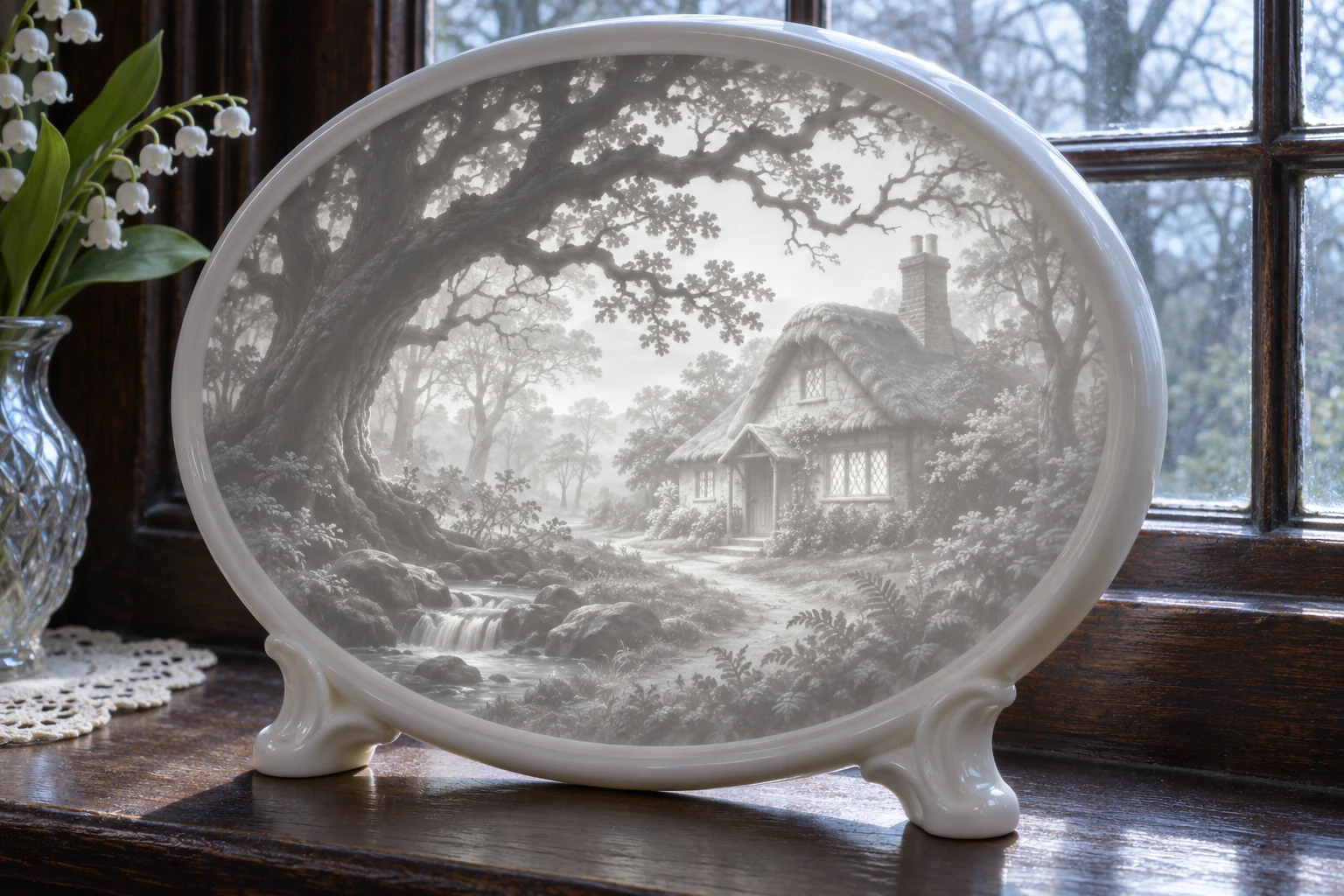
Rest a white porcelain picture against a dark wall and the relief can be disappointingly hard to read. Put the same object in front of a bright window and branches, folds of clothing and distant buildings can fall into place. A lithophane stores its picture in the thickness of the porcelain. Viewed with light behind it, the thin places glow and the thicker places appear dark. The change of lighting does more than improve the display. It changes which physical feature of the object your eye is reading.[1, 2]
The word can suggest stone, and the unlit white relief can look a little like a miniature stone carving. Europe’s nineteenth-century examples are commonly porcelain. Their makers took advantage of translucency, the ability of a material to transmit light while scattering it. You can see a pale patch of daylight through the body of the object without seeing a sharp view of the tree outside the window. The tree that appears in the picture has been modelled into the porcelain itself.[1, 4]
Why the raised parts can turn dark
Imagine a scene of a cottage under snow. The artist wants the roof to appear brightly lit and the doorway beneath the eaves to be dark. With a uniformly coloured ceramic body and broadly even backlighting, leaving a thinner section for the roof lets more light emerge there. Leaving more material across the doorway reduces the amount that reaches the viewer. Between those extremes, successive small changes in thickness can describe the slope of a snowbank or the turn of a figure’s cheek.[1, 2]
This produces a puzzle if you try to read the relief in ordinary lamplight. A raised ridge facing a side lamp may catch a highlight and look bright, while its far side casts a small shadow. Viewed against the window, the same ridge may become the dark stroke of a tree trunk because the optical path through it is thick. The two impressions carry different information. Side lighting helps you see the slope of a surface. Transmitted light makes variations in the amount of material unusually easy to see.[2, 4]
Nor does the relief have to be a scale model of the objects in a scene. A distant mountain that looks pale through haze may need very little porcelain even though a mountain is physically enormous. A tiny dark button on a white shirt may require a little extra material. Think of the sculptor assigning a thickness to each desired shade. Perspective and the apparent distance of objects in the picture can follow from those shades just as they do in a monochrome drawing.[1, 4]
First make the image in wax
One historical approach began with wax supported on a backlit piece of glass. A craftsperson could carve into it while watching the transmitted image change. Removing a little wax from the highlight on a brow let more light through there. It was possible to judge several parts of a face against one another as the work progressed. This was an important convenience. A list of thicknesses might describe the relief numerically, but it would be a slow way to discover whether a figure actually looked alive.[1, 4]
A plaster mould recorded the completed relief. Porcelain material could then be formed in the mould, dried and fired. The mould made it possible to reproduce the design without having to carve every scene anew. The object that hangs in the window is consequently several steps removed from the hand that first adjusted the wax. It still carries the effect of those decisions, down to the narrow transition between a white collar and the shadow on a neck.[1, 2, 4]
A painting small enough to hang in a window
The Swiss ceramics inventory CERAMICA CH documents a German example from the Plaue porcelain manufactory, based on Friedrich Eduard Meyerheim’s painting The Grandfather. That identification raises an interesting question about copying. A modeller working from a painted scene could keep the figures and composition while having to translate clothing, furniture and faces into degrees of transmitted light. Two objects separated in the painting by colour alone might need different tones or a carefully defined edge to remain distinct in the porcelain version.[2]
The Metropolitan Museum of Art catalogues a mid-nineteenth-century German porcelain lithophane just over seventeen centimetres high and twenty-five centimetres wide. That modest scale makes the detail of the process easier to appreciate. A scene roughly the width of a sheet of writing paper can contain many transitions too slight to register in a casual view of the unlit object. Its dimensions describe how much room the modeller had for a composition. They tell you very little about how legible it will be until the light is behind it.[3]
The room becomes part of the display
Nineteenth-century makers incorporated lithophanes into window hangings and lamp shades. A window supplies a broad background of daylight. A lamp offers a compact light source that moves with the object. Put a strong source too far to one side and one end of a landscape can seem dimmer for a reason quite unrelated to the design. The illumination and the porcelain work together. Photographs meant to document a piece can therefore usefully show both the relief and the illuminated scene.[2, 4, 5]
Try an imagined change to the cottage picture. Leave every thickness exactly the same but slide a dark strip behind its pale sky. A new shadow crosses the scene even though no shadow was carved into the clay. Now remove the strip and light the piece evenly from behind. The tree and the doorway return to their assigned values. A well-lit display gives the viewer a chance to see which marks belong to the maker and which came from the room.[1, 2]
That dependence on a window is part of the appeal. A lithophane has a physical surface worth looking at even when its image is obscure. Move it a short distance and the faint ridges take on different jobs. One becomes an eyebrow, another a roofline, and a nearly smooth patch opens into bright sky. The picture was present before the move. All the light had to do was pass through it.[1, 4]
Related reading
Sources
- About | Blair Museum of Lithophanes
- Lithophanie | CERAMICA CH
- Lithophane – German – The Metropolitan Museum of Art
- Lithophanes: Dedicated museum sheds light on these porcelain artworks – The American Ceramic Society
- Original 19th century lithophane – The Davenport Collection
Keep exploring.
One remarkable idea at a time—nature, science, history and beyond.
Last updated November 22, 2026.

Barnakle Editorial Team
Barnakle Editorial Team is the collective byline used for Barnakle’s editorial articles. The contributor profile explains the team identity and links to the publication’s editorial policies.
More from the editorial team →