A bronze sculpture can preserve the faint groove an artist drew through soft wax, even though the wax disappeared before the metal went in. The connection is an impression. A heat-resistant mould takes the negative shape of the model. Once the wax leaves, bronze can occupy the space it held and take the curve of that same mould. Follow just one line, perhaps a crease beside a figure’s mouth, and you can track how a gesture made in a soft material ends up in a hard one.[1, 2, 3]
A groove becomes a ridge and then a groove again
Imagine making a short furrow across a wax cheek. The material surrounding the model fills that furrow. On the inside of the hardened mould it becomes a narrow projecting ridge. When the metal fills the cavity, the ridge keeps bronze out of that small space. Once the mould comes away, the furrow appears in the metal at the same location. The surface has been reversed twice. A tiny mark on the model can survive those reversals, provided the mould captures it and the casting and finishing preserve it.[1, 3]
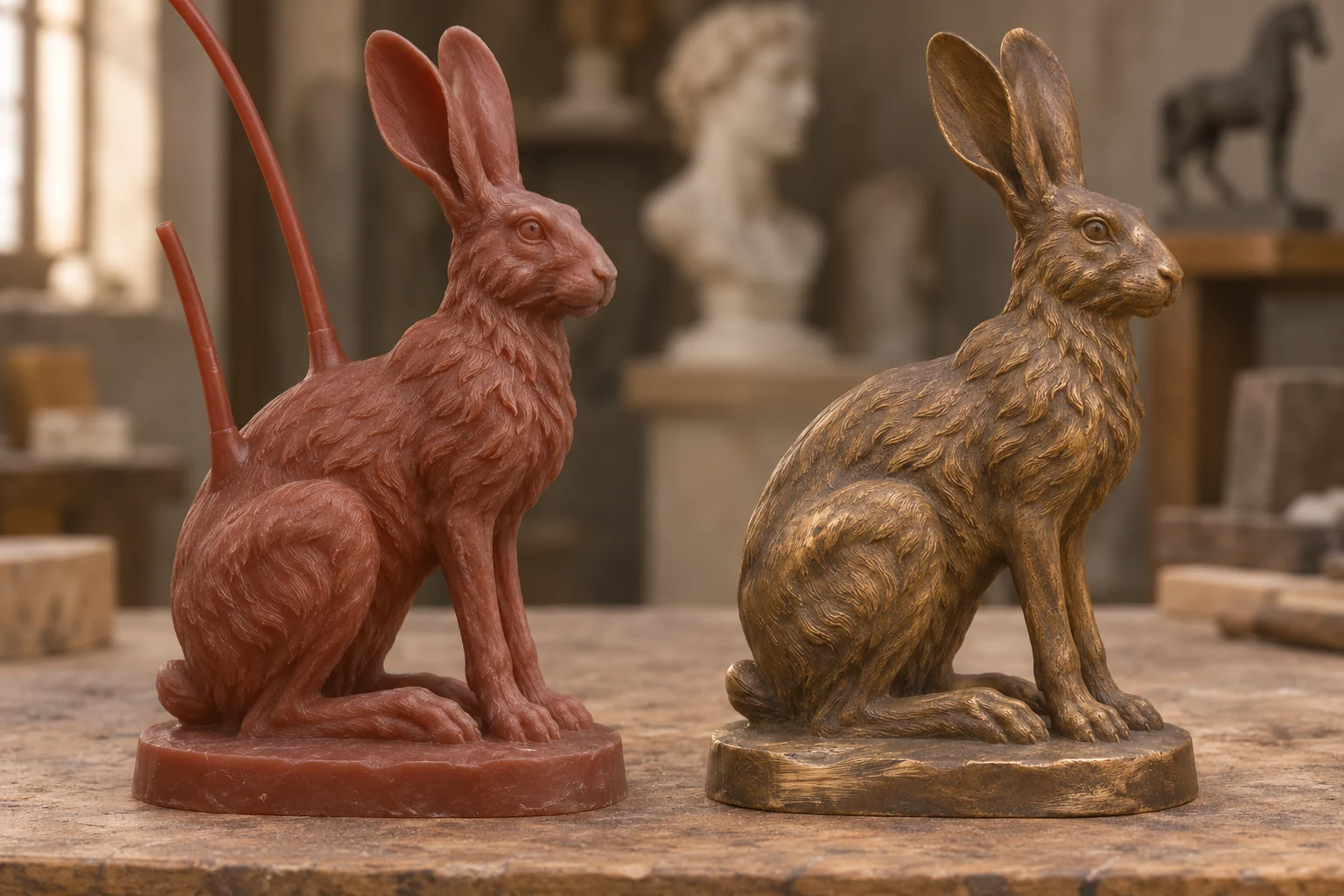
This explains the curious appearance of a model prepared for the foundry. Wax rods may project from feet, hands or other parts of the figure, making a finished sculpture look as though it has suddenly grown branches. The rods are part of the model of the space the foundry needs. After the wax goes, they leave passages connecting the future sculpture to the outside. Some passages give the metal access to the cavity and others allow air or gases to escape. Their outlines can survive as metal appendages that must come off before the sculpture goes on display.[1, 2, 5]
Picture a hand held away from the body with its fingers curved. That little pocket of mould must fill even if the most direct route from the main body is long and narrow. Looking at the statue from the front, a rod beside the hand might spoil its silhouette. Looking at it as a network of spaces that need to fill and empty, the same rod can be a sensible choice. The foundry gets to remove the evidence of many such choices once the cast has cooled.[1, 3, 5]
How the inside stays hollow
Where there was wax, there can be metal. It follows that a figure made around a solid core needs wax only where a wall of bronze is wanted. In a direct method, the sculptor can build the general volume in core material and model a skin of wax over it. The outside of the wax defines the visible shape. Its inside follows the core. When the wax is removed, the space between the inner core and outer mould has the thickness of the modelled skin.[1, 3, 5]
The core has a demanding job precisely when the wax leaves. Until then the wax helped keep the two boundaries in the right relationship. Any movement of the core after that changes the space available for metal. On one side the wall may grow thick while on another the gap can narrow or vanish. Founders have used supports to hold the core in place, and evidence of internal supports can remain in a sculpture. A conservator looking inside may therefore learn something quite different from an art historian studying the expression on the face.[1, 3, 5]
The Getty’s account of Adriaen de Vries’s Juggling Man gives a particularly clear example. Much of the body was modelled in wax over a clay form supported by iron. The hands, juggling plates and right foot were modelled entirely in wax. In the resulting cast, different parts of one sculpture could thus have quite different internal structures. It would be a mistake to infer that a hollow torso necessarily had hollow fingertips. An X-ray can test a guess about how the maker solved the problem of the interior.[5]
A wall of bronze and a solid block of the same bronze have the same material density. Their different weights come from the volume of metal each contains. For two figures with exactly the same outside silhouette, a larger core leaves less room for bronze. A description giving height and width alone cannot settle what either statue weighs.[1, 2]
Which original does the foundry lose?
In direct lost-wax casting, the very piece of wax shaped for the cast is sacrificed. An indirect process introduces another mould before that happens. The foundry takes an impression from an existing sculpture, for example a plaster model, then uses that mould to make a wax version. That wax is the pattern that disappears. The starting sculpture can survive, and the intermediate mould can be used to produce more wax versions if its condition and design permit.[1, 2, 3]
That distinction helps answer a common gallery question. Two bronzes that reproduce the same pose can each be the product of a process that destroys a mould. The mould broken away from one bronze is the investment around its particular wax. The earlier mould used to make wax copies has a different job and a different fate. Repeated casts can share the broad dimensions of a model yet differ in details touched up in wax, marks worked into metal, and the finish selected for the final surface.[1, 2, 4]
Where the foundry's hand remains visible
Casting leaves more work for the maker. Rods and excess metal have to be removed, and places where they joined the model may need to be blended back into the surrounding surface. Chasing uses tools to rework details in the metal. A patina can change its appearance again. As a result, the dark line beside a bronze eyelid might preserve a feature of the wax, a finishing stroke in the bronze, or the effect of patina catching light on an existing edge. The surface gives clues, but rarely a complete sequence from a glance.[3, 4, 5]
Look first at a small detail, then at the figure’s overall volume. The detail asks how well a mark survived the passage through two opposite surfaces. The volume asks how two boundaries stayed in position while the material between them changed. In a successful hollow bronze both problems have been solved so thoroughly that the eye can linger on a juggler’s fingers without ever noticing the vanished layer of wax that decided their shape.[1, 3, 5]
Related reading
- How Did a Linotype Machine Cast a Whole Line of Type?
- How Ancient Craftspeople Made and Coloured Glass
Sources
- Metropolitan Museum of Art — Direct and indirect casting of small bronzes
- Musée Rodin — Lost-wax bronze casting
- Getty Conservation Institute — Casting processes
- North Carolina Museum of Art — Rodin’s lost-wax casting process
- Getty Museum — Foundry to Finish
Keep exploring.
One remarkable idea at a time—nature, science, history and beyond.
Last updated November 23, 2026.

Barnakle Editorial Team
Barnakle Editorial Team is the collective byline used for Barnakle’s editorial articles. The contributor profile explains the team identity and links to the publication’s editorial policies.
More from the editorial team →