The physical network beneath the world’s oceans
What to know
- The global internet depends heavily on physical seabed infrastructure.
- Multiple fiber pairs carry enormous traffic in both directions.
- Repeaters amplify optical signals along long routes.
- Redundant routes reduce—but cannot eliminate—outage risk.
The internet has a physical backbone
International data must cross real geographic distance. Submarine cables provide high-capacity low-latency links between continents. Researchers investigate it through network maps and traffic studies.
Cloud services can make infrastructure feel locationless. Most long-distance paths still depend on hardware.
Glass carries light
Optical fibers contain a transparent core surrounded by lower-index cladding. Total internal reflection confines light along the core. Researchers investigate it through optical tests and materials science.
Real fibers also bend and scatter light. Engineering controls losses over thousands of kilometres.
Lasers encode data
Transmitters vary optical signals to represent digital information. Modulation places many recoverable symbols onto controlled light waves. Researchers investigate it through laboratory communication tests.
A pulse is not simply one visible flash per bit. Modern formats use amplitude, phase and polarization.
Wavelengths share a fiber
Different optical colors can travel simultaneously. Wavelength-division multiplexing separates channels. Researchers investigate it through spectral measurement and receiver tests.
Channels can interact at high power. Capacity grows through several engineering dimensions.
Coherent receivers recover signals
Receivers compare arriving light with a local reference. Digital processing estimates phase, polarization and distortion. Researchers investigate it through error-rate and constellation analysis.
Processing cannot recover information lost completely. Optics and computation work together.
Repeaters span the ocean
Long routes include sealed optical amplifiers at intervals. Pumped fiber transfers energy into weakened data wavelengths. Researchers investigate it through power and optical monitoring.
Repeaters amplify noise as well as signal. Route design balances spacing and performance.
Power travels through the cable
A conductive path supplies electricity to submerged equipment. Landing stations feed controlled direct current along the system. Researchers investigate it through electrical monitoring.
Power architecture differs by design. The cable carries both optical paths and support systems.
A cable contains many layers
Deep-ocean cable protects fibers inside a compact structure. Metal, insulation and strength members resist tension and water. Researchers investigate it through manufacturing tests.
Armor varies with environmental risk. A cable near shore differs from one in deep water.
Shallow water receives more armor
Fishing, anchors and moving sediment create higher nearshore risk. Additional steel protection reduces damage probability. Researchers investigate it through fault records and seabed surveys.
Armor cannot prevent every event. Protection follows a route-specific risk assessment.
Routes are surveyed first
Engineers map depth, slope, geology and human activity. Route selection avoids hazards and controls installation tension. Researchers investigate it through sonar and geotechnical surveys.
The seabed changes over time. Planning reduces rather than removes uncertainty.
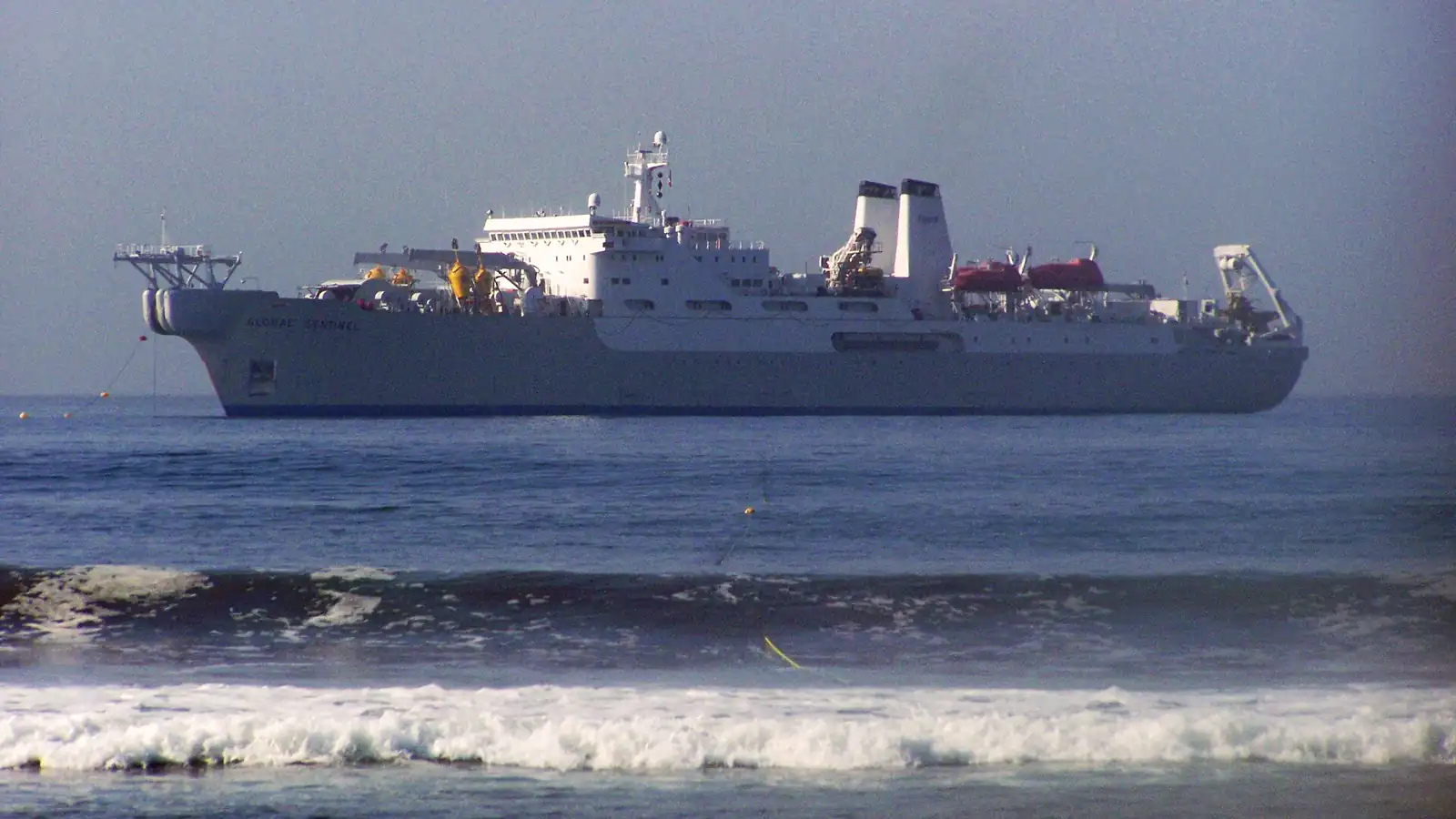
Cable ships lay the system
Specialized vessels pay cable out along a planned route. Speed, tension and position are coordinated continuously. Researchers investigate it through navigation and deck instrumentation.
Weather can interrupt operations. Installation is a controlled marine engineering project.
Burial protects some sections
Near shore, equipment may place cable beneath seabed sediment. Burial separates it from many anchors and fishing tools. Researchers investigate it through post-lay inspection.
Rocky or steep terrain can limit burial. Protection method follows local conditions.
Landing stations connect networks
A cable reaches land through a protected shore approach. Terminal equipment converts and routes optical capacity into terrestrial networks. Researchers investigate it through network operations.
A landing point is not the final destination of data. Traffic continues across many providers and facilities.
Routers choose paths
Internet routing exchanges reachability information among networks. Packets can be directed through available commercial and technical paths. Researchers investigate it through routing tables and performance monitoring.
The shortest geographic route is not always selected. Policy and capacity shape the journey.
Latency follows physics and routing
Light travels slower in glass than in vacuum and routes are not perfectly straight. Distance and equipment add delay. Researchers investigate it through round-trip measurements.
Application delay includes servers and congestion. Cable design is only one part of responsiveness.
Redundancy keeps traffic moving
Major destinations are served by multiple systems and landing regions. Networks can shift traffic after faults. Researchers investigate it through outage and routing analysis.
Simultaneous failures can still strain capacity. Resilience depends on diversity, not cable count alone.
Faults must be located and repaired
Operators detect signal loss and estimate distance to a break. Repair ships recover, splice and test damaged sections. Researchers investigate it through optical time-domain measurement and marine operations.
Permits and weather can delay repair. Restoration may take days or longer.
Satellites complement cables
Satellites connect remote places, moving users and backup services. Radio links reach locations without practical cable access. Researchers investigate it through capacity and latency comparisons.
They do not replace the aggregate capacity of global fiber. A resilient internet uses several technologies.
How to read the evidence
Specialist review of this explanation remains pending.
Sources and further reading
How Barnakle selects and verifies sources · Corrections and updates
Keep exploring.
One remarkable idea at a time—nature, science, history and beyond.
Last updated October 29, 2026.

Barnakle Editorial Team
Barnakle Editorial Team is the collective byline used for Barnakle’s editorial articles. The contributor profile explains the team identity and links to the publication’s editorial policies.
More from the editorial team →