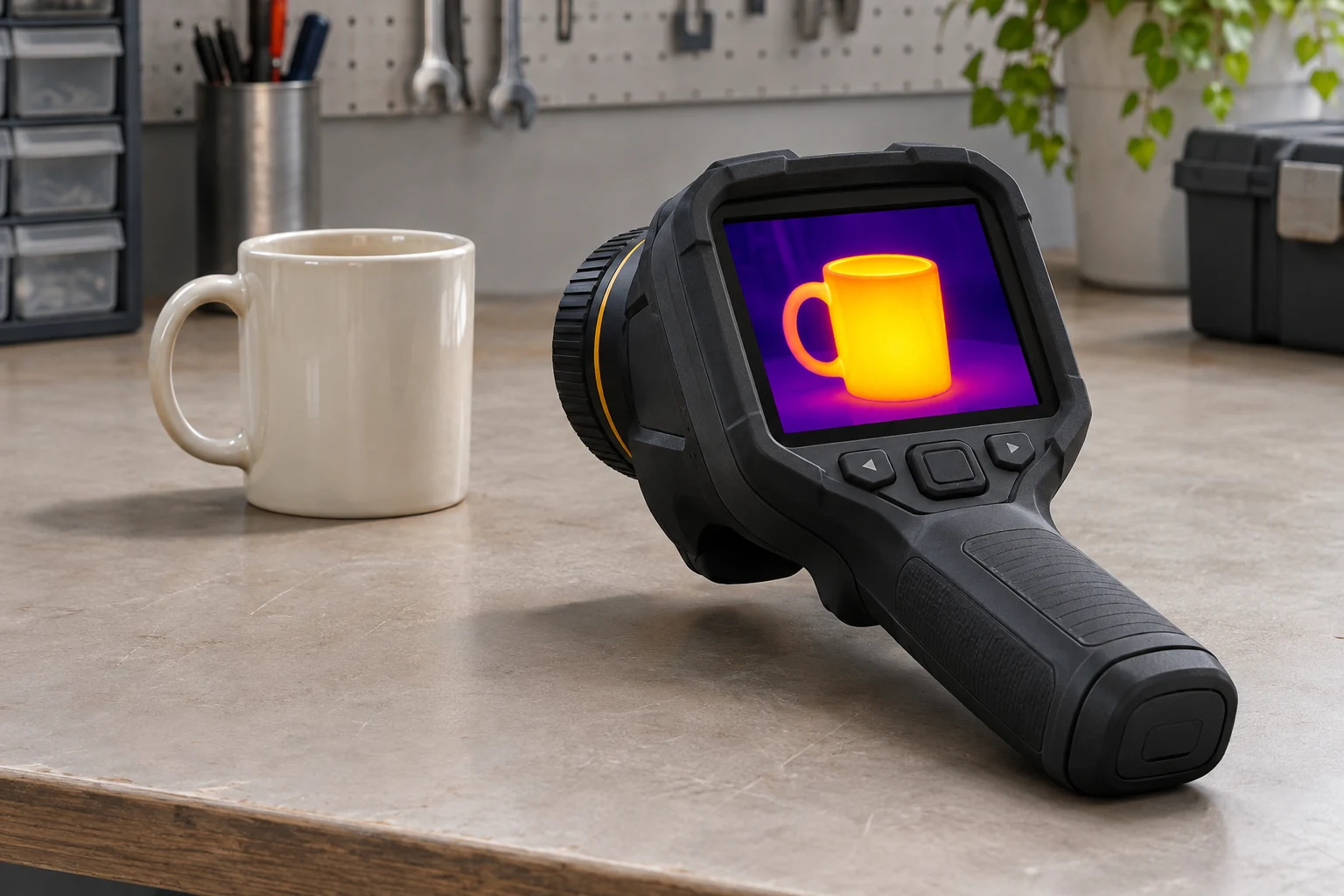
A thermal image can reveal a warm mug in a dark room or a temperature pattern across a wall. Its bright colours are a translation of invisible radiation, rather than the colours those objects would have if our eyes were more sensitive.
How do thermal cameras see heat? They detect infrared radiation, focus it onto a sensor and process the resulting signals into an image. Software assigns visible colours or shades to differences in the detected signal. Temperature estimates require additional information about the surface and its surroundings; a bright patch is not automatically a direct reading of temperature. [2]
Ordinary objects emit invisible radiation
An object does not have to glow red to emit electromagnetic radiation. Objects at everyday temperatures emit infrared radiation that human eyes cannot see. NASA’s introduction to infrared explains how instruments make this otherwise invisible part of the spectrum accessible, including the radiation from people and animals. [1]
Visible and infrared light belong to the same electromagnetic spectrum, but they occupy different wavelength ranges. A camera designed for one range cannot be assumed to respond to all the others. Thermal imaging depends on components selected for the radiation they are meant to detect.
Calling the picture a “heat image” is convenient shorthand. More precisely, the instrument receives radiation arriving from the scene. Its signal is not a measurement of every form of energy stored in an object, and the camera does not need to touch the object to receive that radiation.
What happens inside the camera?
The broad sequence is optical collection, detection and processing. A lens focuses infrared radiation onto a detector array. The array contains many sensing elements, and their responses supply the spatial information needed to build a picture. A housing, electronics and display complete the familiar handheld instrument. [2]
Fluke describes the next step as turning those detector responses into electronic signals and processing the grid into a thermogram. The camera needs a response at many positions in order to show a scene. A single spot measurement and a two-dimensional image therefore answer different questions, even when both involve infrared radiation. [3]
The output is a representation assembled from measurements. There is no tiny rainbow-coloured version of the room passing intact through the lens. That distinction helps explain both the power of the technology and the need to understand the display settings.
The colours are chosen by software
A display palette maps a range of signal values or calculated temperatures onto visible colours. The same data can be displayed in greyscale or in a colourful palette. Changing that palette changes the appearance without changing the object being observed. [2]
Consequently, red does not have an intrinsic temperature in a thermal image. Its meaning depends on the scale. A red region in one picture might be cooler than a blue region in another picture if the images use different temperature ranges. Comparing colours without checking their scales can give a completely wrong impression.
A useful reading habit follows from this: first identify what the scale represents, then interpret the pattern. Colour helps a person notice differences, but it is not a substitute for the numerical context or for the conditions under which the image was made.
Why emitted radiation is not the whole signal
The surface emits radiation, but it can also reflect radiation from nearby objects. The atmosphere between the scene and the camera can absorb and contribute radiation too. FLIR’s technical documentation identifies emissivity, reflected apparent temperature, distance, humidity and atmospheric temperature as relevant measurement parameters. [4]
Emissivity describes how effectively a surface emits compared with an ideal blackbody at the same temperature. Surface finish and material matter. A shiny metal object can show a strong reflection of its surroundings, so its apparent thermal pattern may differ from what a simple interpretation of its actual surface temperature would suggest.
This creates a distinction between detecting a difference and assigning an accurate temperature. An instrument can reveal an interesting pattern while the numerical estimate still depends on assumptions. Calibration and appropriate scene information connect the measured radiation with a defensible temperature value.
Can it see through a wall?
An ordinary thermal camera looking at a wall generally detects radiation from the wall’s visible surface. It does not produce an X-ray-like picture of everything behind it. An object or process behind a wall may alter the surface temperature, and that effect can sometimes become visible as a pattern. Seeing the effect at the surface is different from seeing directly through the material. [5]
A hypothetical warm pipe illustrates the distinction. If the pipe changes the temperature of the facing material enough, the camera may show a warmer strip. The image alone does not establish every detail of the pipe’s location, composition or condition. It provides evidence that has to be interpreted in context.
Why an ordinary window can be surprising
A pane that transmits visible light need not transmit the infrared wavelengths used by a common thermal camera. Ordinary glass can therefore prevent the camera from seeing the scene beyond it and can show reflected infrared radiation instead. Transparency always has to be considered for the relevant wavelength band. [5]
The general lesson extends beyond windows: materials do not have one universal status as either transparent or opaque. A visible photograph and a thermal image can disagree about what seems accessible because they are recording different parts of the spectrum.
Thermal vision is different from infrared illumination
Some night-viewing systems illuminate a scene with infrared light and record the reflected illumination. Passive thermal imaging instead uses thermal radiation from the scene. FLIR distinguishes these approaches, including the different wavelength regions used by active infrared and thermal systems. The presence of “infrared” in both names does not make the operating principle identical. [6]
This explains why a passive thermal camera can form an image without a visible lamp. Its useful signal does not depend on sunlight bouncing off a surface. It still needs sufficient contrast, an appropriate optical path and a detector suited to the task; darkness does not remove those requirements.
A pattern is a clue, not a diagnosis
Thermal imaging is useful in equipment and building inspections because temperature patterns can help locate places worth investigating. Fluke describes industrial inspection and building applications among its uses. A pattern can guide a closer examination, but it does not by itself establish the cause of a defect or replace other evidence. [3]
That is the most productive way to understand a thermogram: a spatial measurement whose meaning depends on physics and context. Its colours make invisible information legible; interpretation makes that information useful.
Frequently asked questions
Does a thermal camera work in complete darkness?
It can form an image without visible illumination because it detects infrared radiation from the scene rather than relying on reflected visible light.
Is white always the hottest colour?
No. That depends on the selected palette and scale. The same thermal data can be shown in several different ways.
Does a bright reflection mean an object is hot?
Not necessarily. Reflected infrared radiation can contribute to the detected signal, especially on low-emissivity surfaces. [4]
Can ordinary glass change what the camera sees?
Yes. Transmission and reflection depend on wavelength. A pane that is transparent to visible light can block the infrared band used by a thermal camera.
Keep exploring
Sources and further reading
- NASA — Infrared waves and thermal imaging
- FLIR — How thermal cameras work
- Fluke — Thermal imaging and the sensor-to-image process
- FLIR technical documentation — Emissivity, reflected radiation and atmospheric effects
- FLIR — What thermal imaging can and cannot see through
- FLIR — Active infrared imaging versus thermal imaging
Reference review: November 10, 2026.
Keep exploring.
One remarkable idea at a time—nature, science, history and beyond.
Last updated November 12, 2026.

Barnakle Editorial Team
Barnakle Editorial Team is the collective byline used for Barnakle’s editorial articles. The contributor profile explains the team identity and links to the publication’s editorial policies.
More from the editorial team →