
Driven wheels need to share a source of motion without being forced to make exactly the same journey.
Quick answer
A differential transmits drive while allowing its two outputs to turn at different speeds. During a corner, the outer wheel follows a longer path and usually rotates faster. In an ideal conventional open differential, the two outputs receive equal torque while their speeds may differ. Limited-slip and locking designs alter that behaviour to help manage traction.
A car has a basic geometric problem whenever it turns. The outside wheels must travel farther than the inside wheels over the same interval. If both driven wheels were rigidly required to turn at the same speed, something would have to give at the tyres or in the driveline.
The differential is the mechanism that accommodates a speed difference while still transmitting drive. Its name becomes easier to understand once we separate three quantities that are often blurred together: rotational speed, torque and power.
Why the outer wheel needs to turn faster
Imagine two wheels following concentric circular paths. The outer circle has a larger radius, so travelling through the same angle covers more distance. With equal effective tyre sizes and little slip, the outer wheel must rotate more times during that turn.
For an illustrative example, suppose the inner path has a radius of nine metres and the outer path eleven metres. Through the same angle, their distances are in the ratio nine to eleven. No engine electronics are needed to create that geometric requirement.
Eaton identifies this cornering speed difference as the fundamental job of an open differential. Allowing it reduces the need for tyres to scrub or hop as the vehicle turns. [1]
What is inside a conventional differential?
A common bevel-gear differential has a rotating case, two side gears connected to the output shafts, and smaller internal pinion gears carried by the case. The small gears are often called spider gears. Their meshing arrangement allows the side gears to turn relative to the case.
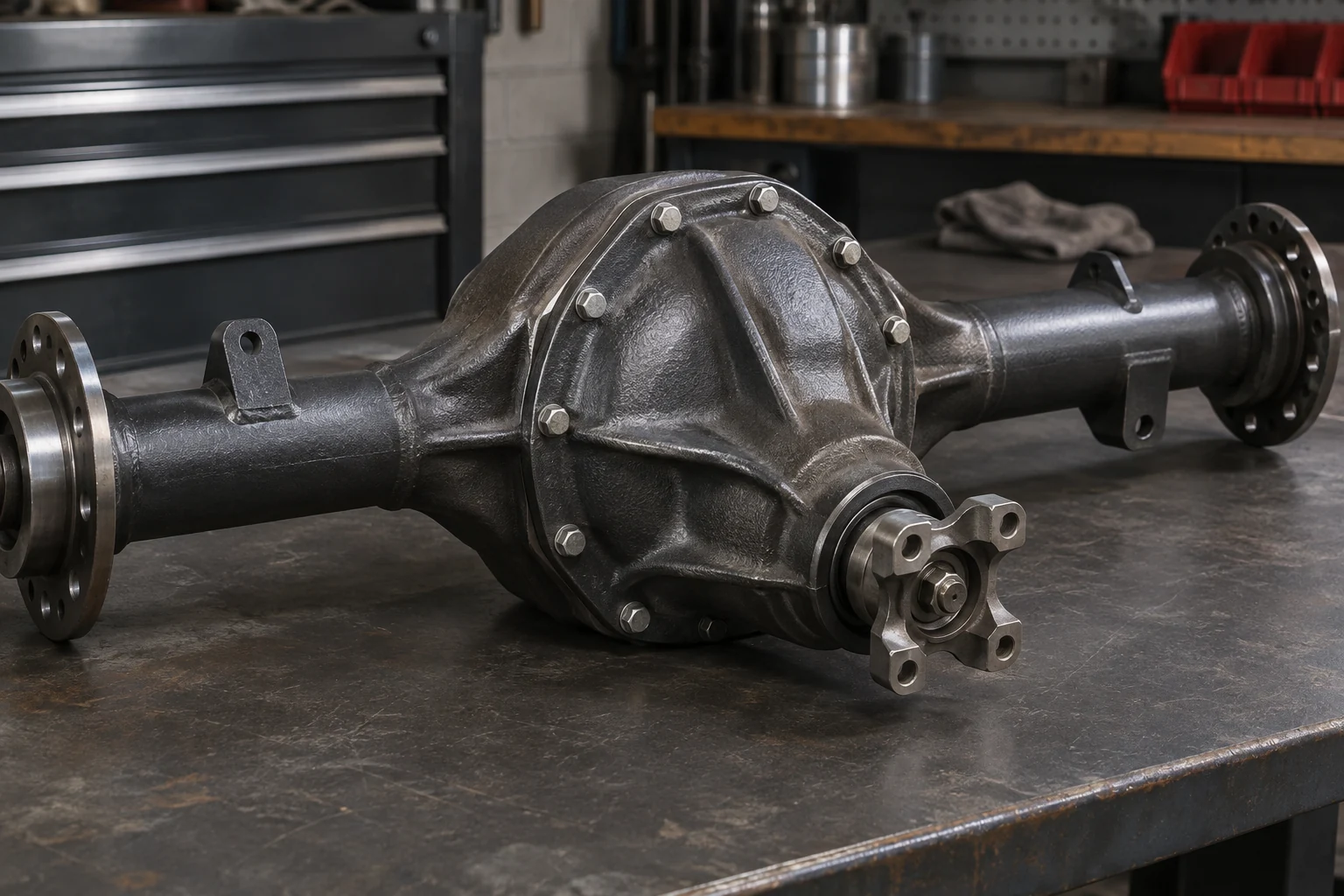
In a familiar rear-axle arrangement, a drive pinion turns a larger ring gear attached to the differential case. That final-drive pair and the internal differential gears perform related but different jobs. The owner’s manual provides component references for these assemblies. [6]
The stationary external housing is not the same as the rotating case inside it. A photograph of the axle’s bulging centre shows where the mechanism lives; it does not show every moving connection beneath the cover.
Straight ahead: both outputs can move together
When the wheels turn at the same speed, the internal pinions are carried around with the case without needing to rotate about their own axes to accommodate an output-speed difference. The two side gears move together relative to the road.
This does not mean the internal gears are switched off. They remain the mechanical connection transmitting force. The distinction is between being carried around an axis and spinning relative to the structure carrying them.
A helpful comparison is a person standing on a rotating platform. The person moves around the platform’s centre even while remaining fixed relative to the platform itself. Differential gears can combine these kinds of motion.
In a turn: one output gains what the other loses
When one side gear turns faster relative to the case, the meshing pinions permit the other side to turn more slowly. For a conventional symmetric ideal differential, the case speed is the average of the two output speeds.
For example, a case rotating at 100 revolutions per minute can accompany outputs at 80 and 120 revolutions per minute. Their average remains 100. These are chosen teaching values, not a specification for a particular vehicle or road manoeuvre.
The gearing accommodates the difference; it does not decide which direction the driver intends to steer. The wheel paths and contact conditions help establish the speeds. Protean’s technical discussion emphasizes this relationship between vehicle geometry and wheel motion. [2]
Why equal torque does not mean equal speed
An ideal open differential delivers equal torque to its two outputs under the usual quasi-steady assumptions. Torque is a twisting action, not a rotational speed. Two shafts can receive the same torque while turning at different rates. [2]
Power adds another distinction: rotational mechanical power equals torque multiplied by angular velocity. If torque is equal and one output rotates faster, that output receives more mechanical power. The words “equal power” and “equal torque” therefore cannot be exchanged casually.
Take an imaginary pair of outputs each transmitting ten newton-metres. If one turns twice as fast as the other, its mechanical power is twice as large in this simple comparison. Nothing in that arithmetic requires unequal torque.
Why one wheel can spin on ice
A wheel on a low-grip surface can support relatively little drive torque before losing grip. In an ideal open differential, the useful torque at the other output is correspondingly limited. The wheel on firm ground does not automatically receive all the unused traction capacity it could otherwise support.
Eaton describes this as the familiar low-traction limitation of the open design. The manufacturer shorthand about drive going to the easiest-spinning wheel describes the visible result, but keeping torque and power separate gives a more precise explanation. [1]
For a hypothetical steady comparison, suppose one tyre can sustain twenty newton-metres at its contact conditions and the other could sustain two hundred. An ideal open arrangement cannot simply provide twenty to one and two hundred to the other. Real transient motion, inertia and control systems add further details, but the imbalance in available grip explains the basic difficulty.
How a limited-slip differential changes the situation
A limited-slip differential adds a mechanism that resists unrestricted relative motion or biases torque between the outputs. Designs include clutch-based and helical-gear arrangements. Unlike the ideal open case, output torque need not remain equal. [3]
The name is deliberately qualified: limited slip is not necessarily a complete lock. The possible torque bias depends on the design and operating conditions. A system that improves performance when grip differs is not a promise that both tyres can always use their maximum individual traction.
This is another example of an engineering compromise. The mechanism must allow useful differentiation in normal turning while changing the response when a large traction difference appears.
What a locking differential does
A locked differential constrains the two outputs to turn together. Eaton’s selectable locker is an example that can operate openly in one state and lock the axle in another. That changes the permitted speed relationship rather than guaranteeing equal contact forces at the two tyres. [4]
Toyota’s explanation notes that locking makes the wheels turn at the same speed and changes cornering behaviour. The turning geometry has not disappeared; the vehicle must accommodate the resulting mismatch elsewhere. [5]
A lock therefore solves a different version of the traction problem by accepting restrictions on differentiation. “More locked” is not automatically “better” for every surface and manoeuvre.
Where traction control and electric motors fit
A brake-based traction-control system can resist a spinning wheel, changing the reaction torque available through an open differential. This is a control intervention around the differential, not a transformation of its basic gear geometry. [2]
Independent wheel motors offer another architecture: torque can be applied separately without the same shared mechanical differential. But a vehicle having two electric motors does not automatically mean one motor drives each wheel. Two motors may instead serve front and rear axles, each with its own mechanical arrangement.
The key is to inspect the actual driveline. Motor count, drive layout and control strategy describe different features. The same cornering requirement remains even when the engineering solution changes.
Frequently asked questions
Does the differential steer the car?
It accommodates the different wheel speeds associated with turning. Steering geometry and tyre forces establish the path; the differential does not read the driver’s intended curve.
Is a differential the same as the final-drive gear ratio?
No. The final-drive reduction and the mechanism allowing output-speed differences are distinct functions, even when packaged in one axle assembly. [6]
Does an open differential send equal power to both wheels?
In the ideal model it sends equal torque. Power can differ because the outputs can rotate at different speeds.
Do front-wheel-drive cars need a differential?
A driven front axle also has to accommodate different wheel paths. The mechanism is commonly integrated with the transmission rather than appearing as a separate rear-axle housing.
Keep exploring
Sources and further reading
- Eaton — What is an open differential?
- Protean Electric — Wheel torque and speed
- Eaton — Limited-slip differentials
- Eaton — Selectable locking differential
- Toyota Canada — Four-wheel-drive and differential explanations, video transcripts
- Eaton — Performance differentials owner’s manual, component reference (PDF)
Reference review: November 10, 2026.
Keep exploring.
One remarkable idea at a time—nature, science, history and beyond.
Last updated November 12, 2026.

Barnakle Editorial Team
Barnakle Editorial Team is the collective byline used for Barnakle’s editorial articles. The contributor profile explains the team identity and links to the publication’s editorial policies.
More from the editorial team →