Tooth counts exchange pedal turns for wheel motion
The same bicycle can feel manageable on a hill and move quickly along a flat road because its drivetrain changes the relationship between your legs and the rear wheel. The gears do not add energy. They change how pedal motion and force are exchanged for wheel motion and force.
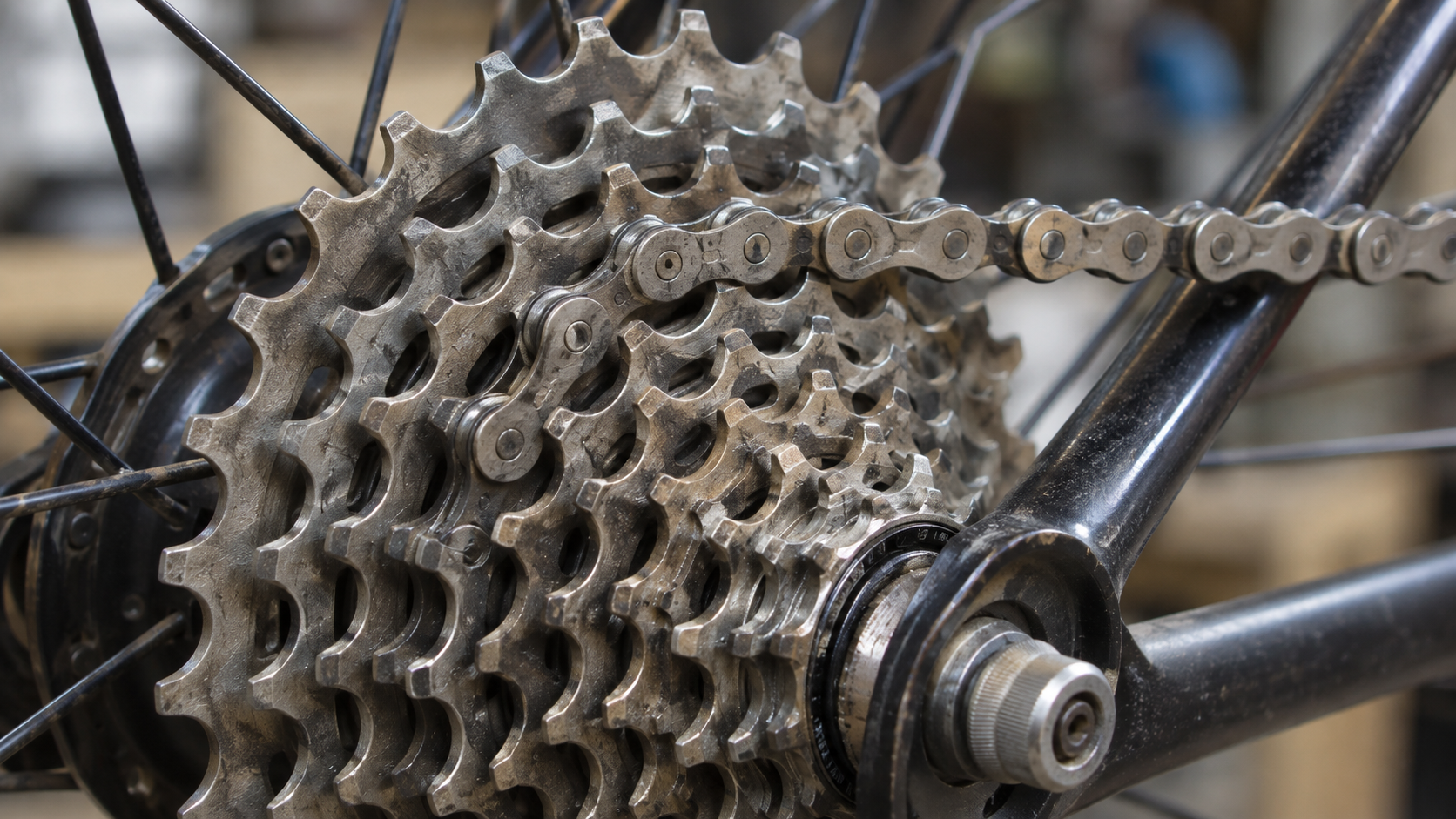
The clearest starting point is the familiar chain-and-derailleur system. It exposes the ratio in plain sight: count the teeth at the front, count them at the back and follow what one complete pedal turn does.
Follow the mechanism
- The rider turns a front chainring with the cranks.
- The moving chain drives a selected rear sprocket.
- The tooth-count ratio determines wheel turns per crank turn when the hub is engaged.
- Shifting changes that ratio while the derailleur guides and tensions the chain.
The chainring and sprocket set the basic ratio
For a conventional chain drive while pedalling forward with the hub engaged, divide the front chainring tooth count by the selected rear sprocket tooth count. The result gives the rear sprocket’s turns per complete crank revolution. With a direct engaged rear-hub connection, it also gives the wheel turns per crank turn.
Take an illustrative 40-tooth chainring and a 20-tooth rear sprocket. One front revolution advances 40 chain pitches. That amount of chain turns the 20-tooth rear sprocket twice, giving a 2:1 ratio.
These values describe a teaching example rather than a recommended setup. Shimano’s gearing guide distinguishes ratio, range and steps; the arithmetic here makes the ratio physically visible. The chain transfers a count of teeth, not a vague instruction to “go faster”.
Sources: [1]
Why a larger rear sprocket makes climbing easier
Keep the same 40-tooth front ring but select a 40-tooth rear sprocket. The ratio becomes 1:1, so one crank revolution now corresponds to one wheel revolution rather than two. At the same wheel speed, the rider must turn the cranks faster.
The exchange brings greater mechanical advantage at the wheel for a given crank torque, ignoring losses. The rider trades distance travelled per pedal turn for a more manageable turning requirement. The hill still demands energy; gearing changes the way that demand is delivered.
The reversal between front and rear can cause confusion. A larger front ring raises the ratio, while a larger rear sprocket lowers it. Calling either one simply “the bigger gear” loses the location information that makes the statement meaningful.
Sources: [1]
| Part or idea | What it does | Common misunderstanding |
|---|---|---|
| 40 front / 40 rear | Ratio 1.0: one wheel turn per crank turn. | A large rear sprocket must be a high gear. |
| 40 front / 20 rear | Ratio 2.0: two wheel turns per crank turn. | Every gear step changes the ratio by the same amount. |
| 40 front / 10 rear | Ratio 4.0: four wheel turns per crank turn. | A higher ratio creates extra rider power. |
| Same ratio, larger wheel | More distance per crank turn. | Tooth ratio alone specifies road speed. |
Cadence and wheel size turn a ratio into road speed
Cadence is the crank’s rotational rate, often expressed in revolutions per minute. Multiply it by the gear ratio to find the engaged wheel’s rotational rate in the simple system described here.
Suppose the illustrative ratio is 2:1 and cadence is 60 crank revolutions per minute. The wheel turns 120 times per minute. If the wheel’s rolling circumference is assumed to be exactly 2 metres, that is 240 metres per minute, or 14.4 kilometres per hour.
The circumference and cadence are invented teaching values. Real rolling circumference depends on the wheel and tyre, and actual motion includes losses and possible slipping. The example shows why “this ratio equals this speed” is incomplete unless cadence and wheel size are also specified.
The derailleur changes the route of the chain
The rear derailleur guides the chain sideways between sprockets. Park Tool’s explanation describes a linkage that moves the assembly and distinguishes the upper guide pulley from the lower tension pulley. Its cage accommodates changes in the chain length taken up by the selected combination.
The derailleur is therefore a selector and chain-management mechanism. It does not make the ratio by pushing on the wheel like another motor. The engaged front and rear tooth counts establish the basic external ratio.
Following those jobs separately makes the layout easier to read. The cassette provides alternatives, the derailleur aligns the chain with one of them, and the cage helps manage the remaining chain path. Seeing the components move together does not mean they all perform the same function.
Sources: [2]
What a click of an indexed shifter means
An indexed system turns each control step into a defined derailleur movement. Shimano describes its indexing as predetermined incremental movement associated with a shifter click. Mechanical systems can use a cable, while electronic systems command a motor to move the mechanism.
The click therefore selects a position in a designed system. It is not itself a fixed amount of extra speed. The change in ratio depends on which sprockets are involved, and a rider’s speed still depends on cadence and the riding conditions.
This also explains why component compatibility matters. The control, mechanism and sprocket spacing need to work together. An explanation of indexing is not permission to combine arbitrary shifters and derailleurs merely because their advertised gear counts look similar.
Sources: [3]
More gears and a wider range are different claims
Gear count tells you how many selectable positions or combinations a system offers. Gear range compares the lowest and highest ratios. Gear steps describe the differences between neighbouring choices. Shimano’s guide treats these as separate terms.
Two hypothetical bicycles could have the same lowest and highest ratios while placing different numbers of intermediate choices between them. The one with more positions need not climb more easily at its lowest setting; it may simply offer finer adjustments between the endpoints.
Similarly, multiplying two front rings by the number of rear sprockets counts combinations, not necessarily distinct ratios with evenly spaced steps. Some combinations can be close to one another. A useful comparison begins with the actual ratios and their progression, rather than treating the largest count as a complete description.
Sources: [1]
Why the wheel can keep turning when you stop pedalling
A freehub or freewheel arrangement allows the rear wheel to continue rotating while the driving chain and cranks do not turn with it. ENVE’s freehub account describes the drive mechanism that permits coasting and distinguishes the cassette from the hub component carrying it.
That means the simple tooth-count calculation applies when the drive is engaged. During coasting, wheel rotation is no longer locked to crank rotation in that way. Forgetting this condition leads to the odd conclusion that stationary pedals should force a coasting wheel to stop.
The distinction is about coupling. A gear ratio describes the motion relationship through an engaged transmission. A mechanism that disengages or overruns changes which motions are constrained together.
Sources: [4]
Not every bicycle shifts by moving the chain sideways
Internal geared hubs change ratios inside the hub assembly. Shimano’s product history records its development of internal gearing, and its user documentation treats these systems separately from external derailleur mechanisms.
The broader principle remains a changed relationship between input and output motion, but the external tooth counts no longer tell the whole story. Internal gearing adds another ratio to the path. The visible front and rear sprockets alone are insufficient to calculate every selected gear.
This article concentrates on the conventional external chain drive because it makes the basic mechanics clear. It is an explanation, not a derailleur-adjustment or component-replacement procedure. Use the documentation for the actual drivetrain when operating or servicing it.
Questions readers ask
Which rear sprocket is easier for a hill?
With the same front chainring, the larger rear sprocket gives the lower ratio and greater mechanical advantage in a conventional derailleur drivetrain.
Do gears give the rider extra power?
No. They exchange force and motion relationships. Real transmissions also have losses. Bearings help manage friction in rotating machinery, but they do not make a drivetrain loss-free.
Does a higher gear always make the bicycle faster?
It produces more wheel turns per crank turn in the engaged system, but actual speed also depends on cadence, available power and riding conditions.
Are twelve gears always a wider range than ten?
No. Count and range are different. Compare the lowest and highest actual ratios, as well as the steps between them.
Why can the pedals stay still while the wheel turns?
The coasting mechanism allows the wheel to overrun the drive. The crank-to-wheel ratio constrains motion when the drivetrain is engaged, not during ordinary coasting.
The gear is a choice about how to deliver motion
A bicycle transmission lets a rider choose how many crank turns accompany a given amount of wheel travel. The tooth counts make that relationship measurable, and the shifting mechanism makes it selectable while using the bicycle as intended.
Once ratio, cadence, range and coasting are separated, the cluster of sprockets becomes much easier to read. It is a set of mechanical choices about the same journey, each exchanging pedal motion and turning effort in a different proportion.
Continue exploring
Sources and further reading
Keep exploring.
One remarkable idea at a time—nature, science, history and beyond.
Last updated November 6, 2026.

Barnakle Editorial Team
Barnakle Editorial Team is the collective byline used for Barnakle’s editorial articles. The contributor profile explains the team identity and links to the publication’s editorial policies.
More from the editorial team →