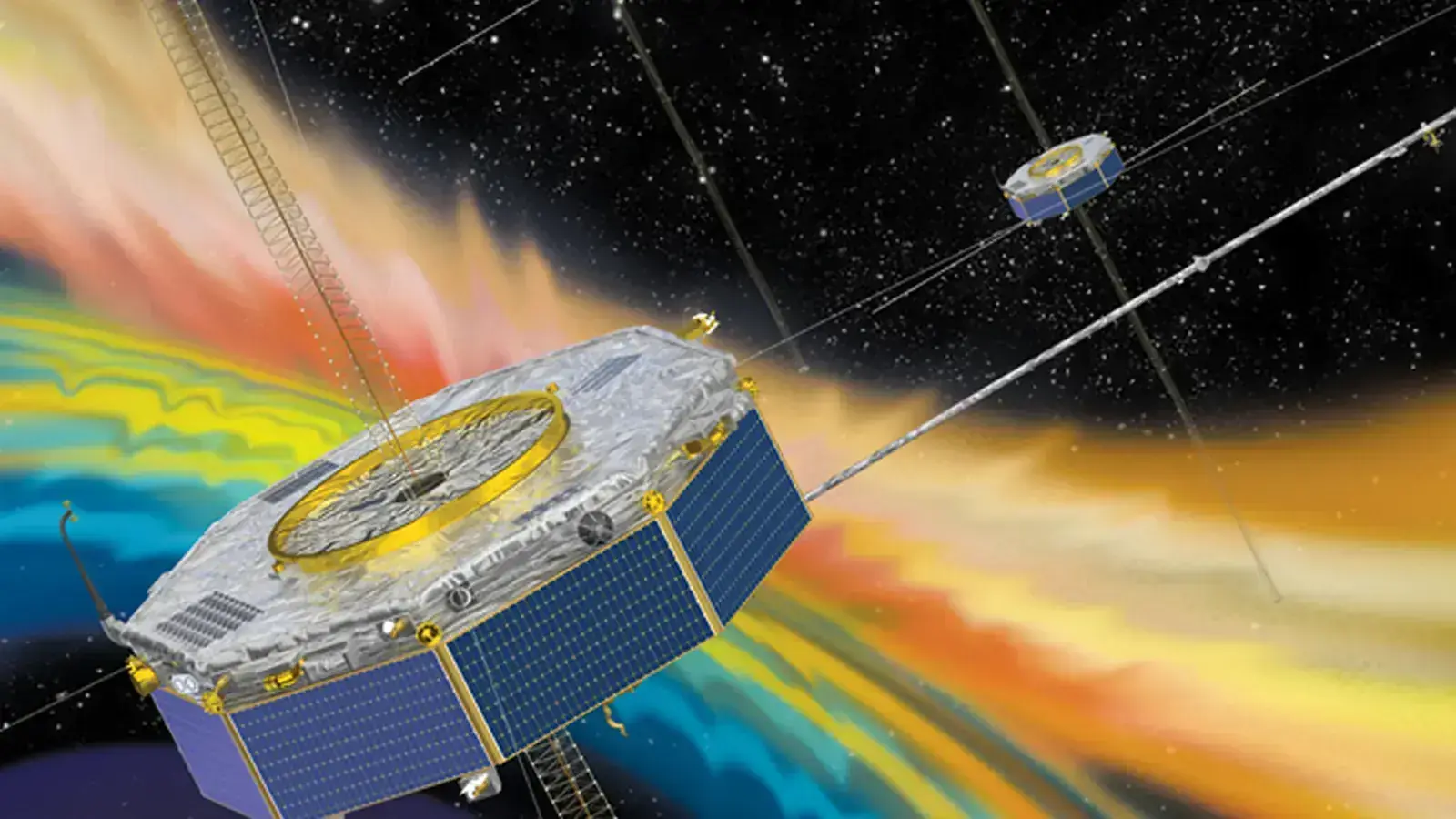
Earth’s magnetic field has reversed its polarity many times. During a reversal, the large-scale field changes so that its north and south magnetic polarity are exchanged. The planet does not rotate upside down, and the geographic poles do not trade places.
Evidence for these events comes from measurements preserved in rocks and sediments. Understanding them also requires understanding the moving, electrically conducting material that generates most of Earth’s field.
The geodynamo beneath our feet
Earth is often drawn as if it contains a giant bar magnet. That is a useful picture of the broad field shape, not a literal description of the source. The main field is generated by motion of electrically conducting liquid in the outer core.
Flow, electrical currents and magnetic fields interact in this geodynamo. As the flow changes, the magnetic field can change in strength and geometry. A reversal is a major reorganisation of that system, rather than a solid magnet spinning over inside the planet.
How rocks preserve past directions
Magnetic minerals can retain information about the field present when a rock formed or a sediment acquired its magnetic record. Combining those records with age estimates allows researchers to reconstruct changes over geological time.
NOAA’s explanation of tracking magnetic poles describes how sampled rocks and radiometric dating help establish the history. Repeated patterns of normal and reversed polarity in ocean-floor rocks also became important evidence for seafloor spreading.
A single measurement is not the complete history. Rock formation, later alteration and dating uncertainty all matter when interpreting a particular record. Agreement among records helps distinguish a widespread field change from a local or incomplete signal.
What happens during a reversal?
The field can weaken and become more complicated than its familiar north–south dipole pattern. The transition is not an instantaneous switch. USGS guidance describes reversals unfolding over hundreds to thousands of years, with their detailed evolution inferred from past records.
Field strength can also change substantially without a complete reversal. A temporary departure from the usual configuration is not necessarily the start of a lasting new polarity. This is why one modern measurement cannot diagnose an entire geological transition.
Is the next reversal overdue?
The last major polarity reversal occurred about 780,000 years ago. That date is not a countdown. The intervals between reversals have varied widely, so an average spacing does not set a deadline for the next event.
NOAA’s geomagnetism FAQ states that we cannot confidently say if or when the present field will reverse. USGS likewise cautions that weakening alone does not establish an approaching reversal.
Pole movement is not the same as polarity reversal
The magnetic poles move as the field changes. Geographic north, magnetic north and the direction a compass points at a particular place are related but distinct concepts. A moving magnetic pole does not by itself mean a reversal is occurring.
A geomagnetic storm is another different phenomenon: solar activity can disturb the magnetic environment over much shorter periods. A storm does not mean the core’s magnetic polarity has permanently flipped.
Would Earth lose its magnetic protection?
A reversal can change the configuration and strength of magnetic shielding, but it is not equivalent to the field disappearing entirely. NASA’s magnetosphere overview explains that the field weakens during a reversal without going completely away.
Understanding possible effects requires examining the changing field and Earth’s surrounding environment, rather than assuming a moment when all protection suddenly vanishes. The geological fact of past reversals also does not supply a precise forecast of future technological impacts.
What scientists can say with confidence
Reversals have happened, rocks preserve evidence of them, and the geodynamo is capable of substantial change. Predicting the next reversal’s date remains a different and much harder problem. A clear account can explain the established history without pretending there is a reliable near-term countdown.
Keep exploring
The magnetic environment also helps shape a familiar light display. Explore what causes the northern lights for the connection between charged particles and Earth’s upper atmosphere.
Sources and further reading
Keep exploring.
We’ll email you when the first edition is ready.
Last updated October 22, 2026.

Barnakle Editorial Team
Barnakle Editorial Team is the collective byline used for Barnakle’s editorial articles. The contributor profile explains the team identity and links to the publication’s editorial policies.
More from the editorial team →