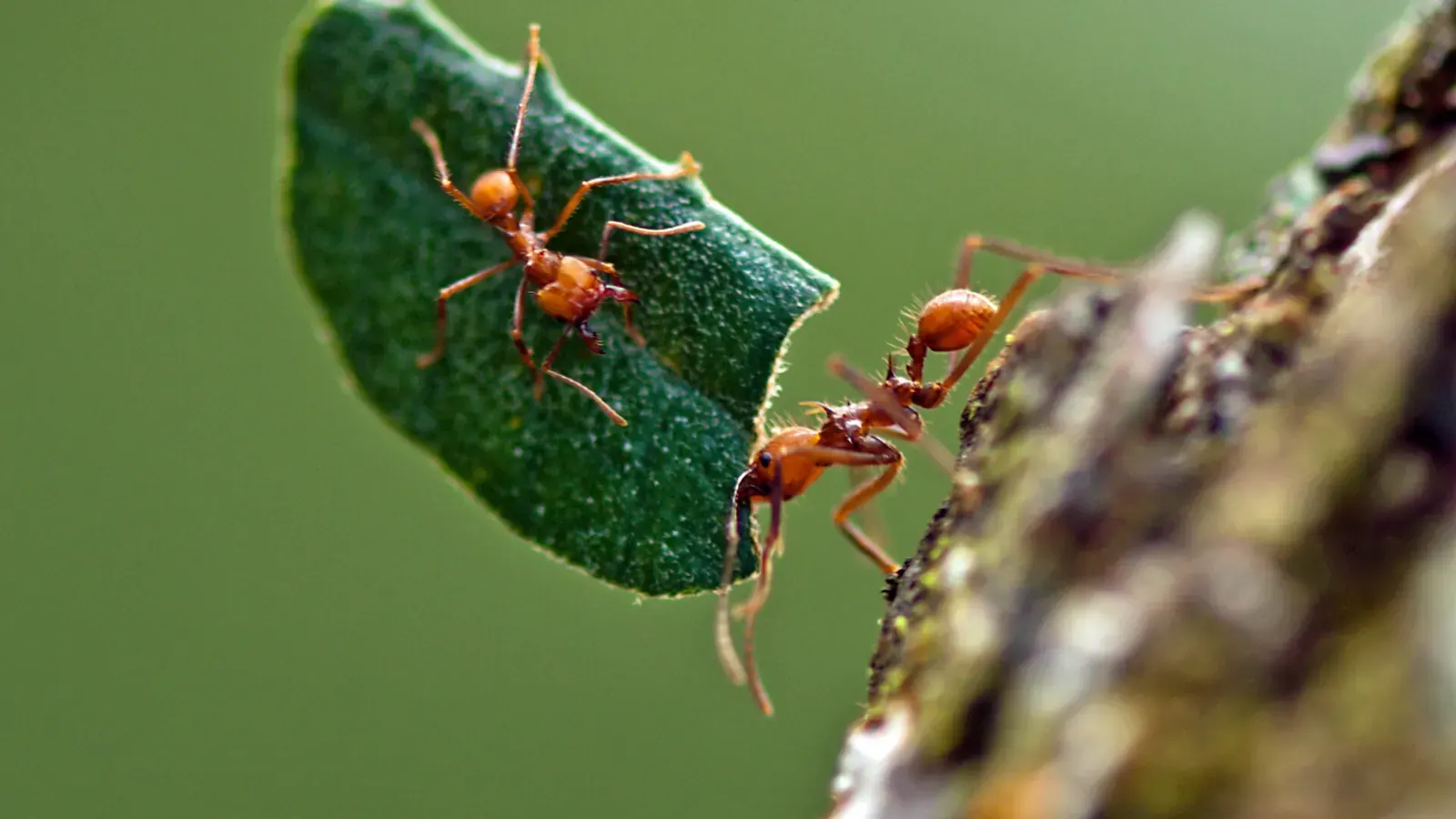
A column of leafcutter ants can carry pieces of vegetation that dwarf the workers themselves. The leaves are not simply being stockpiled as miniature salads. They supply a growing medium for cultivated fungi that play a central role in the colony's food system.
This partnership is a form of agriculture in the biological sense: the ants maintain another organism whose growth helps support their society.
The garden transforms plant material
Workers cut, carry and process vegetation before incorporating it into the fungal garden. The cultivated fungus grows through the substrate and produces food used by the colony.
Research summarised by Pacific Northwest National Laboratory examines how the garden system degrades difficult plant material. Fungal enzymes, ant behaviour and associated microbes contribute to a process more complex than a pile of rotting leaves.
Agriculture evolved through several forms
The Smithsonian's research on fungus-growing ants distinguishes several agricultural systems. Leafcutters represent a specialised development within that wider evolutionary history, not a behaviour performed identically by all ants.
That matters when explaining the relationship. An observation about one genus or farming system cannot automatically be extended to every fungus-growing species. Their cultivars, substrates and degrees of dependence differ.
A garden can be genetically concentrated
A study of Atta colonies used several approaches to examine cultivar diversity. It found evidence consistent with long-term persistence of a fungal clone within the studied nests.
Such concentration helps researchers ask how a large garden is maintained and how vulnerable it might be to specialised enemies. Describing the system as a monoculture is a useful comparison, but the colony is still a living association containing more organisms than the crop fungus alone.
Disease creates work for the farmers
Fungal gardens can be attacked by specialised parasites, including Escovopsis. Ants use maintenance behaviours and chemical defences to limit damage. Some associated bacteria produce compounds involved in the interaction with pathogens.
Research on Acromyrmex symbionts shows why these relationships are studied as a network of interacting organisms. It would be misleading to describe one bacterium as a universal antibiotic guaranteeing that every colony remains disease-free.
The ants and fungi shape one another
The partnership affects what the ants collect, how they organise work and which fungal traits are useful. Comparative genomic research has investigated reciprocal changes in ants and their cultivars across the history of the association.
The analogy with human farming is strongest where it identifies real tasks: preparing substrate, tending a crop, defending it and harvesting food. It becomes weaker if it assigns human intentions or technology to the ants. Their system is an evolved ecological partnership, remarkable precisely because coordinated agriculture can arise through very different biological routes.
Explore a related question
Why Some Fungi Glow in the Dark
Sources and further reading
Keep exploring.
One remarkable idea at a time—nature, science, history and beyond.
Last updated October 27, 2026.

Barnakle Editorial Team
Barnakle Editorial Team is the collective byline used for Barnakle’s editorial articles. The contributor profile explains the team identity and links to the publication’s editorial policies.
More from the editorial team →