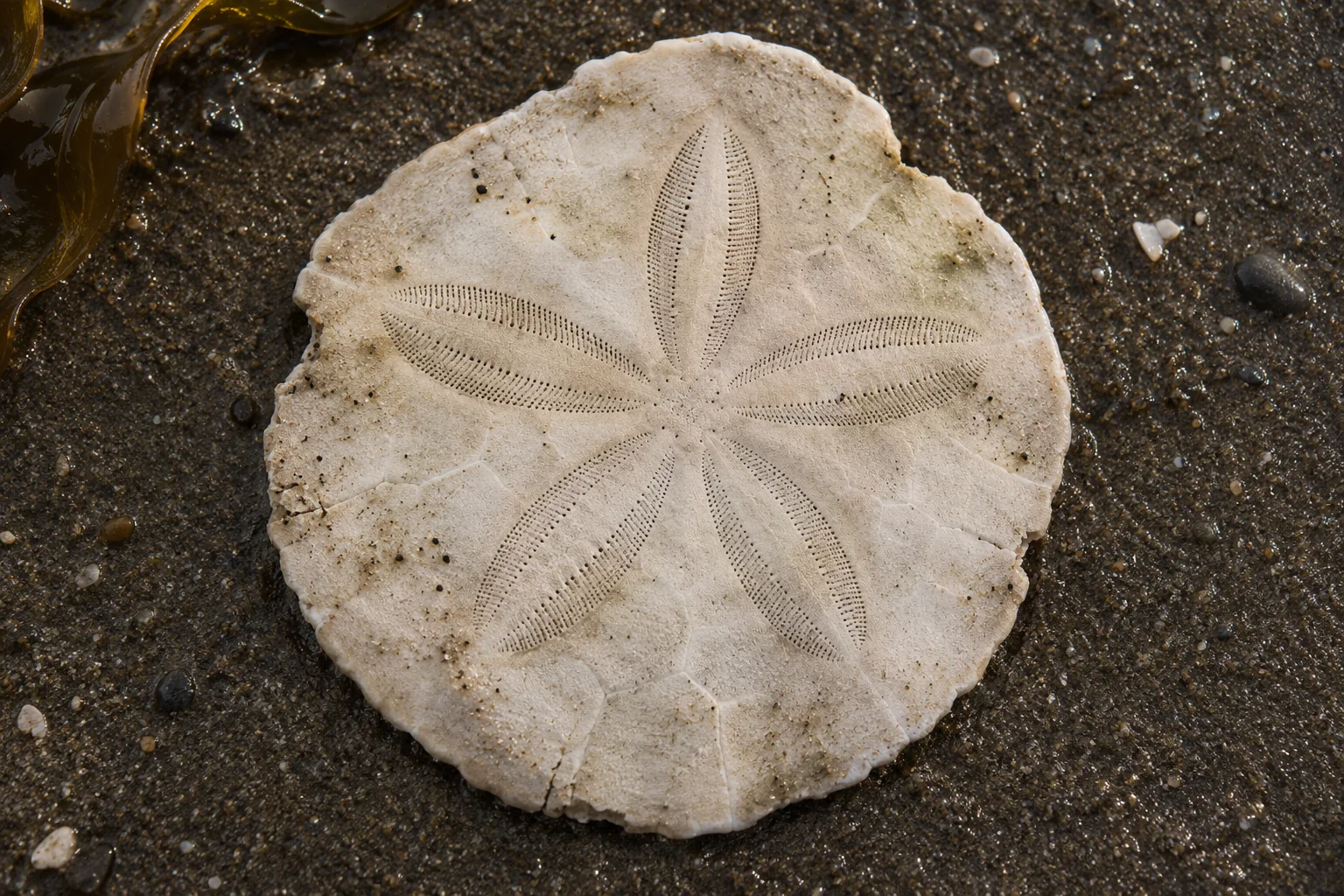
The flower on a sand dollar is part of its breathing apparatus. On the animal’s upper side, five petal-shaped fields contain rows of tiny openings associated with specialized tube feet. When the animal is alive, those soft, thin-walled feet exchange gases with seawater. When the soft parts disappear, the openings remain in its rigid skeleton, which biologists call a test. What looks like a flower stamped onto a beach find is a record of where living tissue once reached through the skeleton. [1, 2]
Look inside one petal
A whole sand dollar fits comfortably in a photograph, but try magnifying just one petal. The outline resolves into repeated pores arranged in paired rows. They follow the long sides of the petal and bend toward its tip. Your eye connects those small, regularly spaced marks into a continuous shape. A chipped specimen may therefore retain an unmistakable section of the design even when the centre and the rest of the disc have gone. [1, 3]
On an intact animal, the respiratory tube feet offer surface area across which dissolved oxygen can enter and carbon dioxide can leave. The name “foot” can make their job sound peculiar. Echinoderms, the group that includes sea stars and sand dollars, put tube feet to several uses. A tube foot specialized for exchanging gases can be effective while staying in approximately the same place. An appendage that manipulates food has a different task. Its position on the body helps tell you which job it does. [1, 2]
Why the flower has five parts
Sand dollars are flattened sea urchins. Adult echinoderms characteristically organize much of their anatomy in five repeated sectors. In a sea star that arrangement is easy to see because the arms project away from the centre. A sand dollar encloses its sectors within one disc. The five petal-shaped areas, called petaloid ambulacra, bring the underlying arrangement into view without the animal having five separate arms. [1, 3]
There is another symmetry to look for. In the eccentric sand dollar of the eastern Pacific, Dendraster excentricus, the point where the petals meet sits away from the geometric centre. Imagine tracing the perimeter and folding the tracing in half from front to back along the animal’s midline. Left and right can correspond even though a turn of one fifth of a circle will not put every feature back where it started. The five-part inheritance and a body with a front and a back can coexist. The easiest way to see both is to look at where the petals meet as well as how many there are. [1, 3]
Why a living sand dollar looks velvety
The chalky white examples that turn up high on beaches have lost the coat that gives a living Pacific sand dollar much of its colour and texture. Very small movable spines crowd its surface. Viewed together, they can look grey, brownish or purple and conceal the fine pore pattern. The motion of those spines becomes much easier to appreciate in close views of a live animal on the seafloor. They help it work its way into sand and shift food particles across its body. [2, 4]
That difference changes what a picture can tell you. A close-up of a cleaned test is well suited to counting petals or locating openings. A time-lapse view of a live animal shows how something without visible legs can change position. A still image of the test alone cannot show which way the living spines moved. Conversely, an even carpet of spines in a photograph of a live animal can make the openings difficult to see without implying that the animal lacks them. [1, 4]
The flower side and the feeding side
The mouth lies on the lower surface. On that side, grooves and small moving structures help deliver food toward the mouth. Small crustaceans, bits of organic matter and microscopic algae are among the foods available to Pacific sand dollars. A particle captured at the body surface can travel a considerable distance for an animal of such modest dimensions. The upper flower records part of the respiratory system, while the feeding structures show how an animal with a mouth underneath can gather material arriving from other directions. [2, 4]
Orientation changes with conditions. In quiet water these sand dollars may embed one edge and stand at an angle, exposing part of the disc to moving water. When conditions get rougher they can settle flatter or bury themselves. Picture the same disc broadside and then edge-on to a current. The area it presents to the flow changes even though its dimensions stay exactly the same. A group of tilted discs therefore tells you something about animals operating in moving water that a neat row of white skeletons in a collection cannot. [4]
Before there is a disc to recognize
A young sand dollar begins life with a very different outline. Aquarists at Monterey Bay Aquarium have followed the development of the Pacific species under a microscope. The fertilized egg divides, and an arm-bearing larval form called a pluteus develops in the water. Later the young animal settles to the bottom. The aquarium’s photographs show how small a juvenile can be even when it has started to resemble an adult. The larval arms are a feature of that drifting stage. Counting them would tell you little about the number of petals on the eventual test. [5]
For a closer look at the pattern, compare a magnified picture of a bare skeleton with an aquarium image of the same species alive. Start at the point where the petals converge, follow a pair of pore rows toward the rim, then find the same part of the live animal beneath its coat of spines. That little exercise reverses what happens on a beach. It puts the soft breathing surfaces back into the spaces where the skeleton shows they belonged.
Keep exploring
A scallop’s two valves and a sand dollar’s test belong to different groups of animals. Explore how a shell can move its owner or change the sound reaching your ear.
Sources and further reading
Museum, aquarium and biological references connect the pore fields to the living animal. The aquarium’s developmental series follows the Pacific species through settlement.
- University of Puget Sound, Slater Museum of Natural History — Eccentric sand dollar
- Aquarium of the Pacific — Pacific sand dollar
- Environment and Climate Change Canada — Biological features of sea urchins and sand dollars
- Monterey Bay Aquarium — Sand dollar natural history
- Monterey Bay Aquarium — Life of a baby sand dollar
Keep exploring.
One remarkable idea at a time—nature, science, history and beyond.
Last updated November 18, 2026.

Barnakle Editorial Team
Barnakle Editorial Team is the collective byline used for Barnakle’s editorial articles. The contributor profile explains the team identity and links to the publication’s editorial policies.
More from the editorial team →