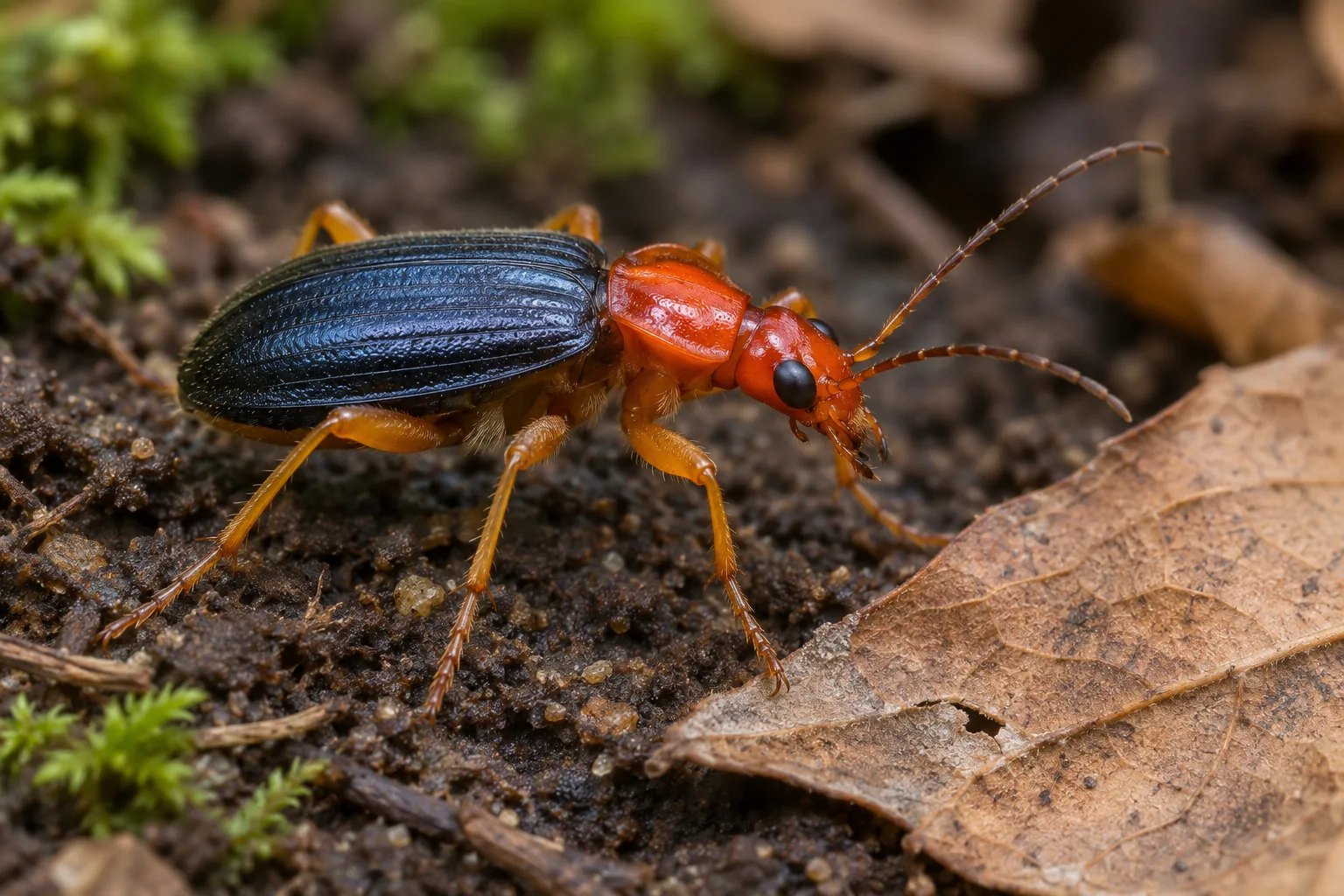
A bombardier beetle can defend itself with a hot, irritating spray produced inside specialised glands near the end of its abdomen. Chemical reactions provide heat and pressure, while the gland’s chambers and moving structures control how the fluid is released. In the well-studied brachinine beetles, a discharge can consist of a rapid sequence of pulses. [1, 2]
The remarkable part is the combination. A repellent chemical alone would not explain the temperature, and a pressurised container alone would not explain how the beetle repeatedly produces the spray. Chemistry and anatomy work together.
What does a bombardier beetle actually release?
The defence is a quinone-based chemical spray. Researchers describe the fluid as irritating and hot; its exact composition and delivery differ among bombardier-beetle groups. The familiar comparison with boiling liquid reflects measured temperatures in studied beetles rather than a claim that every discharge is identical. [1, 6]
A classic 1969 study reported ejection temperatures around 100°C in Brachinus. That is a result for the beetles and conditions investigated, not a thermometer reading obtained from the generic insect illustrated here. [6]
The spray comes from the rear abdominal gland system, not the mouth. Calling the insect a miniature fire-breather is colourful but mechanically misleading. Its defence is a hot chemical discharge, not a flame shooting from its head.
Where does the heat come from?
The reacting chemicals release energy as heat when the defensive system is activated. MIT’s account describes precursor materials coming together in a protective reaction chamber at the time of use. The reaction also generates the conditions needed to expel the hot fluid. [2]
This means the beetle does not have to keep a stomachful of boiling liquid ready all day. Storage and reaction occur in specialised parts of the gland system, with the reaction chamber performing a different job from the reservoir. [1, 2]
An everyday pressure vessel is only a rough analogy. The insect’s structures are biological, and their properties, connections and timing matter. Treating the abdomen as one simple rigid bottle misses the controlled movements that help make repeated discharges possible.
Why does the spray come out in pulses?
An early study of Stenaptinus insignis found that its discharge was pulsed rather than continuous, at roughly 500 pulses per second. The result showed how different the true timing could be from the brief jet visible at ordinary viewing speed. [3]
At that rate, a sequence can appear like a single burst. As an illustrative calculation, 500 equally spaced events per second would be two milliseconds apart. That arithmetic is simply a way to understand the reported frequency; it does not imply all species or all bursts have that exact timing.
Later research examined the internal events. The 2015 study combined anatomical investigation with synchrotron X-ray imaging of living beetles, allowing the researchers to follow vapour dynamics within the reaction chamber. [1]
What do the valve and flexible structures do?
The imaging study connected spray pulsation with specialised structures at the junction between the reservoir and reaction chamber. Its models supported a feedback mechanism in which the pressure event itself moves the structures controlling the passage. [1]
In the team’s explanation, rising pressure displaces a flexible structure and closes the inlet; after fluid is expelled and pressure falls, the passage can reopen. This allows another small reaction event instead of requiring an independently timed muscle contraction for every tiny pulse. [2]
Earlier numerical work had also explored how inlet and outlet behaviour could produce periodic ejections. That modelling was an important line of investigation, but a model and direct internal observation are different kinds of evidence. The later imaging helped test the proposed mechanical behaviour. [4]
The pressure cycle is therefore more informative than the vague statement that the beetle “explodes.” It identifies a sequence of changes in flow and structure that can repeat while leaving the animal intact.
How can researchers see something happening inside a beetle?
Ordinary video records the outside of the insect and the outgoing spray. X-ray imaging can reveal internal boundaries and changes that external footage cannot. Combining these views with anatomy and modelling helps connect an observed jet with a plausible internal mechanism. [1, 2]
No single method supplies every answer. A high-speed record of external pulses establishes timing. Internal imaging can show where vapour appears and structures move. A model tests whether a proposed interaction is mechanically consistent. Their agreement is more useful than a dramatic photograph alone.
This is also why the date of a study matters without making every older observation obsolete. The early pulse-jet work and later imaging address connected questions at different levels of detail.
Can bombardier beetles aim the spray?
Research photographs show that some bombardier beetles can direct the discharge toward different parts of their body when attacked. Movement of the abdominal tip and interactions with specialised surfaces help change the outgoing direction. A threat does not have to stand directly behind the insect to encounter its defence. [5]
That result should not be expanded into a claim of unlimited accuracy at any distance. The study concerned particular beetles, stimuli and observed targeting behaviour. A useful defence has a direction and range without behaving like a precision instrument in every setting.
The visible insect in a still image also cannot demonstrate the mechanism by itself. Identifying an external shape is different from measuring the temperature, pressure or path of a discharge.
Does the defence always stop a predator?
No single defence should be assumed infallible. A 2018 laboratory study examined Pheropsophus jessoensis swallowed by two toad species. Some toads subsequently vomited living beetles after the insects discharged chemicals inside them; outcomes depended on the animals involved. [7]
The result is remarkable without being universal. It does not mean all swallowed bombardier beetles survive, that every predator responds the same way or that being swallowed is the insect’s preferred defence strategy. The experiment tested a particular interaction.
Predator studies and gland studies also answer different questions. One investigates what the mechanism does during encounters; the other investigates how it works. Neither replaces the other.
What makes this system biologically interesting?
The beetle couples a rapid energy-releasing reaction with structures that manage the resulting forces. That makes it interesting to researchers studying biological materials, fluid control and defensive adaptations. It is an example of coordinated functions rather than a single magical ingredient. [1, 4]
The explanatory picture is a sequence: stored materials enter a reaction region, heat and pressure rise, fluid is expelled, and the pathway resets. Studying that sequence turns a startling wildlife fact into a testable account of how a small animal controls an unusually forceful chemical defence.
Keep exploring
Compare this chemical defence with two other remarkable ways animals use energy:
Sources and further reading
Bombardier-beetle evidence checked November 16, 2026. Research abstracts, repository summaries and the MIT team’s account are identified below; results are qualified by species and study.
- Arndt et al. (2015) — Mechanistic origins of bombardier beetle (Brachinini) explosion-induced defensive spray pulsation; MIT repository abstract
- MIT News — How some beetles produce a scalding defensive spray; research-team account
- Dean et al. (1990) — Defensive spray of the bombardier beetle: a biological pulse jet; abstract
- Beheshti and McIntosh (2007) — The bombardier beetle and its use of a pressure relief valve system to deliver a periodic pulsed spray; modelling abstract
- Eisner and Aneshansley (1999) — Spray aiming in the bombardier beetle: Photographic evidence; indexed research text
- Aneshansley et al. (1969) — Biochemistry at 100°C: Explosive Secretory Discharge of Bombardier Beetles; abstract
- Sugiura and Sato (2018) — Successful escape of bombardier beetles from predator digestive systems; abstract and indexed article text
Keep exploring.
One remarkable idea at a time—nature, science, history and beyond.
Last updated November 17, 2026.

Barnakle Editorial Team
Barnakle Editorial Team is the collective byline used for Barnakle’s editorial articles. The contributor profile explains the team identity and links to the publication’s editorial policies.
More from the editorial team →