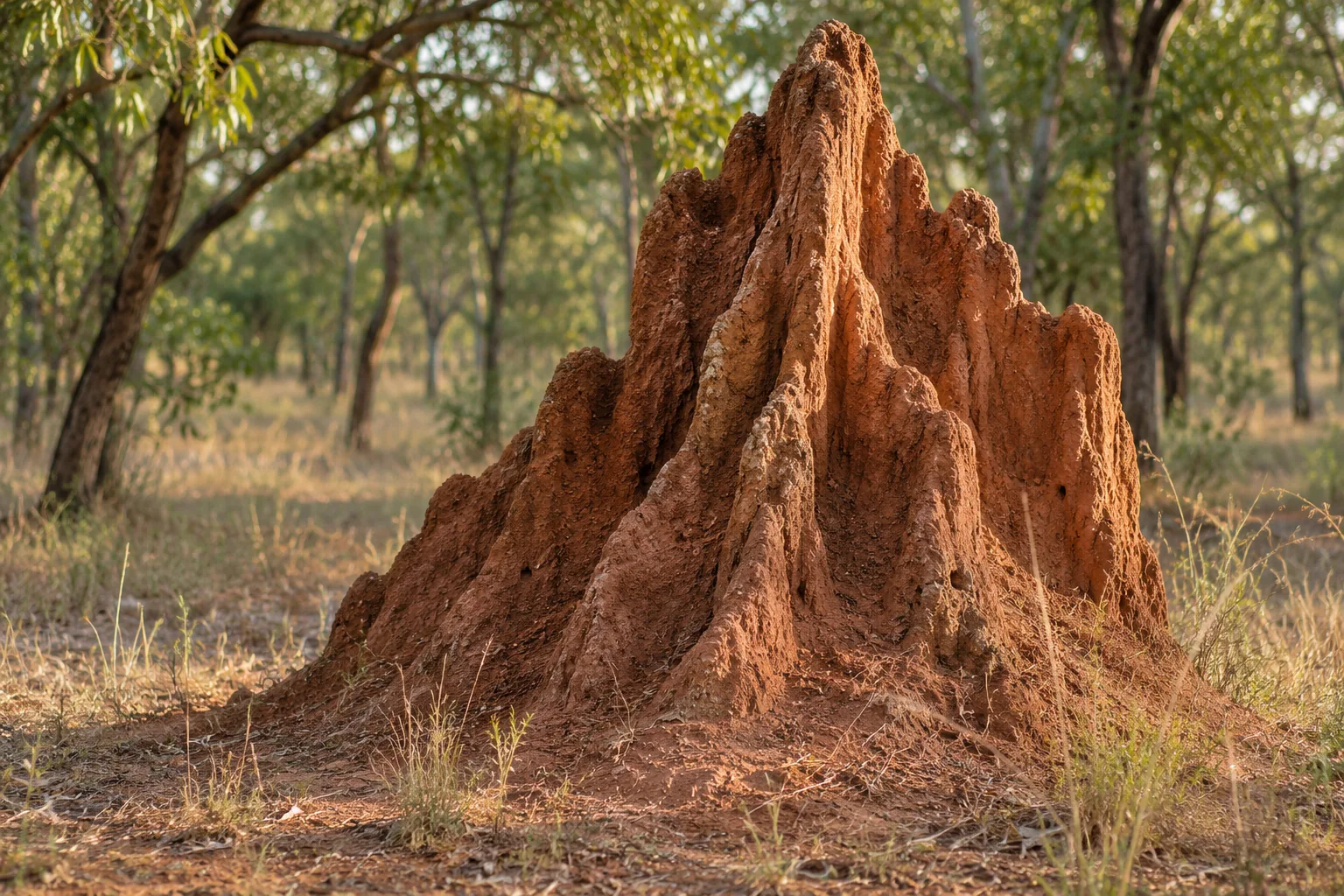
A termite mound can help a dense colony exchange respiratory gases without an electric fan. Its internal channels and porous exterior interact with temperature differences, sunlight and—in some settings—wind. In studied species, daily heating and cooling can drive air circulation through the mound, carrying gases between the nest and surfaces where exchange with the outside occurs. [1, 4]
There is no single mechanism that can safely be assigned to every termite mound. The scientifically interesting answer depends on the species, the structure it builds and its environment. A tower in a sunny African landscape need not operate in precisely the same way as a more shaded mound in southern Asia.
Why does a termite colony need ventilation?
Termites and the fungi cultivated by some species respire. They consume oxygen and produce carbon dioxide. In a densely occupied underground environment, exchanging those gases is an essential part of maintaining suitable living conditions. [1, 3]
The mound above ground may function partly as an extension of this exchange system rather than simply being the place where all the termites live. Research on fungus-growing species describes networks of channels above subterranean nests and fungus gardens. [1, 4]
That arrangement is important when interpreting a photograph. The impressive visible tower is only part of the colony’s architecture. Its height does not tell you where the insects or their cultivated fungi are concentrated below it.
How can changing temperatures move air through a mound?
Different parts of a mound warm and cool at different rates. Thin outer structures can respond quickly to changing conditions, while deeper material changes temperature more slowly. The resulting contrast can drive buoyancy-related circulation through connected passageways. [1, 2]
This is different from imagining the whole mound warming uniformly. A uniform temperature change would not create the same contrast between connected regions. Geometry and differences in thermal response help convert an environmental change into a flow pattern.
In the 2015 study of Odontotermes obesus mounds, the researchers directly measured internal flows alongside temperature and carbon dioxide. They found a daily reversal associated with the changing thermal relationship between outer conduits and the deeper chimney. [1]
What happens during the day and at night?
In the studied Asian mounds, the outer flutelike channels warmed more quickly during the day. Air moved upward through those channels and downward through the central region. At night, faster cooling of the exterior reversed that pattern. [2]
The result is not a permanent chimney pulling air upward through its centre at the same rate all day. It is a changing circulation. Explaining the mound as a system that responds to a cycle captures something a static diagram can miss.
Harvard’s account describes this behaviour as analogous to a slowly breathing lung. The analogy concerns gas exchange supported by changing flows, not a claim that the mound contains muscular lungs or inhales with the timing of an animal. [2, 3]
How do gases cross the mound’s wall?
Moving air within the mound and exchanging gases across its boundary are related but separate processes. In the 2015 study, internal circulation transported gas between the nest and outer regions, while diffusion across the porous exterior contributed to exchange with the surrounding atmosphere. [1]
This distinction avoids two opposite oversimplifications. Calling the exterior “solid” does not establish that gas cannot cross it. Calling it “porous” does not establish that wind freely blows through every wall or that diffusion alone rapidly services an entire deep nest.
The relevant scale matters. A small pore can support gas movement across a short wall thickness without making a long underground route equally effective. Transport over the full structure requires considering the connected system rather than one material property in isolation.
Do African termite mounds use the same pattern?
A 2017 study investigated Macrotermes michaelseni in an African environment. Direct measurements again supported a role for periodic solar heating, but the detailed flows and carbon-dioxide patterns differed from those in the Asian species. The position of the sun and more direct heating changed how the structure was driven. [4]
The African mounds in that study did not simply reproduce the once-daily overturning of strongly stratified gases reported in the Asian case. Similar broad principles can produce different schedules and spatial patterns when the environmental inputs change. [4]
This is a useful example of generalising carefully. A finding in one species can motivate a test in another. Agreement on part of the mechanism does not require identical performance in every detail.
Does the texture of the wall make a difference?
Yes. A 2019 investigation combined multiscale X-ray imaging with flow simulations to examine nest-wall microstructure. It identified networks of pores at different scales that affected permeability, gas diffusion, insulation and drainage. [5]
The word “soil” therefore hides substantial architecture. Two walls made from earth can differ in how their pores connect and how water moves through them. A photograph of a rough surface cannot reveal all of those internal connections.
The drainage result also links weather with ventilation. Rainwater occupying spaces in a porous structure changes the conditions for gas movement. A wall that drains effectively can restore its gas-exchange function after wetting. These are interacting material functions, rather than unrelated bonuses listed beside one another. [5]
Is wind irrelevant to termite ventilation?
No. It would be a mistake to turn evidence for thermal circulation into a universal claim that wind never matters. A 2020 study of Odontotermes obesus described a dense core and a more porous outer shell, and discussed how that architecture can permit wind-induced ventilation while serving other functions. [6]
Which driver dominates depends on the mound and conditions. The useful question is how much gas movement comes from each process in a particular setting, not which one-word explanation wins for all termites everywhere.
The 2020 findings also emphasise that the periphery is remodelled. A mound is an animal-built structure maintained over time, not a permanently fixed object whose first shape explains every later observation. [6]
Are termite mounds natural air conditioners?
The phrase captures their influence on an internal environment, but it can blur different jobs. Ventilation exchanges gases; insulation changes heat transfer; temperature and humidity regulation involve further interactions. Keeping these functions distinct makes the explanation more accurate. [3, 4]
Researchers are interested in whether buildings can use changing environmental conditions more effectively. That is inspiration from a biological mechanism, not evidence that copying a mound’s exterior shape will automatically ventilate a human building. Scale, materials, occupancy and climate all change the design problem. [3]
The mound’s lesson is more specific and more interesting than an architectural resemblance: connected spaces, uneven heating and a carefully structured boundary can work together to exchange matter with the surroundings. Measuring those relationships is how researchers discover what the insects’ buildings actually do.
Keep exploring
Explore another insect farming system and another animal-built structure that changes its surroundings:
Sources and further reading
Termite-mound studies reviewed November 16, 2026, with Asian and African species kept distinct. Wall-microstructure and bilayer findings are cited from their research abstracts.
- King, Ocko and Mahadevan (2015) — Termite mounds harness diurnal temperature oscillations for ventilation; PNAS author PDF
- Harvard SEAS — How termites ventilate; research-team explanation
- Wyss Institute — Termite mounds could inspire new ideas for sustainable building ventilation
- Ocko et al. (2017) — Solar-powered ventilation of African termite mounds; Journal of Experimental Biology author PDF
- The architectural design of smart ventilation and drainage systems in termite nests (2019); research abstract
- Bi-layered architecture facilitates high strength and ventilation in nest mounds of fungus-farming termites (2020); research abstract
Keep exploring.
One remarkable idea at a time—nature, science, history and beyond.
Last updated November 17, 2026.

Barnakle Editorial Team
Barnakle Editorial Team is the collective byline used for Barnakle’s editorial articles. The contributor profile explains the team identity and links to the publication’s editorial policies.
More from the editorial team →