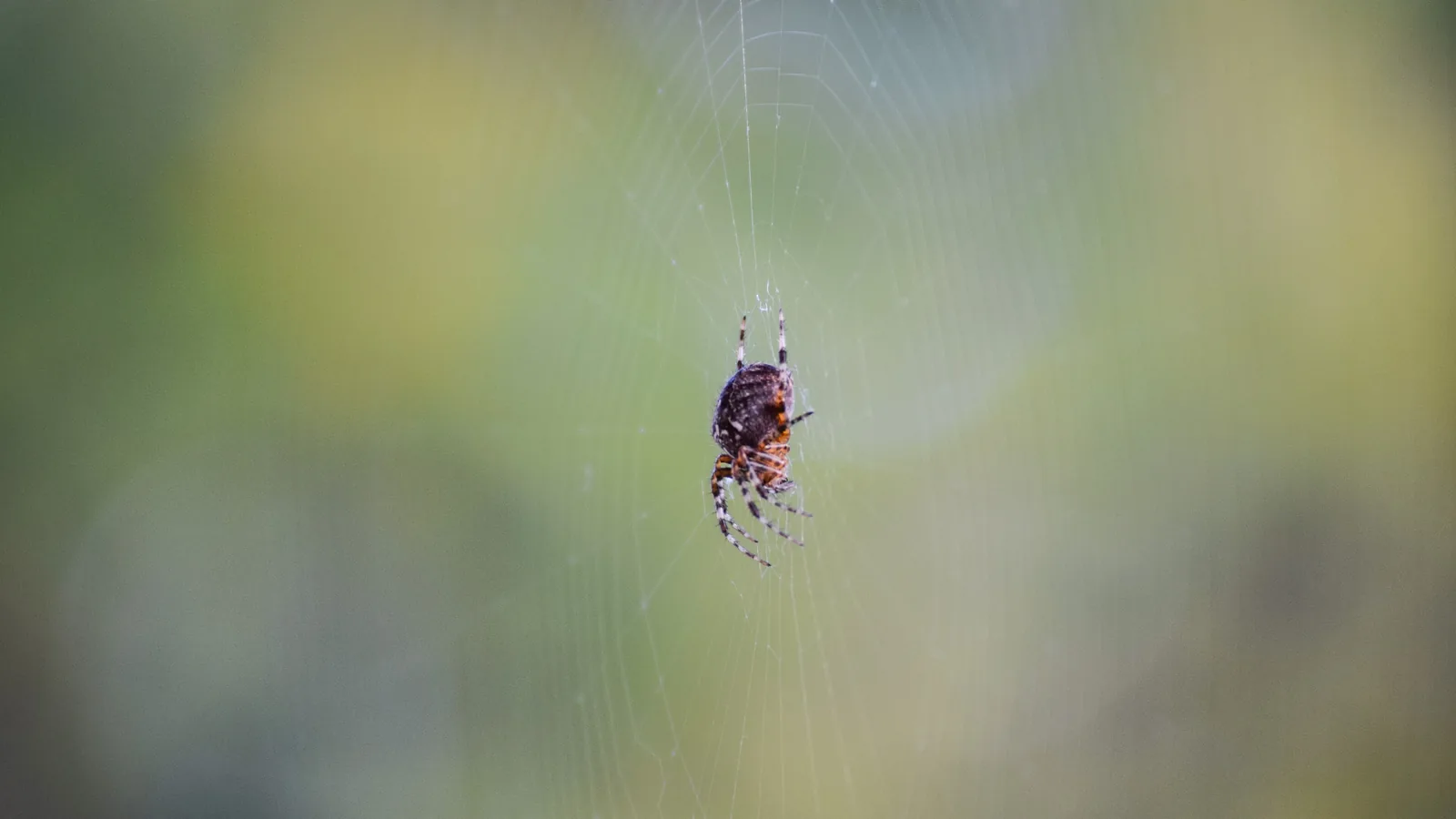
A spider's silk begins as a concentrated protein solution inside specialised glands. During spinning, that material passes through a controlled environment and becomes a fibre. The transformation depends on protein chemistry and physical processing, not simply on a liquid thread hardening because it touched air.
A spider can produce different silks for different jobs. A safety line, an egg covering and a capture thread need not have the same composition or mechanical behaviour.
Spidroins provide the building material
The principal silk proteins are called spidroins. Their sequences contain repeated regions and terminal domains that help control how the molecules behave. A useful spinning system must store a concentrated solution without allowing it to aggregate prematurely.
Research on pH-sensitive assembly shows how parts of the protein can help regulate the transition. The challenge is to keep the material soluble in one setting while enabling rapid organised assembly in another.
The duct changes the conditions
As the solution moves through the spinning apparatus, it encounters changes in acidity, ions, water content and mechanical forces. A narrowing duct contributes to the flow conditions.
Experiments and reviews describe these factors as interacting controls. No single measurement of acidity or pulling speed alone explains the entire transformation across every silk gland and species.
Drawing helps organise the fibre
Spinning involves drawing material into a thread while the proteins assemble. Mechanical alignment and the development of molecular structure contribute to the resulting properties.
The finished material contains organised regions within a larger protein architecture. This arrangement helps explain how a fibre can combine resistance to pulling with the capacity to deform. Statements about “stronger than steel” need a specified property and comparison; strength, stiffness and toughness are not interchangeable measurements.
Different glands support different functions
Spiders can have several silk-producing gland types, with the set varying among groups. Spinnerets and their outlets help manage where the material is delivered. A web is therefore assembled from materials whose roles may differ.
Some capture systems also use adhesive components. The glue is not simply another name for the main load-bearing silk fibre. Distinguishing the components makes the web's behaviour easier to understand.
Artificial silk tests what researchers have learned
Producing a silk-like protein is only part of recreating a useful fibre. Researchers also need to reproduce aspects of storage, assembly and drawing. A 2024 microfluidic study combined chemical and mechanical triggers to investigate that process.
Such work tests specific manufacturing strategies rather than demonstrating that one laboratory recipe fully duplicates every natural silk. The spider's achievement lies in coordinating protein design with a controlled spinning route. Understanding both parts is necessary to explain why a liquid stored in a gland can become a functional thread outside the body.
Explore a related question
How Spiders Read Vibrations Through Their Webs
Sources and further reading
Keep exploring.
One remarkable idea at a time—nature, science, history and beyond.
Last updated October 27, 2026.

Barnakle Editorial Team
Barnakle Editorial Team is the collective byline used for Barnakle’s editorial articles. The contributor profile explains the team identity and links to the publication’s editorial policies.
More from the editorial team →