
Iron returns toward a chemically stable form through an electrochemical reaction with water and oxygen
The short answer
Iron rusts when it is oxidized in the presence of water and oxygen. Different regions on the wet surface act like tiny electrochemical cells: iron atoms lose electrons, oxygen gains them and hydrated iron oxides form. Salt, acids, heat and contact with dissimilar metals can accelerate corrosion, while coatings and sacrificial metals interrupt the process.
Rust looks like a simple orange stain, but it is the visible product of many linked reactions. Refined iron contains stored chemical energy because extracting it from ore reverses naturally favoured oxidation. In a suitable environment, corrosion gradually returns the metal toward oxide minerals.
Rust is a family of compounds
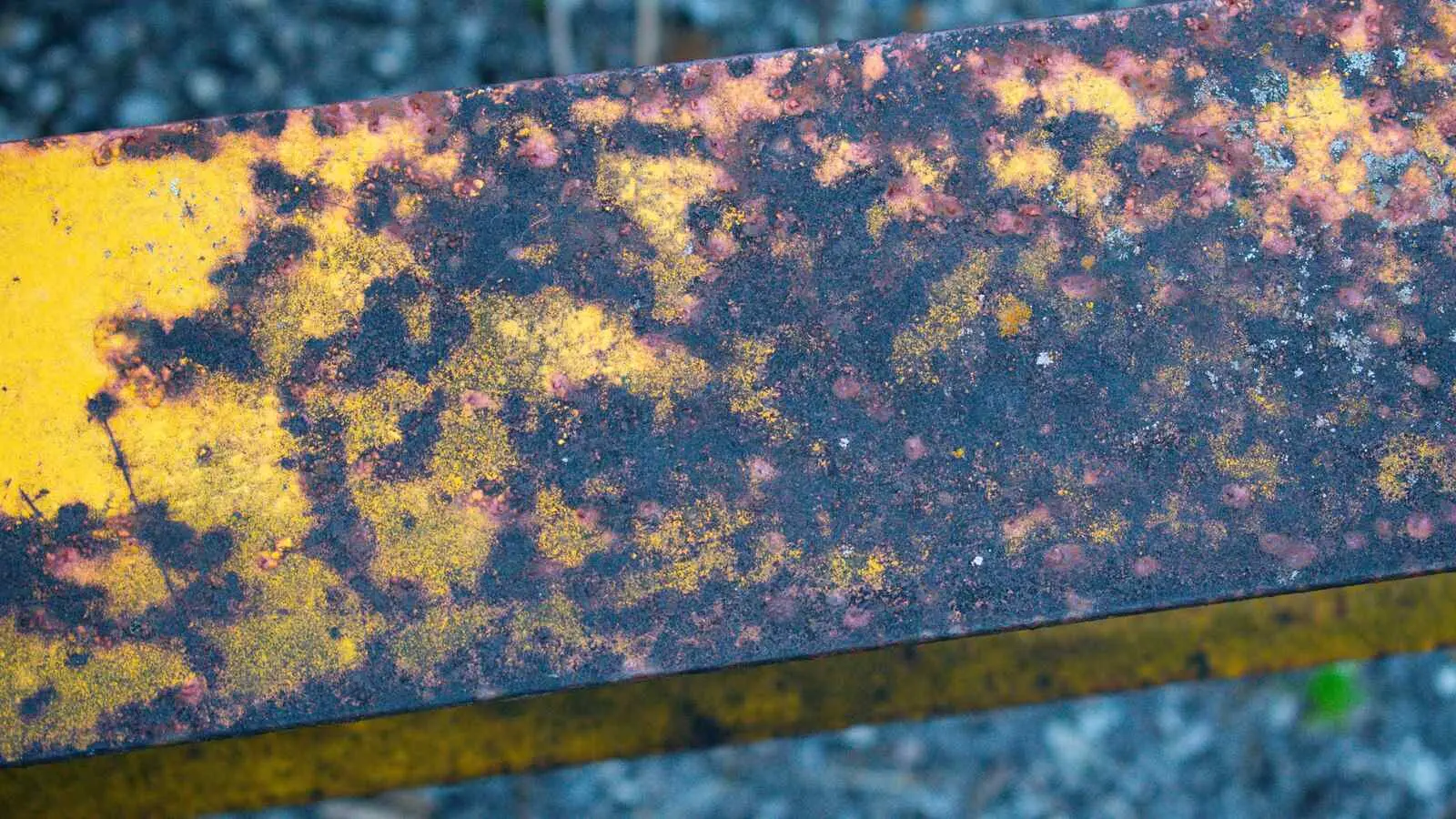
The familiar coating contains mixtures of hydrated iron oxides and oxyhydroxides rather than one perfectly uniform substance. Composition and colour vary with water, oxygen, contaminants and drying history.
Understanding Rust is a family of compounds requires separating the immediate mechanism from the conditions that make it stronger, weaker or easier to observe. Researchers measure those variables independently, compare natural examples and test whether the same explanation predicts new results. This turns a plausible story into an evidence-based account.
The evidence for Rust is a family of compounds comes from methods that fail in different ways. Direct observation establishes what occurs, instruments quantify timing or structure, experiments isolate candidate causes and models test whether known rules reproduce the pattern. Agreement across methods is more persuasive than repetition of one memorable example.
Context also matters for Rust is a family of compounds. Scale, species, location, temperature, geometry and measurement limits can change the result without overturning the underlying process. Careful reporting preserves that variation, states uncertainty and prevents a useful explanation from becoming an exaggerated universal rule.
A practical explanation should also answer what would change the observation. Following that question reveals the limits of the evidence and identifies the next measurement needed.
Oxidation releases electrons
At anodic sites, iron atoms enter solution as ions and leave electrons behind in the metal. That electron loss is oxidation and begins the electrochemical corrosion circuit.
Understanding Oxidation releases electrons requires separating the immediate mechanism from the conditions that make it stronger, weaker or easier to observe. Researchers measure those variables independently, compare natural examples and test whether the same explanation predicts new results. This turns a plausible story into an evidence-based account.
The evidence for Oxidation releases electrons comes from methods that fail in different ways. Direct observation establishes what occurs, instruments quantify timing or structure, experiments isolate candidate causes and models test whether known rules reproduce the pattern. Agreement across methods is more persuasive than repetition of one memorable example.
Context also matters for Oxidation releases electrons. Scale, species, location, temperature, geometry and measurement limits can change the result without overturning the underlying process. Careful reporting preserves that variation, states uncertainty and prevents a useful explanation from becoming an exaggerated universal rule.
A practical explanation should also answer what would change the observation. Following that question reveals the limits of the evidence and identifies the next measurement needed.
Oxygen is reduced elsewhere
Electrons travel through the metal to cathodic regions, where dissolved oxygen reacts with water. Ions moving through the moisture film complete the circuit.
Understanding Oxygen is reduced elsewhere requires separating the immediate mechanism from the conditions that make it stronger, weaker or easier to observe. Researchers measure those variables independently, compare natural examples and test whether the same explanation predicts new results. This turns a plausible story into an evidence-based account.
The evidence for Oxygen is reduced elsewhere comes from methods that fail in different ways. Direct observation establishes what occurs, instruments quantify timing or structure, experiments isolate candidate causes and models test whether known rules reproduce the pattern. Agreement across methods is more persuasive than repetition of one memorable example.
Context also matters for Oxygen is reduced elsewhere. Scale, species, location, temperature, geometry and measurement limits can change the result without overturning the underlying process. Careful reporting preserves that variation, states uncertainty and prevents a useful explanation from becoming an exaggerated universal rule.
A practical explanation should also answer what would change the observation. Following that question reveals the limits of the evidence and identifies the next measurement needed.
Water acts as an electrolyte
A thin film of moisture dissolves gases and ions, allowing electrical charge to move. Dry iron can oxidize slowly, but ordinary rusting accelerates greatly when liquid water is available.
Understanding Water acts as an electrolyte requires separating the immediate mechanism from the conditions that make it stronger, weaker or easier to observe. Researchers measure those variables independently, compare natural examples and test whether the same explanation predicts new results. This turns a plausible story into an evidence-based account.
The evidence for Water acts as an electrolyte comes from methods that fail in different ways. Direct observation establishes what occurs, instruments quantify timing or structure, experiments isolate candidate causes and models test whether known rules reproduce the pattern. Agreement across methods is more persuasive than repetition of one memorable example.
Context also matters for Water acts as an electrolyte. Scale, species, location, temperature, geometry and measurement limits can change the result without overturning the underlying process. Careful reporting preserves that variation, states uncertainty and prevents a useful explanation from becoming an exaggerated universal rule.
A practical explanation should also answer what would change the observation. Following that question reveals the limits of the evidence and identifies the next measurement needed.
Salt speeds corrosion
Dissolved salt increases conductivity and can disrupt protective films. Road salt and sea spray therefore create particularly aggressive environments for vehicles, bridges and coastal equipment.
Understanding Salt speeds corrosion requires separating the immediate mechanism from the conditions that make it stronger, weaker or easier to observe. Researchers measure those variables independently, compare natural examples and test whether the same explanation predicts new results. This turns a plausible story into an evidence-based account.
The evidence for Salt speeds corrosion comes from methods that fail in different ways. Direct observation establishes what occurs, instruments quantify timing or structure, experiments isolate candidate causes and models test whether known rules reproduce the pattern. Agreement across methods is more persuasive than repetition of one memorable example.
Context also matters for Salt speeds corrosion. Scale, species, location, temperature, geometry and measurement limits can change the result without overturning the underlying process. Careful reporting preserves that variation, states uncertainty and prevents a useful explanation from becoming an exaggerated universal rule.
A practical explanation should also answer what would change the observation. Following that question reveals the limits of the evidence and identifies the next measurement needed.
Acidity changes reaction rates
Acidic conditions can dissolve surface films and increase available hydrogen ions. Alkaline concrete may protect embedded steel until carbonation or chloride penetration changes the local chemistry.
Understanding Acidity changes reaction rates requires separating the immediate mechanism from the conditions that make it stronger, weaker or easier to observe. Researchers measure those variables independently, compare natural examples and test whether the same explanation predicts new results. This turns a plausible story into an evidence-based account.
The evidence for Acidity changes reaction rates comes from methods that fail in different ways. Direct observation establishes what occurs, instruments quantify timing or structure, experiments isolate candidate causes and models test whether known rules reproduce the pattern. Agreement across methods is more persuasive than repetition of one memorable example.
Context also matters for Acidity changes reaction rates. Scale, species, location, temperature, geometry and measurement limits can change the result without overturning the underlying process. Careful reporting preserves that variation, states uncertainty and prevents a useful explanation from becoming an exaggerated universal rule.
A practical explanation should also answer what would change the observation. Following that question reveals the limits of the evidence and identifies the next measurement needed.
Rust can trap more moisture
Unlike the compact oxide on aluminium, ordinary rust is often porous and flaky. Water and oxygen can reach fresh iron underneath, allowing corrosion to continue.
Understanding Rust can trap more moisture requires separating the immediate mechanism from the conditions that make it stronger, weaker or easier to observe. Researchers measure those variables independently, compare natural examples and test whether the same explanation predicts new results. This turns a plausible story into an evidence-based account.
The evidence for Rust can trap more moisture comes from methods that fail in different ways. Direct observation establishes what occurs, instruments quantify timing or structure, experiments isolate candidate causes and models test whether known rules reproduce the pattern. Agreement across methods is more persuasive than repetition of one memorable example.
Context also matters for Rust can trap more moisture. Scale, species, location, temperature, geometry and measurement limits can change the result without overturning the underlying process. Careful reporting preserves that variation, states uncertainty and prevents a useful explanation from becoming an exaggerated universal rule.
A practical explanation should also answer what would change the observation. Following that question reveals the limits of the evidence and identifies the next measurement needed.
Galvanic contact matters
When dissimilar metals touch in an electrolyte, their voltage difference can make one corrode faster. Engineers select compatible materials or electrically isolate them.
Understanding Galvanic contact matters requires separating the immediate mechanism from the conditions that make it stronger, weaker or easier to observe. Researchers measure those variables independently, compare natural examples and test whether the same explanation predicts new results. This turns a plausible story into an evidence-based account.
The evidence for Galvanic contact matters comes from methods that fail in different ways. Direct observation establishes what occurs, instruments quantify timing or structure, experiments isolate candidate causes and models test whether known rules reproduce the pattern. Agreement across methods is more persuasive than repetition of one memorable example.
Context also matters for Galvanic contact matters. Scale, species, location, temperature, geometry and measurement limits can change the result without overturning the underlying process. Careful reporting preserves that variation, states uncertainty and prevents a useful explanation from becoming an exaggerated universal rule.
A practical explanation should also answer what would change the observation. Following that question reveals the limits of the evidence and identifies the next measurement needed.
Scratches expose vulnerable metal
Paint and polymer coatings work by separating iron from water and oxygen. A chip creates a local opening where corrosion may spread beneath the remaining coating.
Understanding Scratches expose vulnerable metal requires separating the immediate mechanism from the conditions that make it stronger, weaker or easier to observe. Researchers measure those variables independently, compare natural examples and test whether the same explanation predicts new results. This turns a plausible story into an evidence-based account.
The evidence for Scratches expose vulnerable metal comes from methods that fail in different ways. Direct observation establishes what occurs, instruments quantify timing or structure, experiments isolate candidate causes and models test whether known rules reproduce the pattern. Agreement across methods is more persuasive than repetition of one memorable example.
Context also matters for Scratches expose vulnerable metal. Scale, species, location, temperature, geometry and measurement limits can change the result without overturning the underlying process. Careful reporting preserves that variation, states uncertainty and prevents a useful explanation from becoming an exaggerated universal rule.
A practical explanation should also answer what would change the observation. Following that question reveals the limits of the evidence and identifies the next measurement needed.
Sacrificial metals protect steel
Zinc coatings and attached magnesium or zinc anodes oxidize preferentially. They can protect exposed steel electrochemically, not merely by forming a physical barrier.
Understanding Sacrificial metals protect steel requires separating the immediate mechanism from the conditions that make it stronger, weaker or easier to observe. Researchers measure those variables independently, compare natural examples and test whether the same explanation predicts new results. This turns a plausible story into an evidence-based account.
The evidence for Sacrificial metals protect steel comes from methods that fail in different ways. Direct observation establishes what occurs, instruments quantify timing or structure, experiments isolate candidate causes and models test whether known rules reproduce the pattern. Agreement across methods is more persuasive than repetition of one memorable example.
Context also matters for Sacrificial metals protect steel. Scale, species, location, temperature, geometry and measurement limits can change the result without overturning the underlying process. Careful reporting preserves that variation, states uncertainty and prevents a useful explanation from becoming an exaggerated universal rule.
A practical explanation should also answer what would change the observation. Following that question reveals the limits of the evidence and identifies the next measurement needed.
Stainless steel relies on passivation
Chromium in stainless steel forms a thin self-repairing oxide film. Chlorides, low oxygen or unsuitable grades can still cause pitting and crevice corrosion.
Understanding Stainless steel relies on passivation requires separating the immediate mechanism from the conditions that make it stronger, weaker or easier to observe. Researchers measure those variables independently, compare natural examples and test whether the same explanation predicts new results. This turns a plausible story into an evidence-based account.
The evidence for Stainless steel relies on passivation comes from methods that fail in different ways. Direct observation establishes what occurs, instruments quantify timing or structure, experiments isolate candidate causes and models test whether known rules reproduce the pattern. Agreement across methods is more persuasive than repetition of one memorable example.
Context also matters for Stainless steel relies on passivation. Scale, species, location, temperature, geometry and measurement limits can change the result without overturning the underlying process. Careful reporting preserves that variation, states uncertainty and prevents a useful explanation from becoming an exaggerated universal rule.
A practical explanation should also answer what would change the observation. Following that question reveals the limits of the evidence and identifies the next measurement needed.
Corrosion is monitored as infrastructure ages
Inspectors combine visual surveys, thickness measurements, electrical techniques and exposure data. Maintenance targets the environment and mechanism rather than treating every reddish mark identically.
Understanding Corrosion is monitored as infrastructure ages requires separating the immediate mechanism from the conditions that make it stronger, weaker or easier to observe. Researchers measure those variables independently, compare natural examples and test whether the same explanation predicts new results. This turns a plausible story into an evidence-based account.
The evidence for Corrosion is monitored as infrastructure ages comes from methods that fail in different ways. Direct observation establishes what occurs, instruments quantify timing or structure, experiments isolate candidate causes and models test whether known rules reproduce the pattern. Agreement across methods is more persuasive than repetition of one memorable example.
Context also matters for Corrosion is monitored as infrastructure ages. Scale, species, location, temperature, geometry and measurement limits can change the result without overturning the underlying process. Careful reporting preserves that variation, states uncertainty and prevents a useful explanation from becoming an exaggerated universal rule.
A practical explanation should also answer what would change the observation. Following that question reveals the limits of the evidence and identifies the next measurement needed.
Common misconceptions
Rust is not a living mould and it does not require metal to be submerged. Humid air can supply enough water. Stainless steel is corrosion-resistant rather than rust-proof, and painting over active corrosion without preparation does not reliably stop the electrochemical reactions underneath.
A concise explanation is useful only when it preserves the causal chain. It becomes misleading when it substitutes a familiar label for a mechanism, confuses association with cause or extends evidence beyond the conditions actually studied.
How scientists know
Corrosion scientists measure electrical potential and current, expose metal coupons to controlled humidity or salt spray, identify products with spectroscopy and microscopy, and monitor structures with ultrasonic thickness gauges. Long-term field stations connect laboratory mechanisms with real climates and pollutants.
No single measurement carries the conclusion. Observations, experiments, physical theory and repeated records provide independent checks, while disagreement points to an uncontrolled variable or a question that still needs a better test.
Frequently asked questions
Does pure iron rust faster than steel?
Composition and microstructure matter, but environmental conditions and alloy design prevent one universal ranking.
Why does salt water rust metal faster?
Salt makes the water film more conductive and chloride can damage protective surface layers.
Can rust be reversed?
Oxides can be removed or chemically converted, but lost metal must be repaired or replaced.
Why does aluminium not rust orange?
It forms aluminium oxide, usually a thin adherent layer rather than iron’s orange-brown products.
Is rust dangerous?
Surface rust may be cosmetic, but section loss in structural parts can become a serious safety problem.
Key takeaways
- Rusting is an electrochemical oxidation process.
- Water carries ions while metal carries electrons.
- Salt and galvanic contact can accelerate attack.
- Coatings, passivation and sacrificial metals interrupt corrosion.
Continue exploring
Sources and further reading
Keep exploring.
One remarkable idea at a time—nature, science, history and beyond.
Sources and further reading
Barnakle uses credible primary and authoritative sources wherever possible.
- NASA Kennedy — Corrosion Fundamentals
- https://public.ksc.nasa.gov/corrosion/corrosion-fundamentals/
- Electrochemical Society — What is Corrosion?
- https://www.electrochem.org/corrosion-science
- NIST — Corrosion Science Data
- https://www.nist.gov/programs-projects/corrosion-science
- FHWA — Corrosion Protection
- https://www.fhwa.dot.gov/bridge/corrosion/
Last reviewed October 6, 2026.

Barnakle Editorial Team
A member of the Barnakle editorial team, exploring remarkable ideas with clarity, curiosity and care.
More from this author →