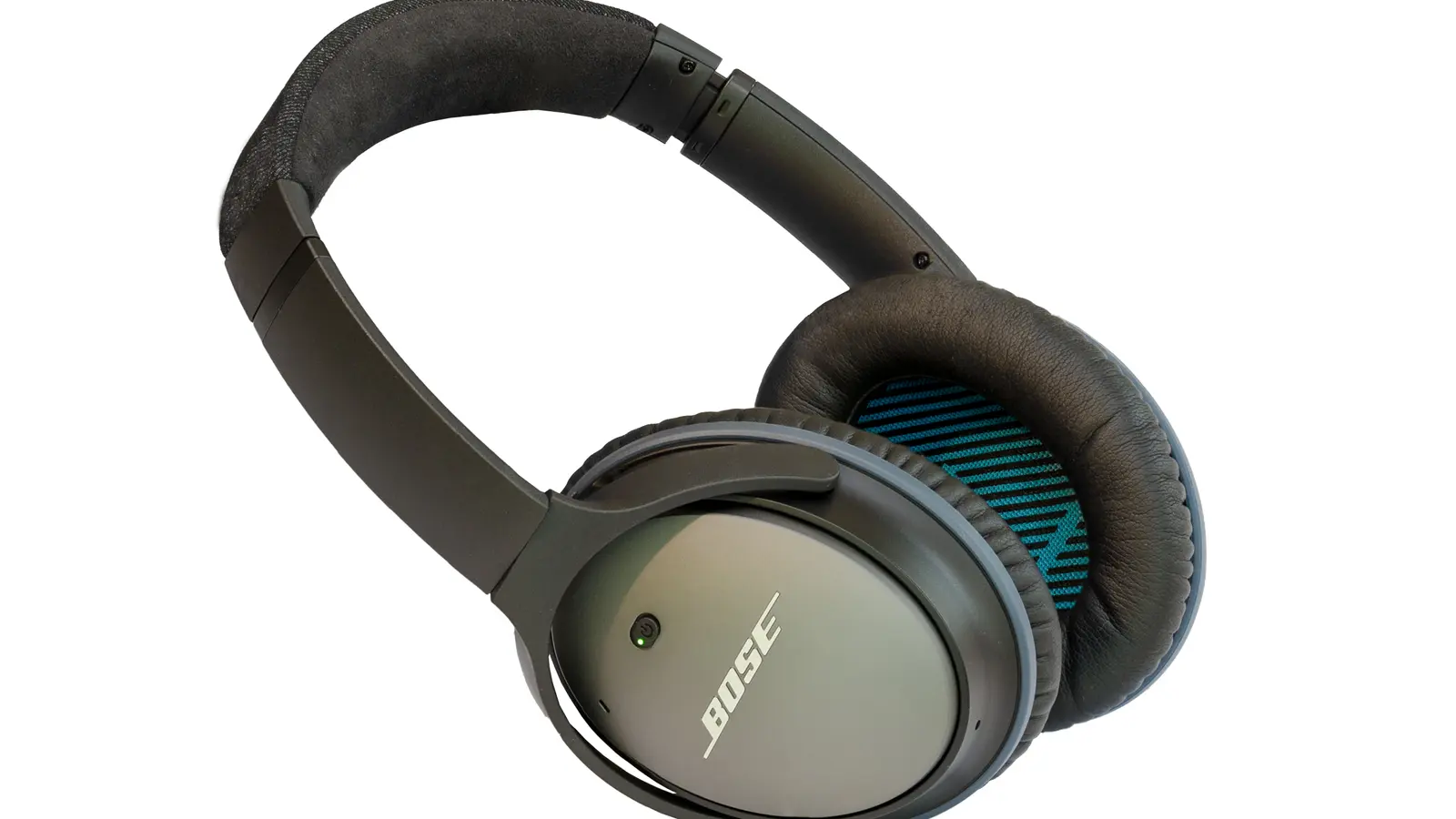
Microphones, signal processing and speakers create controlled anti-noise inside the ear cup
The short answer
Noise cancellation does not erase sound throughout a room. It creates a small controlled acoustic zone near each ear. Because sound changes with position and time, the headphones must measure, calculate and respond quickly enough for the corrective wave to arrive where it matters.
Sound is a changing pressure field
Air molecules oscillate around their resting positions as pressure variations travel. Frequency describes oscillation rate, amplitude relates to pressure magnitude and phase describes timing within the cycle.
Microphones sample environmental noise
Feedforward microphones listen outside the ear cup, feedback microphones listen nearer the ear and hybrid systems use both. Placement changes what each sensor can predict and correct.
A processor calculates anti-noise
Digital or analogue electronics filter the microphone signal to account for delay, speaker response, ear-cup acoustics and the changing fit around a listener’s head.
Destructive interference reduces amplitude
When a pressure increase from noise meets a properly timed pressure decrease from the speaker, their values add toward zero. Imperfect amplitude or timing leaves residual sound.
Low frequencies are easier to predict
Engine hum and ventilation noise change relatively slowly, giving the system time to estimate the next cycle. Short, high-frequency transients demand faster response and vary sharply with position.
Passive isolation remains important
Cushions, enclosure mass and a good seal physically impede sound. This passive layer is especially valuable at higher frequencies that active control handles less consistently.
Fit changes the result
Glasses, hair, ear shape, pad wear and head movement alter leakage and the acoustic path. Adaptive algorithms update filters as those conditions change.
Cancellation has spatial limits
The anti-noise is optimized around the eardrum region. A waveform that cancels at one location can reinforce sound elsewhere, which is why headphones are more practical than silencing an open room.
Listening safety still depends on volume
Reducing background noise may let listeners choose a lower playback level, but active cancellation does not make excessively loud music safe. Exposure level and duration still matter.
Common misconceptions
Noise-cancelling headphones do not produce literal silence, remove every voice or violate energy conservation. The speaker adds controlled sound energy whose pressure pattern reduces selected noise at the ear. Active cancellation is also different from simple soundproofing, although both can work together.
How scientists know
Engineers measure attenuation with microphones in artificial ears, acoustic manikins and human listeners. Frequency-response and transfer-function tests reveal performance by pitch, while adaptive-control experiments measure delay, stability, seal leakage, movement and transient response.
Why are airplane engines reduced so well?
Their strong, steady low-frequency components are comparatively predictable.
Why can voices still be heard?
Speech changes rapidly across many frequencies and reaches the ear through leakage and the listener’s body.
Does ANC damage hearing?
The technology itself is not a substitute for safe playback levels and exposure times.
Why do some people feel pressure?
Reduced low-frequency sound and system response can create a pressure-like perception without changing cabin pressure.
Does ANC work without music?
Yes, powered active cancellation can operate independently of programme audio on many models.
Key takeaways
- Microphones measure noise near the listener.
- A processor generates a timed inverse waveform.
- Interference reduces sound mainly in a small zone around the ear.
- Passive sealing and active control complement one another.
Continue exploring
- How sound travels
- Why we hear echoes
Sources and further reading
Keep exploring.
We’ll email you when the first edition is ready.
Last updated October 29, 2026.

Barnakle Editorial Team
Barnakle Editorial Team is the collective byline used for Barnakle’s editorial articles. The contributor profile explains the team identity and links to the publication’s editorial policies.
More from the editorial team →