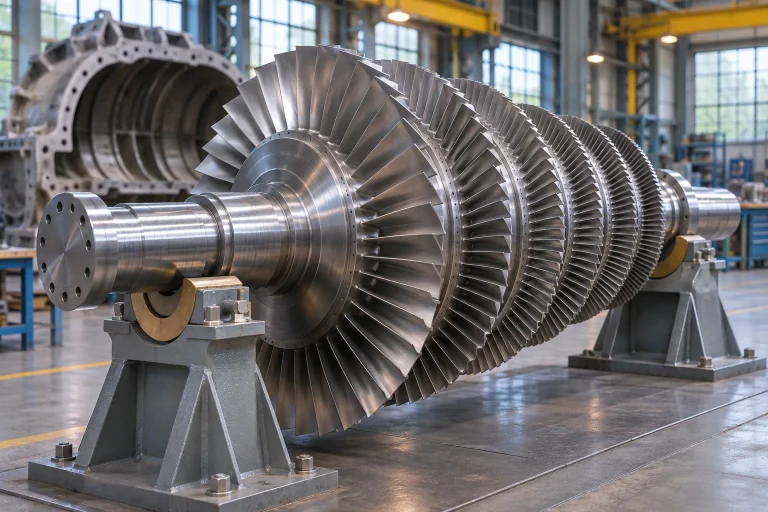
A flywheel stores energy in the motion of a spinning rotor. An input of work speeds the rotor up, increasing its rotational kinetic energy. When the system supplies useful energy, the rotor slows down. In electrical storage equipment, a motor-generator connects that mechanical motion with an electrical circuit. [1, 3]
The wheel is not a source of unlimited power. It holds energy supplied earlier, with losses during storage and conversion. Its usefulness comes from being able to accept energy and return it when needed, often over short intervals that matter to a machine or electricity network. [5]
How can a spinning object contain stored energy?
Any moving material has kinetic energy. In a rotating object, the different parts travel around the axis at different linear speeds. Material farther from the axis moves faster than material closer in when both complete each revolution together. The whole rotor's energy adds up across that moving mass. [2]
Physicists express the result as E = ½ Iω². Here I is the moment of inertia, which describes the mass distribution about the chosen axis, and ω is angular speed. The equation separates two design questions: how the rotor's mass is arranged and how quickly the rotor turns. [2]
An ordinary stationary disc has the same material as it did a moment earlier while spinning, but it lacks that rotational kinetic energy. The stored resource is associated with motion, rather than a chemical change inside the rotor.
What happens when a flywheel charges?
In an electrical flywheel system, power supplied to the motor produces torque on the rotor. The rotor accelerates and its kinetic energy rises. During discharge, the rotating assembly drives the generator, transferring energy back into electrical form while its speed falls. [3]
The U.S. Department of Energy's account of the Amber Kinetics demonstration describes this motor-generator sequence directly. The project combined a spinning rotor with sensing and electrical control, allowing charging and discharge to be managed as part of a grid-connected system. [4]
The control equipment is an essential part of that example. A spinning object on its own is not a complete electrical storage installation. The system must control the exchange of energy between a changing rotor speed and the circuit receiving or supplying power. [4]
Why does rotation speed matter so much?
Speed appears squared in the energy equation. For the same rigid rotor and axis, doubling angular speed would multiply its rotational energy by four. Halving speed would leave one quarter of that energy, rather than one half. Those are mathematical comparisons, not operating instructions for a real machine. [2]
The relationship also explains why discharge need not bring a rotor to a complete stop. Useful energy can be taken from a permitted speed interval. How much is available depends on the difference between the energy at the upper and lower speeds, along with conversion losses. [6]
For an illustrative comparison, imagine a rotor slowing from a chosen speed to half that speed. In the idealized equation, it has given up three quarters of its initial rotational energy. That arithmetic says nothing about whether a particular machine is designed to use that entire interval.
Why aren't all flywheels made as heavy as possible?
Mass is only one factor. Its distribution, allowable speed, material properties and the rest of the system all matter. Sandia's description distinguishes steel rotors from composite rotors, while explaining that both store energy through the same basic rotational mechanism. Different material choices permit different engineering compromises. [3]
A heavier rotor and a faster rotor are therefore not interchangeable solutions. Increasing either introduces consequences for supports, loads and the surrounding assembly. A useful storage design must coordinate the rotor with bearings, containment and the equipment that exchanges power with it. [3, 6]
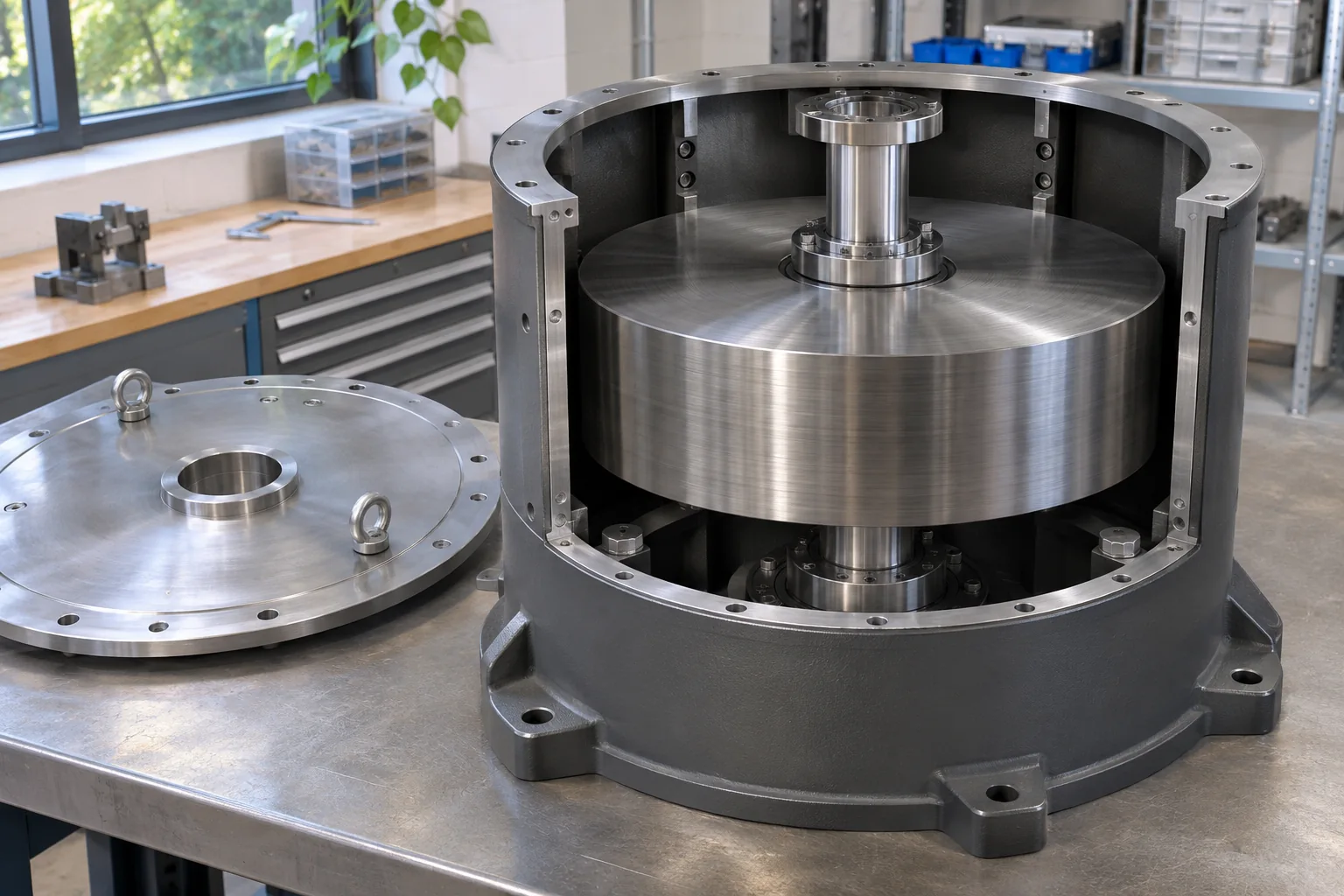
Nor does the wheel's appearance alone reveal its storage capacity. Two cylindrical housings can conceal different rotors, operating ranges and auxiliary equipment. A photograph can illustrate the principle without providing enough information to calculate the complete system's performance.
Why use a vacuum and magnetic bearings?
Air resists a fast-moving rotor, and conventional bearings also introduce friction. Both processes remove useful rotational energy and produce heat. Many storage designs reduce these losses by placing the rotor in a low-pressure enclosure and using magnetic bearings to reduce mechanical contact. [1, 6]
These measures reduce losses rather than abolishing them. A flywheel still has an energy budget that includes conversion and supporting equipment. It should not be described as continuing forever once set spinning, or as recovering every unit of electricity used to charge it. [5, 6]
The enclosure serves a different function from the rotating mass. Seeing a sealed cylinder from outside does not mean the cylinder itself is spinning. The rotor turns within a supporting assembly, and its surroundings are designed for that behavior.
Where did the idea come from?
Flywheels long predate electrical storage installations. They have been used in mechanical systems to smooth the delivery of power when the input arrives in pulses. A rotating mass can accept energy during one part of a cycle and return some during another, reducing changes in motion. [6]
That familiar mechanical role helps explain the modern system. Electrical power electronics and motor-generators extend the exchange to an electrical network, but the central store remains rotational motion. A flywheel does not need to become an electrochemical battery to provide a storage service.
Is energy capacity the same as power capacity?
No. Energy capacity describes the amount available to store or deliver, commonly measured electrically in watt-hours. Power capacity describes a rate of energy transfer, measured in watts. A system that delivers a large burst of power may still have a relatively short discharge duration. [5]
Imagine two ideal stores holding the same energy. One releases it quickly, while the other releases it slowly. Their energy amounts can match while their output rates differ. This is why one headline power figure cannot establish how long a flywheel can support a load.
What makes flywheels useful on an electricity grid?
Storage can help balance electricity supply and demand. Flywheels are among the technologies used for rapid responses to short-term fluctuations, including services concerned with power quality and grid frequency. This is a different task from supplying an entire region through a long period without generation. [1, 5]
The appropriate role depends on the actual design and the service required. The basic operating cycle remains easy to follow: electricity speeds a rotor up, rotation holds the energy, and generation slows the rotor down. Losses and operating limits determine how much of the earlier input can be returned.
Keep exploring
Compare the motor that puts a rotor in motion with the chemical storage used inside a battery.
- How Do Electric Motors Turn Electricity into Motion?
- How Batteries Work: Chemical Reactions, Voltage and Capacity
Sources and further reading
Flywheel principles checked November 17, 2026, using physics and institutional energy sources. The illustration is conceptual; historical project descriptions are examples, not current product specifications.
- U.S. Environmental Protection Agency — Electricity Storage
- OpenStax, University Physics Volume 1 — Moment of Inertia and Rotational Kinetic Energy
- Sandia National Laboratories — Technologies for energy storage flywheels and superconducting magnetic energy storage (2000 abstract)
- U.S. Department of Energy — Amber Kinetics Flywheel Energy Storage Demonstration (2017)
- U.S. Energy Information Administration — Energy storage for electricity generation
- Climate Technology Centre & Network — Flywheels: mechanisms, losses and applications
Keep exploring.
One remarkable idea at a time—nature, science, history and beyond.
Last updated November 24, 2026.

Barnakle Editorial Team
Barnakle Editorial Team is the collective byline used for Barnakle’s editorial articles. The contributor profile explains the team identity and links to the publication’s editorial policies.
More from the editorial team →