

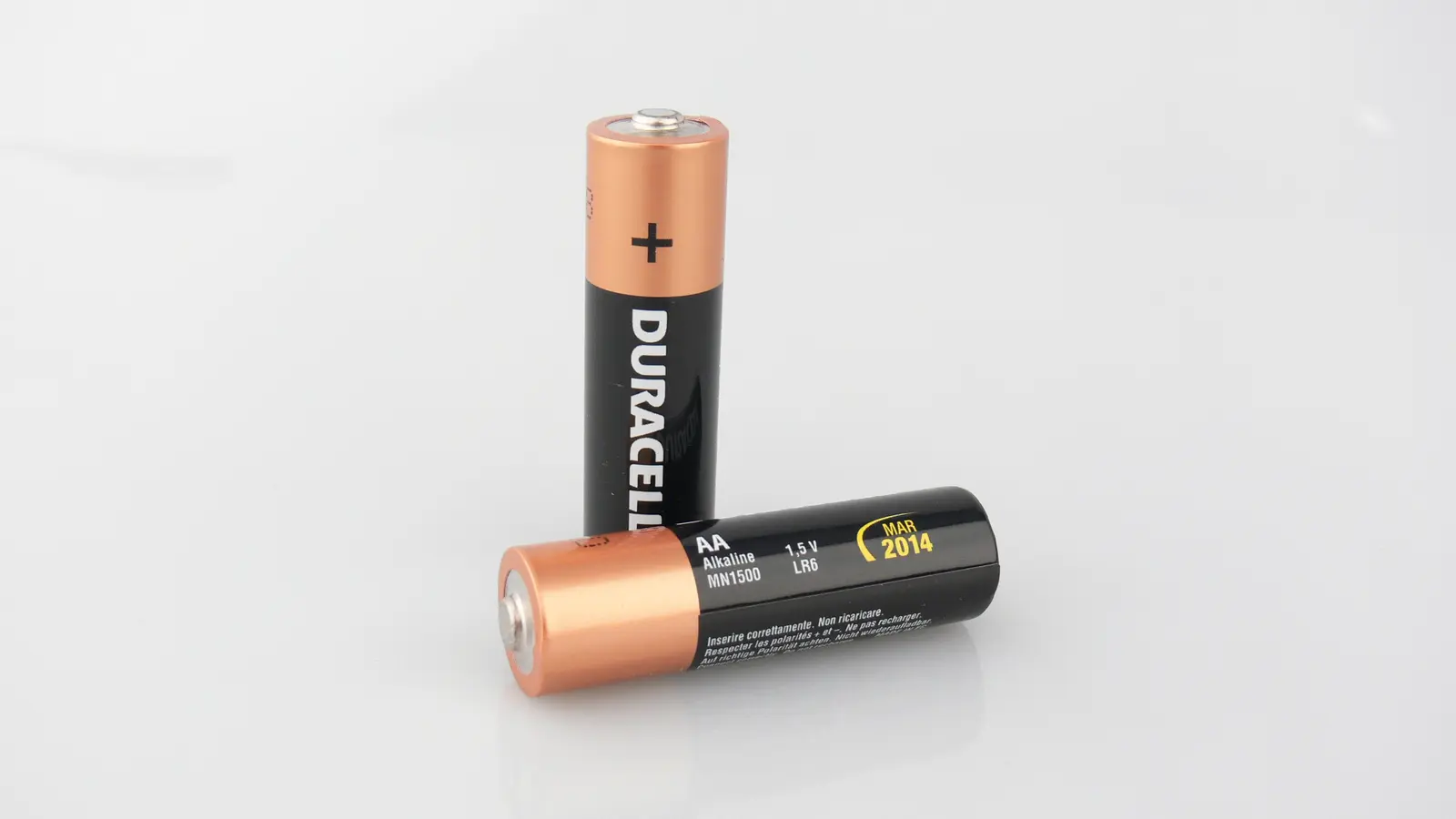
Separated chemical reactions push electrons through a circuit while ions move inside the cell
The short answer
A battery stores energy in chemicals capable of undergoing a redox reaction. Its two electrodes and electrolyte keep oxidation and reduction partly separated. When a circuit closes, electrons travel through the external device from one electrode toward the other, while ions move through the electrolyte to maintain charge balance. Rechargeable batteries use external electrical energy to reverse much of the chemistry.
A battery does not store loose electricity like water in a tank. It stores chemical free energy and creates a voltage because its electrode materials have different tendencies to give up or accept electrons. The circuit controls where those electrons travel, making their motion useful.
A cell has two electrodes
The anode and cathode host different chemical reactions. During discharge, oxidation releases electrons at the anode and reduction consumes them at the cathode.
Understanding A cell has two electrodes means separating the immediate mechanism from the conditions that change its strength, timing or visibility. Researchers measure those variables independently, compare natural examples and test whether the explanation predicts new observations. That turns a plausible story into an evidence-based account.
The evidence comes from methods that fail in different ways. Direct observation establishes what occurs, instruments quantify structure or timing, experiments isolate candidate causes and models test whether known physical or biological rules reproduce the pattern. Agreement among methods is stronger than repetition of one memorable example.
Context also matters. Scale, composition, temperature, geometry, environment and measurement limits can change an outcome without overturning the underlying process. Accurate reporting preserves this variation, states uncertainty and avoids turning a useful explanation into a universal rule.
A practical explanation should identify what would change the observation. Following that question reveals the limits of present evidence and the next measurement needed.
This mechanism connects a reader-level question with a broader scientific principle. Following matter, energy or information through each stage shows where the explanation is established, where natural variation enters and why a superficially similar event may have another cause.
Scientists also test alternatives rather than stopping at the first plausible account. A strong explanation predicts several linked observations, survives controlled comparison and specifies where it should fail. That approach keeps a clear answer accurate without hiding complexity.
The electrolyte carries ions
Electrolyte permits ionic motion but usually blocks easy electron flow. This forces electrons through the external wire when a conductive path is available.
Understanding The electrolyte carries ions means separating the immediate mechanism from the conditions that change its strength, timing or visibility. Researchers measure those variables independently, compare natural examples and test whether the explanation predicts new observations. That turns a plausible story into an evidence-based account.
The evidence comes from methods that fail in different ways. Direct observation establishes what occurs, instruments quantify structure or timing, experiments isolate candidate causes and models test whether known physical or biological rules reproduce the pattern. Agreement among methods is stronger than repetition of one memorable example.
Context also matters. Scale, composition, temperature, geometry, environment and measurement limits can change an outcome without overturning the underlying process. Accurate reporting preserves this variation, states uncertainty and avoids turning a useful explanation into a universal rule.
A practical explanation should identify what would change the observation. Following that question reveals the limits of present evidence and the next measurement needed.
This mechanism connects a reader-level question with a broader scientific principle. Following matter, energy or information through each stage shows where the explanation is established, where natural variation enters and why a superficially similar event may have another cause.
Scientists also test alternatives rather than stopping at the first plausible account. A strong explanation predicts several linked observations, survives controlled comparison and specifies where it should fail. That approach keeps a clear answer accurate without hiding complexity.
A separator prevents direct contact
Porous separators allow ions through while keeping electrodes apart. If electrodes touch, an internal short can release energy rapidly and create heat.
Understanding A separator prevents direct contact means separating the immediate mechanism from the conditions that change its strength, timing or visibility. Researchers measure those variables independently, compare natural examples and test whether the explanation predicts new observations. That turns a plausible story into an evidence-based account.
The evidence comes from methods that fail in different ways. Direct observation establishes what occurs, instruments quantify structure or timing, experiments isolate candidate causes and models test whether known physical or biological rules reproduce the pattern. Agreement among methods is stronger than repetition of one memorable example.
Context also matters. Scale, composition, temperature, geometry, environment and measurement limits can change an outcome without overturning the underlying process. Accurate reporting preserves this variation, states uncertainty and avoids turning a useful explanation into a universal rule.
A practical explanation should identify what would change the observation. Following that question reveals the limits of present evidence and the next measurement needed.
This mechanism connects a reader-level question with a broader scientific principle. Following matter, energy or information through each stage shows where the explanation is established, where natural variation enters and why a superficially similar event may have another cause.
Scientists also test alternatives rather than stopping at the first plausible account. A strong explanation predicts several linked observations, survives controlled comparison and specifies where it should fail. That approach keeps a clear answer accurate without hiding complexity.
Voltage reflects chemical potential
Electrode materials differ in electrochemical potential. Their difference creates electromotive force, measured as open-circuit voltage under defined conditions.
Understanding Voltage reflects chemical potential means separating the immediate mechanism from the conditions that change its strength, timing or visibility. Researchers measure those variables independently, compare natural examples and test whether the explanation predicts new observations. That turns a plausible story into an evidence-based account.
The evidence comes from methods that fail in different ways. Direct observation establishes what occurs, instruments quantify structure or timing, experiments isolate candidate causes and models test whether known physical or biological rules reproduce the pattern. Agreement among methods is stronger than repetition of one memorable example.
Context also matters. Scale, composition, temperature, geometry, environment and measurement limits can change an outcome without overturning the underlying process. Accurate reporting preserves this variation, states uncertainty and avoids turning a useful explanation into a universal rule.
A practical explanation should identify what would change the observation. Following that question reveals the limits of present evidence and the next measurement needed.
This mechanism connects a reader-level question with a broader scientific principle. Following matter, energy or information through each stage shows where the explanation is established, where natural variation enters and why a superficially similar event may have another cause.
Scientists also test alternatives rather than stopping at the first plausible account. A strong explanation predicts several linked observations, survives controlled comparison and specifies where it should fail. That approach keeps a clear answer accurate without hiding complexity.
Current depends on the complete circuit
Closing a switch provides an electron path. Reaction rates, internal resistance and the load determine how much current flows and how terminal voltage changes.
Understanding Current depends on the complete circuit means separating the immediate mechanism from the conditions that change its strength, timing or visibility. Researchers measure those variables independently, compare natural examples and test whether the explanation predicts new observations. That turns a plausible story into an evidence-based account.
The evidence comes from methods that fail in different ways. Direct observation establishes what occurs, instruments quantify structure or timing, experiments isolate candidate causes and models test whether known physical or biological rules reproduce the pattern. Agreement among methods is stronger than repetition of one memorable example.
Context also matters. Scale, composition, temperature, geometry, environment and measurement limits can change an outcome without overturning the underlying process. Accurate reporting preserves this variation, states uncertainty and avoids turning a useful explanation into a universal rule.
A practical explanation should identify what would change the observation. Following that question reveals the limits of present evidence and the next measurement needed.
This mechanism connects a reader-level question with a broader scientific principle. Following matter, energy or information through each stage shows where the explanation is established, where natural variation enters and why a superficially similar event may have another cause.
Scientists also test alternatives rather than stopping at the first plausible account. A strong explanation predicts several linked observations, survives controlled comparison and specifies where it should fail. That approach keeps a clear answer accurate without hiding complexity.
Energy and power are different
Energy describes how much work a battery can deliver; power describes how quickly. High current can increase losses and reduce accessible capacity.
Understanding Energy and power are different means separating the immediate mechanism from the conditions that change its strength, timing or visibility. Researchers measure those variables independently, compare natural examples and test whether the explanation predicts new observations. That turns a plausible story into an evidence-based account.
The evidence comes from methods that fail in different ways. Direct observation establishes what occurs, instruments quantify structure or timing, experiments isolate candidate causes and models test whether known physical or biological rules reproduce the pattern. Agreement among methods is stronger than repetition of one memorable example.
Context also matters. Scale, composition, temperature, geometry, environment and measurement limits can change an outcome without overturning the underlying process. Accurate reporting preserves this variation, states uncertainty and avoids turning a useful explanation into a universal rule.
A practical explanation should identify what would change the observation. Following that question reveals the limits of present evidence and the next measurement needed.
This mechanism connects a reader-level question with a broader scientific principle. Following matter, energy or information through each stage shows where the explanation is established, where natural variation enters and why a superficially similar event may have another cause.
Scientists also test alternatives rather than stopping at the first plausible account. A strong explanation predicts several linked observations, survives controlled comparison and specifies where it should fail. That approach keeps a clear answer accurate without hiding complexity.
Recharge drives chemistry backward
A charger applies voltage in the opposite direction, moving electrons and ions toward a higher-energy arrangement. Side reactions prevent perfect reversibility.
Understanding Recharge drives chemistry backward means separating the immediate mechanism from the conditions that change its strength, timing or visibility. Researchers measure those variables independently, compare natural examples and test whether the explanation predicts new observations. That turns a plausible story into an evidence-based account.
The evidence comes from methods that fail in different ways. Direct observation establishes what occurs, instruments quantify structure or timing, experiments isolate candidate causes and models test whether known physical or biological rules reproduce the pattern. Agreement among methods is stronger than repetition of one memorable example.
Context also matters. Scale, composition, temperature, geometry, environment and measurement limits can change an outcome without overturning the underlying process. Accurate reporting preserves this variation, states uncertainty and avoids turning a useful explanation into a universal rule.
A practical explanation should identify what would change the observation. Following that question reveals the limits of present evidence and the next measurement needed.
This mechanism connects a reader-level question with a broader scientific principle. Following matter, energy or information through each stage shows where the explanation is established, where natural variation enters and why a superficially similar event may have another cause.
Scientists also test alternatives rather than stopping at the first plausible account. A strong explanation predicts several linked observations, survives controlled comparison and specifies where it should fail. That approach keeps a clear answer accurate without hiding complexity.
Heat affects performance and safety
Cold slows ion movement and reactions. Excess heat accelerates degradation, and some chemistries can enter thermal runaway after damage or improper charging.
Understanding Heat affects performance and safety means separating the immediate mechanism from the conditions that change its strength, timing or visibility. Researchers measure those variables independently, compare natural examples and test whether the explanation predicts new observations. That turns a plausible story into an evidence-based account.
The evidence comes from methods that fail in different ways. Direct observation establishes what occurs, instruments quantify structure or timing, experiments isolate candidate causes and models test whether known physical or biological rules reproduce the pattern. Agreement among methods is stronger than repetition of one memorable example.
Context also matters. Scale, composition, temperature, geometry, environment and measurement limits can change an outcome without overturning the underlying process. Accurate reporting preserves this variation, states uncertainty and avoids turning a useful explanation into a universal rule.
A practical explanation should identify what would change the observation. Following that question reveals the limits of present evidence and the next measurement needed.
This mechanism connects a reader-level question with a broader scientific principle. Following matter, energy or information through each stage shows where the explanation is established, where natural variation enters and why a superficially similar event may have another cause.
Scientists also test alternatives rather than stopping at the first plausible account. A strong explanation predicts several linked observations, survives controlled comparison and specifies where it should fail. That approach keeps a clear answer accurate without hiding complexity.
Chemistry determines trade-offs
Alkaline, lead-acid, nickel-metal hydride and lithium-ion cells use different materials. Energy density, cost, cycle life, voltage, safety and recyclability must be balanced.
Understanding Chemistry determines trade-offs means separating the immediate mechanism from the conditions that change its strength, timing or visibility. Researchers measure those variables independently, compare natural examples and test whether the explanation predicts new observations. That turns a plausible story into an evidence-based account.
The evidence comes from methods that fail in different ways. Direct observation establishes what occurs, instruments quantify structure or timing, experiments isolate candidate causes and models test whether known physical or biological rules reproduce the pattern. Agreement among methods is stronger than repetition of one memorable example.
Context also matters. Scale, composition, temperature, geometry, environment and measurement limits can change an outcome without overturning the underlying process. Accurate reporting preserves this variation, states uncertainty and avoids turning a useful explanation into a universal rule.
A practical explanation should identify what would change the observation. Following that question reveals the limits of present evidence and the next measurement needed.
This mechanism connects a reader-level question with a broader scientific principle. Following matter, energy or information through each stage shows where the explanation is established, where natural variation enters and why a superficially similar event may have another cause.
Scientists also test alternatives rather than stopping at the first plausible account. A strong explanation predicts several linked observations, survives controlled comparison and specifies where it should fail. That approach keeps a clear answer accurate without hiding complexity.
Common misconceptions
A dead battery is not necessarily empty of all chemical energy, and electrons do not normally travel through the electrolyte from one terminal to the other. The familiar positive and negative labels also depend on whether a rechargeable cell is discharging or being charged; electrochemical reaction roles are the precise guide.
Clear shorthand is valuable only when it preserves the causal chain. It becomes misleading when it substitutes a label for a mechanism, confuses association with cause or extends evidence beyond tested conditions.
How scientists know
Electrochemists use potentiostats, impedance spectroscopy, calorimetry, microscopy, diffraction and chemical analysis. Charge–discharge cycling measures capacity and degradation, while abuse testing examines shorts, overcharge, heat and mechanical damage.
No single measurement carries the conclusion. Observations, experiments, theory and repeated records provide independent checks, while disagreement can reveal an uncontrolled variable or a question requiring a better test.
Frequently asked questions
Why do batteries lose charge in storage?
Slow side reactions consume active material even without an external load.
Why does cold weaken a battery?
Ion transport and reaction rates slow, raising internal resistance.
Can every battery be recharged?
No. Primary cells are not designed for safe reversible cycling.
What does capacity mean?
It measures charge available under specified conditions, often in ampere-hours.
Why recycle batteries?
They contain valuable materials and may create fire or pollution hazards in ordinary waste.
Key takeaways
- Batteries store chemical rather than free electrical energy.
- Electrons use the outer circuit while ions move internally.
- Voltage comes from electrode potential difference.
- Rechargeability depends on reversible chemistry and control.
Continue exploring
Sources and further reading
Keep exploring.
One remarkable idea at a time—nature, science, history and beyond.
Sources and further reading
Barnakle uses credible primary and authoritative sources wherever possible.
- U.S. Department of Energy — How batteries work
- https://www.energy.gov/eere/articles/how-does-lithium-ion-battery-work
- Argonne National Laboratory — Battery science
- https://www.anl.gov/cse/batteries
- NIST — Battery safety and measurement
- https://www.nist.gov/topics/batteries
- Electrochemical Society — Battery basics
- https://www.electrochem.org/battery
Last reviewed October 7, 2026.

Barnakle Editorial Team
A member of the Barnakle editorial team, exploring remarkable ideas with clarity, curiosity and care.
More from this author →