Desiccants keep an enclosed space drier by taking up water vapor from the surrounding air. Silica gel, a common material inside drying packets, provides a large internal surface on which water molecules can collect. Removing some vapor changes the moisture conditions around the packaged object. [1, 2]
The water does not vanish. It becomes associated with the desiccant, which has a finite capacity under a given set of conditions. The packet, the enclosure, the product and the outside environment together determine how long the arrangement can provide useful moisture control. [1, 4]
How can hard little beads take up water?
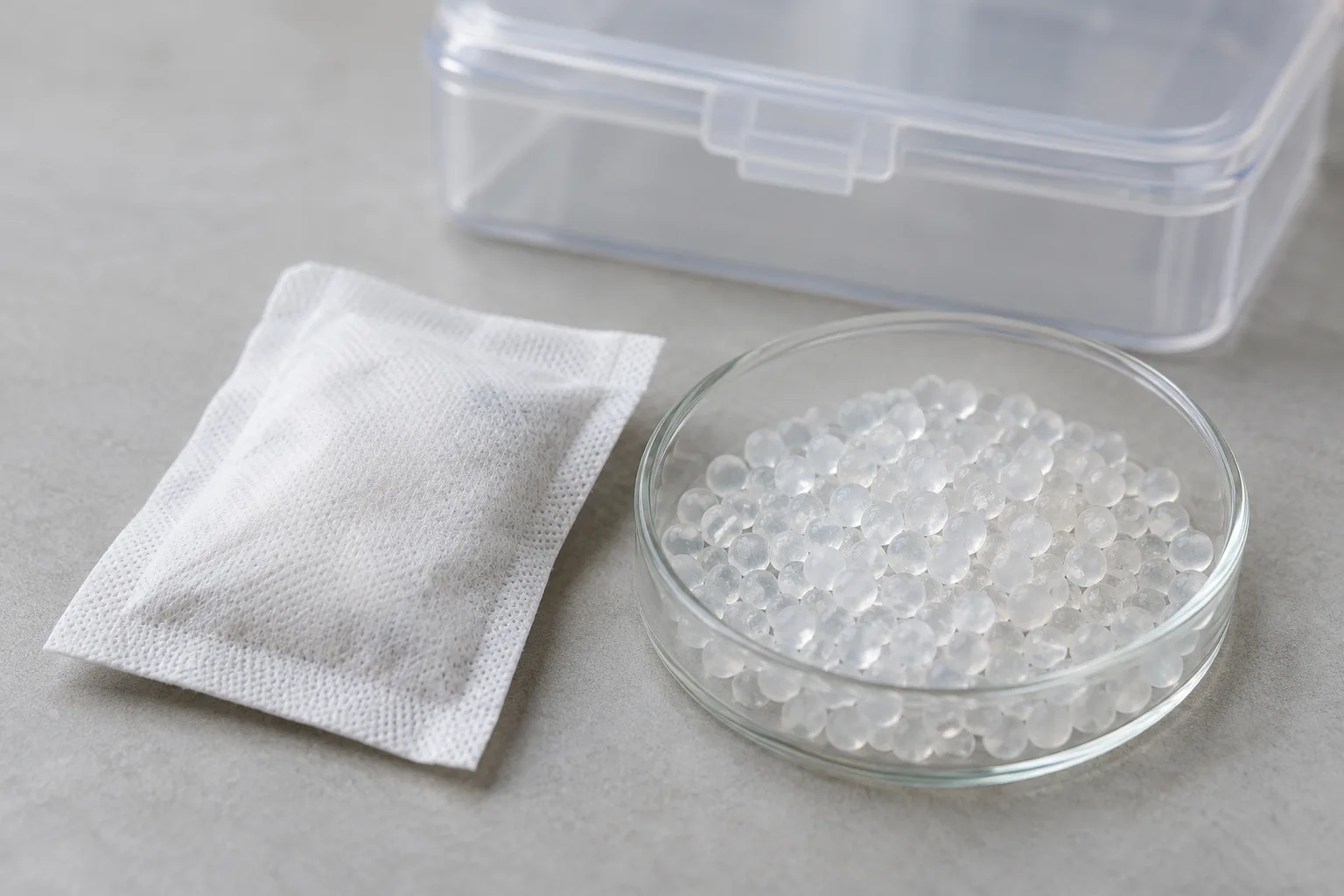
Silica gel has an irregular, porous structure with a network of very small spaces. Its internal surfaces greatly exceed the outer surface that a person can see. Water molecules can attach within this network, allowing beads that feel solid and dry to contain adsorbed moisture. [2, 3]
The relevant surface is therefore not just the shiny outside of each bead. Imagine a building with many internal rooms compared with a solid block of the same external dimensions. The analogy helps explain hidden area, although the pores in silica gel operate at molecular scales rather than as miniature rooms.
Sanner's technical account describes surface silanol groups that can interact with water through hydrogen bonding. The detailed chemistry gives water an affinity for the surface; the porous architecture supplies abundant places for that interaction to occur. [3]
Is adsorption the same as absorption?
The similar words describe different processes. Adsorption concerns molecules accumulating at surfaces. Absorption involves uptake into the bulk of a material. In silica gel, the surfaces of internal pores are central, so adsorption is the more precise term for the principal drying mechanism. [2]
“Sorption” is a broader term that can cover uptake without specifying which mechanism dominates. Desiccants are a category of materials selected for their affinity for moisture, and that category includes more than one composition or physical process. Every moisture-control packet should not be assumed to contain identical beads. [2, 3]
This distinction also explains why using a sponge as an analogy has limits. A sponge commonly takes up visible liquid through relatively large spaces. A silica-gel packet can act on invisible vapor before any droplet appears on the object it is protecting.
Why does the sachet let moisture in?
A packet must allow water vapor to reach the drying material while containing the particles. Commercial desiccants can be supplied as sachets, canisters or chambers integrated into packaging. The appropriate format provides access to the enclosed air without scattering loose desiccant through the product. [3]
The outside package has another job: limiting the entry of moisture from the wider environment. These two barriers therefore serve different purposes. Vapor access to the desiccant is useful inside the enclosure, while unrestricted exchange with humid outside air would continually add to the load. [3, 4]
For an illustrative comparison, place an idealized moisture sorbent inside a small sealed box and another inside an open room. The room presents a much larger and continually replenished environment. Equal amounts of material would not be expected to create equal moisture conditions in those two settings.
Why does the surrounding container matter?
Real enclosures exchange moisture through gaps, joints and construction materials. The Canadian Conservation Institute distinguishes air movement through leakage points from gas diffusion through materials or still air. A box that looks closed is not automatically an impermeable barrier to water vapor. [4]
Improved sealing can reduce the rate at which outside moisture enters, giving a sorbent a smaller ongoing task. Repeated opening, poor seals or permeable walls can change the balance. The desiccant cannot be evaluated as though the rest of the package were irrelevant. [4]
This is a rate problem as well as a capacity problem. A material might be capable of taking up additional water, yet the system still needs vapor to reach it at a rate appropriate to the changing conditions.
What happens when the beads are already holding water?
A sorbent exchanges water with its surroundings until an equilibrium condition is reached. At a fixed temperature, its equilibrium moisture content depends on the surrounding relative humidity. Silica gel holding more water is not necessarily finished in every possible environment, but it may no longer maintain the desired dry conditions in its current one. [1]
Relative humidity is also not simply a count of water molecules. It expresses the vapor condition relative to saturation at the same temperature. Changes in temperature can therefore alter relative humidity and the moisture balance even when nobody has added a fresh splash of water. [1, 6]
The practical question is more specific than “are the beads wet?” It is whether the material and enclosure can keep the surrounding conditions within the range required for the object.
Does every silica gel have the same capacity?
No. Pore structure and the conditions of use affect the relationship between water uptake and humidity. Experimental measurements are needed to characterize that relationship, rather than assigning every bead one universal percentage or assuming it behaves identically at all temperatures. [5]
A 2025 study of silica gel examined adsorption and desorption under controlled conditions and found distinct paths for uptake and release. This hysteresis means that moisture history can matter: drying a material and wetting it toward the same external condition need not follow the same curve. [5]
Those findings should be applied at their proper scale. A measurement on a specified silica gel in a research setup is not a performance guarantee for an unidentified packet found in a drawer. Material identity, previous exposure and current conditions still matter. [5]
Can a desiccant release water again?
Yes. Sorption can be reversed by changing conditions so that the material gives up moisture, a process called desorption. Engineered drying systems use this principle in a regeneration stage, then return the desiccant to another moisture-removal cycle. The complete cycle requires energy and appropriate control. [2]
That principle does not establish a safe or effective heating procedure for every packaged desiccant. Sachet construction and additives can differ, as can the material itself. A general explanation of reversibility is different from instructions for treating a particular consumer packet.
Is the driest possible environment always best?
No. Conservation science treats incorrect relative humidity as a material-specific problem. Some objects are vulnerable to dampness, while others can be harmed by drying or by repeated fluctuations. The appropriate aim can be a stable range rather than the lowest possible reading. [6]
Museum moisture control demonstrates this wider role. A sorbent can help buffer changes by taking up and releasing water, while the enclosure slows exchange with the room. Understanding the object and monitoring its environment are as important as knowing that silica gel attracts moisture. [1, 6]
A little packet works because of a large hidden surface and a controlled exchange of water vapor. Its limits are equally physical: it must have useful capacity, moisture must reach it, and the enclosure must keep the continuing load manageable. The beads are one part of that moisture-control system.
Keep exploring
Compare water vapor collecting as droplets on glass with liquid water moving through the fibers of a paper towel.
Sources and further reading
Desiccant behavior checked November 17, 2026, against conservation science, engineering guidance and experimental research. This is a mechanism explanation, not a drying or regeneration protocol for a particular product.
- Canadian Conservation Institute — Silica Gel: Passive Control of Relative Humidity, Technical Bulletin 33
- ASHRAE Handbook — Sorbents and Desiccants, chapter 32
- Sanner — Desiccant FAQs: Silica Gel & Moisture Protection
- Canadian Conservation Institute — Airtightness Measurement of Display Cases and Other Enclosures, Technical Bulletin 38
- Hraiech et al., Scientific Reports (2025) — Experimental characterization of silica gel adsorption and desorption isotherms
- Canadian Conservation Institute — Agent of Deterioration: Incorrect Relative Humidity
Keep exploring.
One remarkable idea at a time—nature, science, history and beyond.
Last updated November 24, 2026.

Barnakle Editorial Team
Barnakle Editorial Team is the collective byline used for Barnakle’s editorial articles. The contributor profile explains the team identity and links to the publication’s editorial policies.
More from the editorial team →