Shape-memory alloys can recover an earlier shape because their internal crystal structure changes in a reversible way. In a typical thermal shape-memory cycle, deformation imposed in a lower-temperature state is recovered when heating drives the material into another solid phase. The “memory” is a materials response, not a stored electronic instruction. [1]
Nitinol, a nickel-titanium alloy, is a familiar example. Its unusual behavior connects the arrangement of atoms with motion visible at the scale of a wire, spring or engineered actuator. Temperature, stress and processing history all help determine which response a particular sample can produce. [3, 4]
What changes inside the metal?
The important transformation takes place between solid crystal structures, commonly called martensite and austenite. Sandia describes it as a reversible, diffusionless, solid-to-solid martensitic transformation. The atoms rearrange cooperatively; the material does not have to melt and be cast again to change its response. [5]
Martensite can exist in different orientation variants. Under suitable deformation, their arrangement changes so that the sample takes on a new macroscopic shape. A subsequent reverse transformation can restore the earlier form, provided the deformation stayed within the recoverable behavior of the material. [3, 5]
Calling this “remembering” is useful shorthand because the result is so visible. The physical explanation lies in the transformation pathway and the prepared material, rather than in a metal wire recognizing a shape as a person would.
What happens in a simple thermal recovery cycle?
Consider a prepared alloy in its martensitic state. It is deformed and remains in that altered shape after the external force is removed. Heating through the relevant transformation range changes the phase toward austenite, and the alloy recovers its predeformed shape. NASA describes this sequence as the basis of shape-memory actuation. [1]
This differs from an ordinary spring returning immediately when released. The visibly bent shape can persist until a thermal condition changes. The material's state matters as much as its outline: two similar-looking pieces of wire can behave differently if their composition or processing differs. [2, 4]
The example describes a mechanism, not a universal demonstration recipe. A piece of unidentified wire cannot be assigned an appropriate activation temperature or recoverable strain merely by looking at it.
Why are there several transformation temperatures?
Transformation commonly occurs over ranges rather than at one perfectly sharp switching point. Engineers distinguish the start and finish of the change toward martensite from the start and finish of the reverse change toward austenite. Stress also affects the conditions at which transformation occurs. [5]
The path during heating is therefore not necessarily the same as the path during cooling. This dependence on the direction and history of change is part of the material's hysteresis. Describing an alloy with a single “memory temperature” can conceal behavior that matters in an actual mechanism. [2, 5]
An actuator designer must account for the relevant range and load. Beginning a transformation and completing it are different events; a component can pass through a mixture of phases while its mechanical response evolves. [2]
How is the remembered shape established?
The alloy's preparation matters. Manufacturing and heat treatment influence its microstructure and transformation behavior, so the final component is more than a particular mixture of nickel and titanium. Shape recovery depends on a controlled processing history as well as on what happens during a later use cycle. [4]
A 2023 experimental study of nitinol wires examined how heat-treatment time and temperature affected properties including transformation temperature, angular displacement and recovered strain. The measured relationships demonstrate why a treatment that works for one sample should not be assumed to produce the same behavior in every wire. [4]
This is a useful distinction between setting up the material and activating it. Establishing a component's intended response is a manufacturing task. Later heating uses that prepared response; it does not automatically teach an arbitrary metal object whatever shape happens to be convenient.
Is superelasticity the same as heat-triggered memory?
They are related but distinct effects. In thermal shape memory, heating helps recover deformation. In superelastic behavior, a suitably prepared alloy in the appropriate temperature range can recover a large deformation when a mechanical load is removed, without needing a separate heating step at that moment. [2]
The stress-induced transformation is central to that recovery. Research on nitinol describes the growth of martensite during loading and the reverse change during unloading. The resulting stress-strain behavior can differ strongly from the small, approximately linear elastic response familiar from many ordinary metal parts. [3]
This is why “it springs back” does not fully identify the mechanism. Rubber, a steel spring and a superelastic alloy may all recover shape, but their internal routes to recovery differ. The outward action alone is not enough to classify the material.
Can shape recovery do useful work?
Yes. If the recovering alloy acts against a load, its transformation can supply mechanical work. NASA identifies this as a reason to develop compact actuators: devices that turn an input, such as heat, into controlled movement. A wire can pull, while other geometries can deliver twisting motion. [1]
The energy still needs an input. A thermally activated component does not produce free motion indefinitely. Heating, cooling, the opposing load and the rest of the mechanism all belong in the operating cycle. A material capable of recovery is one element of a complete actuator.
Has this been demonstrated beyond a small wire?
NASA reported using a nickel-titanium-hafnium shape-memory-alloy torque-tube actuator to move a full-sized F/A-18 wing section in a ground demonstration. Electrical heating and controlled cooling enabled the removed wing section to move through a range of positions. This was a documented engineering test, not merely an artist's concept. [6]
The named alloy and actuator arrangement matter. The example does not imply that any nitinol spring can fold an aircraft wing, or that every aircraft uses such a system. It shows how a carefully designed phase-changing component can be integrated into a larger mechanism. [6]
Can an alloy recover from any damage?
No. Recoverable deformation has limits, and repeated loading can introduce fatigue and cracks. Research on nitinol's crack-growth behavior addresses a different question from whether a fresh sample can return to its initial shape once. Both questions matter for the useful life of a component. [3]
Thermal recovery is therefore not a general form of self-repair. A cut, a fracture or excessive permanent deformation cannot be assumed to disappear when the material is warmed. The impressive behavior works within a specific material state and operating range.
The visible “memory” is the result of that organized physical system: preparation establishes the component, stress changes its configuration, and a reversible crystal transformation enables recovery. Understanding those conditions makes the returning wire more interesting than a claim that the metal somehow knows what it used to look like.
Keep exploring
Compare crystal-driven shape recovery with rubber elasticity and the electrical response of piezoelectric materials.
Sources and further reading
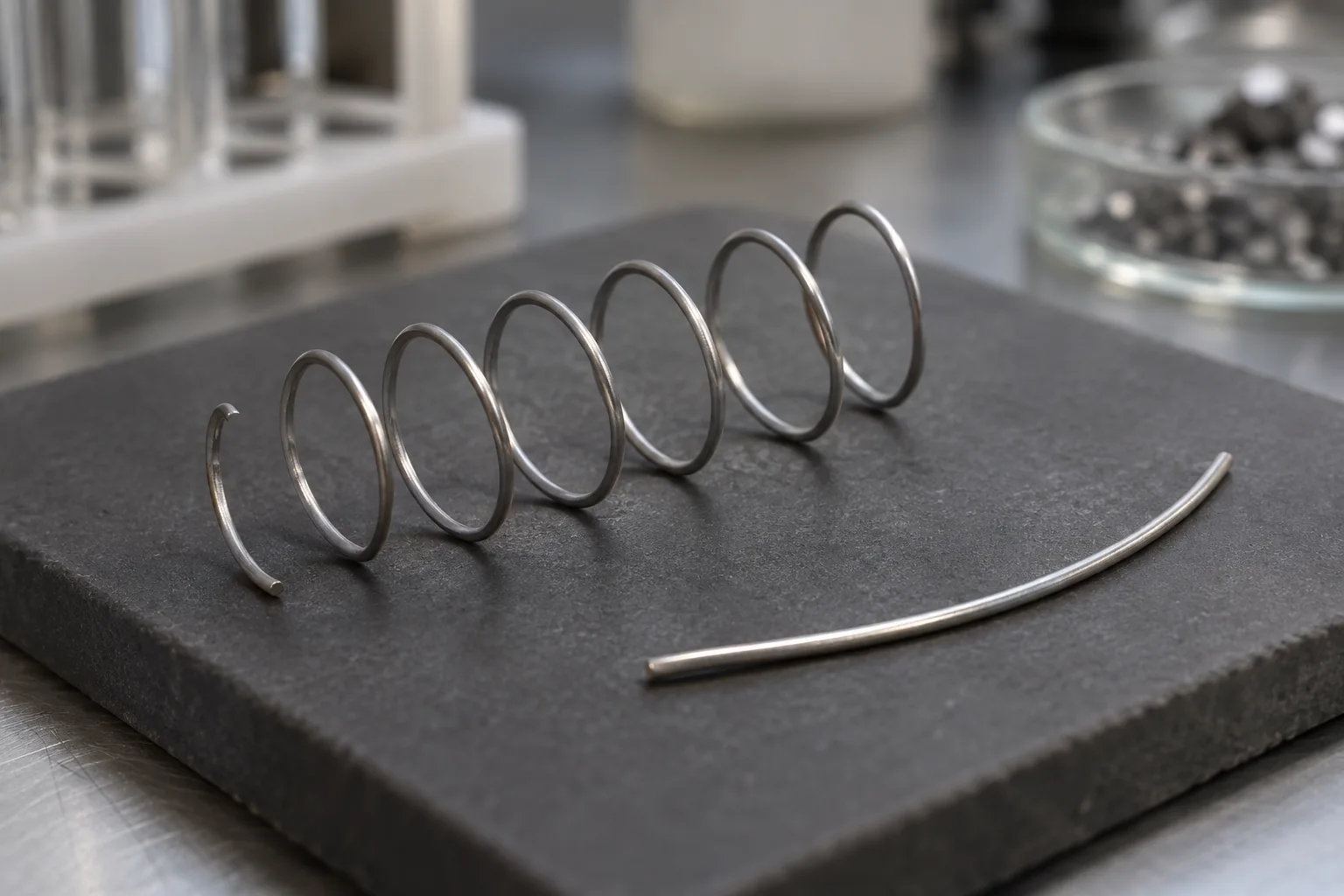
Shape-memory explanations checked November 17, 2026. NASA and research sources distinguish thermal recovery from superelasticity; the wire illustration is not a recorded transformation experiment.
- NASA Technical Reports Server — Potential High-Temperature Shape-Memory-Alloy Actuator Material Identified (2005)
- University of Illinois, Shape Memory and Structures Research Group — Shape Memory Alloys
- McKelvey and Ritchie, University of California, Berkeley — Fatigue-crack growth in superelastic Nitinol (1998 research account)
- Materials (2023) — Effect of Heat Treatment Time and Temperature on the Microstructure and Shape Memory Properties of Nitinol Wires
- Sandia National Laboratories — LAMÉ Manual: Shape Memory Alloy Model, theory
- NASA — Metal with Memory: F-18 Wing Fold (2018 demonstration)
Keep exploring.
One remarkable idea at a time—nature, science, history and beyond.
Last updated November 24, 2026.

Barnakle Editorial Team
Barnakle Editorial Team is the collective byline used for Barnakle’s editorial articles. The contributor profile explains the team identity and links to the publication’s editorial policies.
More from the editorial team →