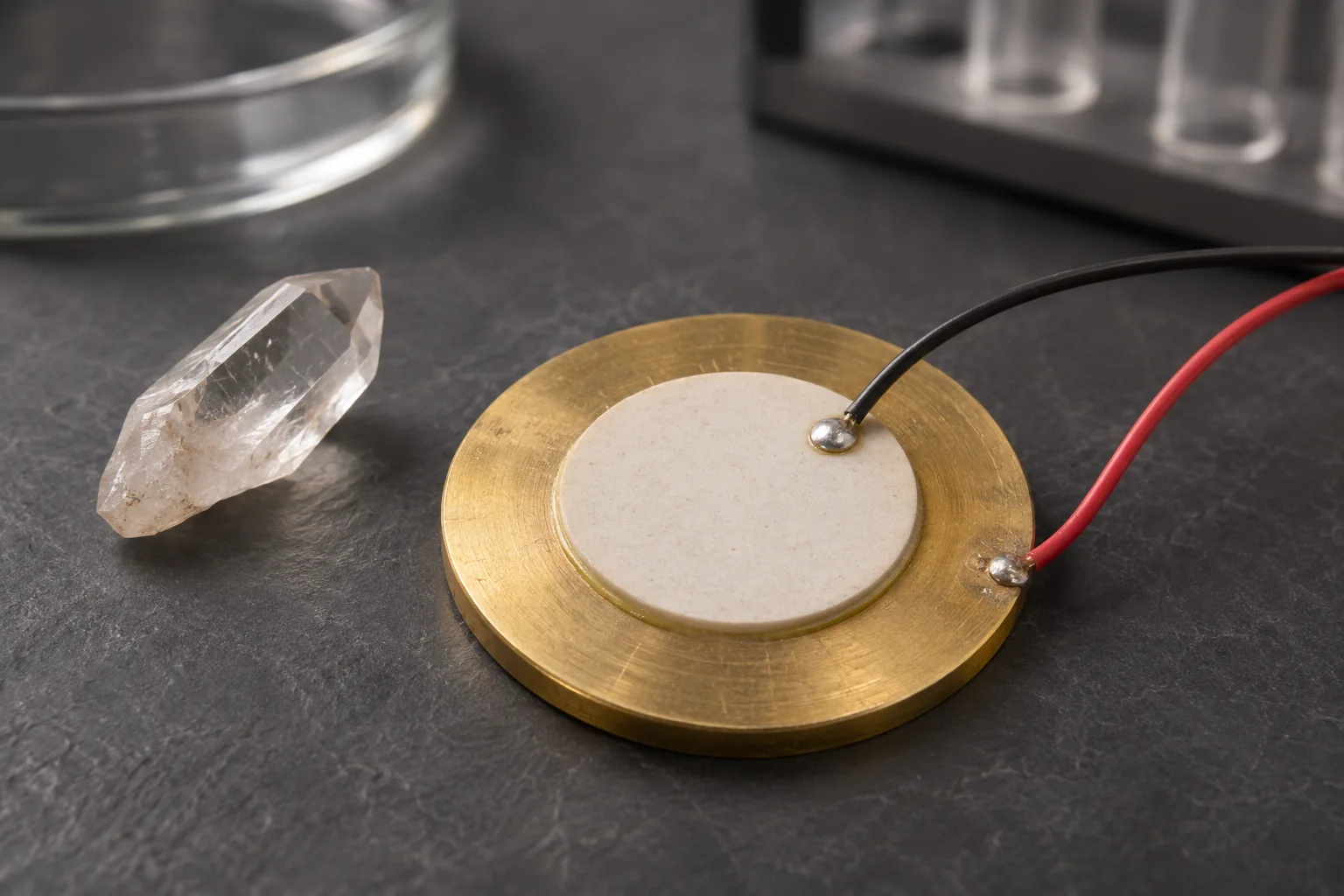
A small ceramic disc can turn a tap into an electrical signal. Apply an electrical signal to a suitable disc and it can bend or vibrate instead. This two-way connection between mechanical force and electricity is called piezoelectricity, and it appears in sensors, precision actuators, sound-producing devices and vibration-energy research.
Piezoelectric materials generate an electrical response because mechanical stress changes their internal polarization. The positions of positive and negative charge shift relative to each other in a way that can be detected at electrodes. The energy comes from the mechanical work done on the material. A piezoelectric element is an energy converter, not a source of free electricity. [1, 2]
What happens inside a piezoelectric material?
Solids contain positive and negative charges, but that does not automatically make every solid piezoelectric. The arrangement of those charges matters. In a suitable structure, deforming the material changes the separation of charge centres and creates a net electrical polarization.
That microscopic change can produce charge at conducting surfaces attached to the material. Connecting those surfaces to a circuit lets the electrical response be measured or used. Reversing the direction of a deformation can reverse the response, depending on the material’s orientation and the way it is loaded. [1]
The term “pressure electricity” is a useful starting point, but mechanical stress includes more than simply squeezing a block from above. Depending on the material and its orientation, stretching, bending or shear can contribute. The direction of force relative to the material’s axes is part of the device design. [3]
It is also worth distinguishing three quantities. Force is the push or pull. Stress describes force distributed over an area. Strain describes the resulting relative deformation. A tiny deformation can produce a useful signal; the material does not have to visibly squash like a sponge.
Charge is not the same thing as voltage
Piezoelectric sensor descriptions often begin with charge generated for an applied force. Voltage also depends on the electrical arrangement. In a simplified model, the sensor has capacitance, so the same charge can correspond to different voltages when capacitance changes.
A useful elementary relationship is voltage = charge ÷ capacitance. Consider an illustrative device producing 10 nanocoulombs with a total capacitance of 10 nanofarads. Dividing those values gives 1 volt. If the same charge is distributed across 100 nanofarads, the result is 0.1 volt. These are invented round numbers for explaining the relationship, not specifications for a particular piezoelectric component.
That example shows why a voltage alone does not fully describe performance. The connected electronics, wiring and measurement instrument affect what is observed. Sensor manufacturers use charge amplifiers or other conditioning circuits to turn a high-impedance charge signal into a form that instruments can handle reliably. [3, 4]
Why a steady load does not produce endless current
Press a piezoelectric element and a charge response appears. Hold the same force indefinitely and it does not keep delivering a fresh supply of energy. In real sensor systems, charge can leak through internal and external electrical paths, so the observed signal changes with time.
This is why piezoelectric sensors are especially associated with changing forces, vibrations and pressure pulses. Conventional arrangements are not ideal for indefinitely measuring an unchanging weight. Properly designed systems can make measurements that are approximately static over a suitable interval, but that interval and the electronics must be understood. [4, 5]
A helpful comparison is a signal that announces a change rather than a fuel tank feeding a machine. The electrical output can be excellent for detecting a knock or vibration even when it would be a poor choice for continuously powering a lamp. Sensitivity and useful energy supply are different requirements.
Releasing the load also matters. The material returns toward its earlier condition, producing another electrical response. For repeated harvesting, the mechanical input must keep changing: repeated bending, vibration or impacts provide new work to convert.
The same effect works in reverse
In the direct piezoelectric effect, mechanical loading produces an electrical response. In the converse effect, an applied electric field produces mechanical deformation. These are linked aspects of the same electromechanical coupling. [2]
With a slowly changing electrical input, a device can make a small controlled movement. With an alternating input, it can vibrate. If it is attached to another structure, that movement can drive the structure too. A familiar piezoelectric sounder uses motion to disturb the surrounding air, turning an electrical signal into sound.
Resonance is important in many designs. A structure responds particularly strongly around certain natural vibration frequencies. Driving a piezoelectric resonator near an appropriate frequency can therefore create a much larger response than driving it far away from that frequency, within the limits of its design.
A quartz clock illustrates why this two-way behavior is useful. Electrical circuitry sustains a predictable mechanical oscillation and uses it as a timing reference. The quartz does not power the clock by itself; the circuit supplies energy to maintain operation. Barnakle’s separate quartz-watch explainer follows that timing process in more detail.
Quartz, ceramics and polymers are different choices
Quartz is a naturally occurring piezoelectric crystal, but many practical devices use manufactured materials. Some piezoelectric ceramics can be prepared with a useful overall orientation of their internal electric domains. Flexible polymers offer another set of mechanical possibilities. The word “piezoelectric” identifies an effect, not one uniform substance. [1]
Choosing a material involves trade-offs. A designer may care about sensitivity, stiffness, temperature behavior, mechanical durability, cost or how the material couples to the surrounding object. A material that works well in one sensor is not automatically the best choice for a flexible wearable device or an underwater transducer.
Research also considers environmental and manufacturing constraints. The University of Bath describes work on porous, lead-free piezoelectric structures intended to combine favorable electrical behavior with different mechanical properties. Such work addresses a design problem, rather than establishing that one new material can replace every existing ceramic. [6]
Can footsteps and vibrations generate useful electricity?
Yes, mechanical movement can be converted to electrical energy and stored through a suitable circuit. The difficult question is how much usable energy a complete system delivers under realistic conditions. A visible voltage pulse is only one part of that assessment.
Researchers at the University of Bath have highlighted inconsistent reporting in piezoelectric energy-harvesting studies and argued for standardized measurement protocols. Relevant experimental details are needed to compare devices and reproduce claims. A large voltage figure without the corresponding loading and circuit information can be misleading. [7]
Consider a hypothetical capacitor storing 1 microjoule of energy after each event. Even ten events every second would correspond to only 10 microwatts before further losses. That arithmetic does not predict a commercial floor tile or vibration harvester. It shows why a small amount per event remains small unless the rate and scale are sufficient.
Useful harvesting opportunities therefore depend on the available mechanical energy, how often it occurs, how effectively the device couples to it and what the powered equipment needs. A low-power sensor that occasionally transmits a reading is a different task from charging a laptop. Claims should be matched to a defined task.
Piezoelectricity versus other electrical effects
| Effect | What changes | Key distinction |
|---|---|---|
| Piezoelectricity | Mechanical stress and electrical polarization are coupled. | A suitable material can act as both sensor and actuator. |
| Piezoresistivity | Electrical resistance changes under strain. | A resistance change is not the same as generating piezoelectric charge. |
| Electromagnetic induction | Changing magnetic flux produces an electrical response. | It relies on magnetic-field relationships rather than piezoelectric deformation. |
These mechanisms can all appear in equipment that responds to movement, but they should not be treated as interchangeable. Knowing the conversion mechanism helps explain why one device needs a coil and magnet, another needs a resistive bridge and another uses electrodes on a crystal or ceramic.
Questions about piezoelectric materials
Do all crystals make electricity when squeezed?
No. The internal structure and the direction of loading matter. Being crystalline alone is not enough to guarantee a usable piezoelectric response.
Does a piezoelectric disc contain a battery?
The effect itself does not require a hidden battery. Mechanical work can produce the electrical response, while a device operating as an actuator receives electrical energy from its driving circuit.
Why can a tiny sensor produce a surprisingly high voltage?
A small amount of charge on a small capacitance can correspond to a high voltage. That does not, by itself, imply a large current or a large amount of available energy.
Is a quartz watch powered by the crystal?
No. The crystal provides a useful resonant element. The watch’s energy source and electronics maintain and count the oscillation.
What is the most useful question to ask about a harvesting claim?
Ask for energy or power delivered to a specified load under stated mechanical conditions. That is more informative than an isolated open-circuit voltage.
Explore related questions
Sources and further reading
Sources checked November 13, 2026. Research abstracts and institutional overviews are identified below; a full-text review of restricted papers is not claimed.
- IEEE Technology Navigator — Piezoelectric effect
- COMSOL official theory documentation — Piezoelectricity
- Kistler — Piezoelectric effect: definition, applications and measurement
- PCB Piezotronics — General Piezoelectric Theory
- Static Force Measurement Using Piezoelectric Sensors (2021) — research paper
- University of Bath — Porous Piezoelectric Single Crystal Sensors research project
- University of Bath — Are piezoelectrics good for generating electricity? How to evaluate them
Keep exploring.
One remarkable idea at a time—nature, science, history and beyond.
Last updated November 14, 2026.

Barnakle Editorial Team
Barnakle Editorial Team is the collective byline used for Barnakle’s editorial articles. The contributor profile explains the team identity and links to the publication’s editorial policies.
More from the editorial team →