The short answer
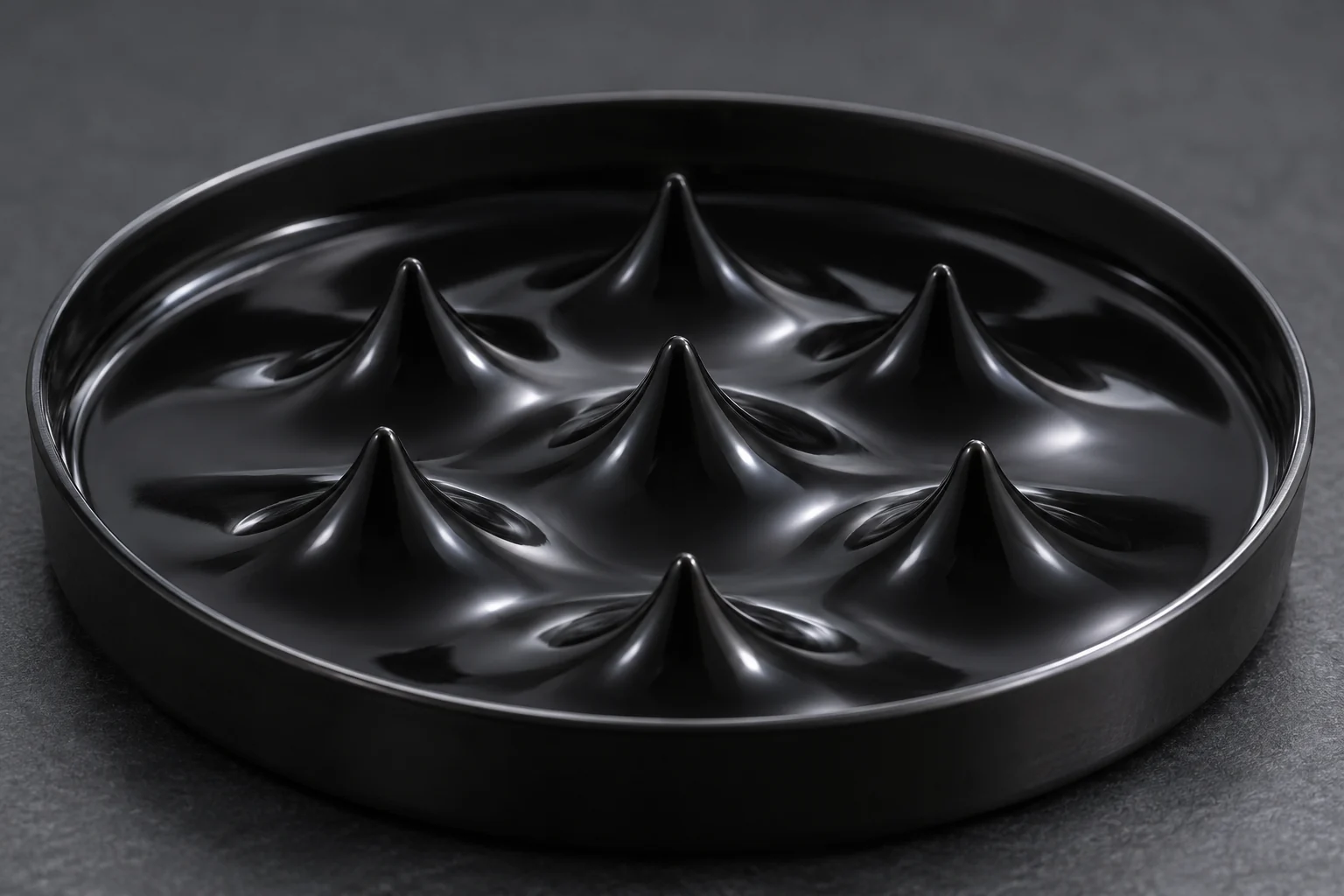
Ferrofluid forms spikes when an applied magnetic field makes a peaked liquid surface favourable compared with a flat one. Magnetic effects compete with gravity, which resists lifting liquid upward, and surface tension, which resists creating extra surface area. Above suitable conditions, a flat surface can become unstable and develop peaks. This is called the normal-field or Rosensweig instability. [1][2]
The black points are not little iron needles. Each visible spike is a shape made by the liquid as a whole. Its ability to rise, merge and flatten again makes the material look extraordinary, but the behaviour follows physical forces acting on a specially formulated suspension.
What ferrofluid contains
A ferrofluid is a liquid carrier containing extremely small magnetic particles. A stabilizing dispersant or surfactant helps keep the particles from clumping together. The carrier, particle properties and stabilizing chemistry all matter to the resulting material. [3]
The particles are small enough that their suspension behaves very differently from a jar of coarse iron filings stirred into oil. Brownian motion and the coating help maintain a dispersed colloidal system rather than an ordinary pile of visible grains.
The word fluid therefore describes a real aspect of the material. It can flow and change shape even while responding strongly to a nearby magnet. A dark appearance does not mean the entire sample is a molten metal or that every component is magnetic.
How a magnetic field changes the surface
The dispersed particles respond to the applied field, giving the suspension a bulk magnetic response. The field and the material interact, changing the mechanical stresses at the surface.
A small upward deformation can alter the magnetic field around it. Under suitable conditions, the magnetic contribution favours increasing that deformation. The effect must compete with the cost of raising liquid against gravity and increasing its surface area.
That balance is why the surface does not simply stretch into an arbitrarily tall tower. It settles into shapes constrained by all the relevant forces, the amount of liquid and the geometry of the field and vessel. University of Toronto experiments explicitly examine this competition. [2]
Surface tension resists the extra area
A smooth liquid surface tends to minimize its area when other constraints are fixed. Building narrow peaks creates more interface between liquid and air than a relatively flat surface occupying the same footprint.
Surface tension therefore supplies a restoring influence against small, tightly curved deformations. Gravity adds another restoring contribution because raising liquid changes its gravitational potential energy. Magnetism does not cancel either one; it changes the full balance.
A useful comparison is the surface of water disturbed by a small object. The final shape depends on several influences at once. In a ferrofluid demonstration, the magnetic response provides a particularly controllable additional influence, but ordinary fluid mechanics remains present.
Why a threshold appears
At a sufficiently weak applied field, the flat surface can remain stable. A small disturbance then tends to settle rather than growing into a pronounced peak. As conditions change, that same kind of disturbance can become unstable.
The threshold depends on the material and the arrangement. Particle concentration, magnetization, surface tension, density, liquid depth and container geometry can all affect observed behaviour. There is no single magnet strength that makes every ferrofluid form the same pattern. [2]
The word instability does not mean the experiment has malfunctioned. It means that a previous configuration no longer restores small disturbances under the new conditions. Pattern formation can be the predictable result of crossing that boundary.
Why the spikes often look regularly spaced
A population of peaks shares a finite supply of liquid and interacts through the surrounding field and surface. Very short-scale deformations incur a strong surface-tension cost, while larger-scale changes have different gravitational and magnetic costs.
The resulting competition can favour characteristic spacings and organized patterns. The exact arrangement changes with depth, boundaries, the field and how the field was applied. A display under a small nearby permanent magnet is not equivalent to an ideal infinitely wide layer in a perfectly uniform field.
This distinction prevents an attractive image from being overinterpreted. A photograph of neat peaks demonstrates that a pattern exists. It does not, without measurements and a model, reveal the complete magnetic field or every material property of the sample.
The visible peaks are much larger than the particles
Individual magnetic nanoparticles are far smaller than the glossy peaks visible to the unaided eye. Many particles and carrier-liquid molecules contribute to each visible structure.
That is why one spike cannot be identified with one particle standing on end. Nor is the dish turning into a forest of solid magnets. The liquid surface is rearranging in response to stresses transmitted through the suspension.
The same distinction appears in many materials: a small-scale ingredient can give a bulk substance a useful property without being the size of its visible shape. Knowing the ingredient and explaining the large-scale pattern are related but separate tasks.
Why moving a magnet changes the design
A nearby magnet produces a field that varies across space. Moving it changes the field’s direction and strength at different parts of the sample, so the forces and resulting liquid geometry change too.
Researchers also impose time-varying fields. MIT experiments combined vertical and rotating fields and produced different patterns depending on the order in which the fields were applied. The result illustrates that the history of a driven fluid can matter alongside its final settings. [4]
It does not follow that a ferrofluid can reproduce any requested shape. Its response remains constrained by the physical arrangement and material. An artist’s carefully engineered display may contain more control than a single hand-held magnet provides.
Do the spikes remain after the magnet is removed?
In a typical demonstration, removing the applied field allows gravity and surface tension to bring the surface back toward a flatter state. How quickly that happens depends on properties such as viscosity and on the experimental conditions.
The liquid may still wet or stain its container. The loss of the spiked shape does not mean the particles or carrier have disappeared. NASA’s account of ferrofluid art describes how difficult material compatibility and staining can be in practical displays. [5]
The distinction is between reversible shape response and perfect reversibility of every consequence. A demonstration can visibly recover its smooth surface while its container, suspension chemistry or long-term stability still needs attention.
What the same material does beyond demonstrations
Ferrofluids can be held and manipulated by magnetic fields in engineered systems. Applications include seals and thermal-management roles in some loudspeakers, where the useful function is not necessarily a field of visible spikes. [3][5]
Researchers also study droplets, impacts and non-uniform fields. A 2023 study examined how falling ferrofluid drops and magnetic geometry interact to produce different peak arrangements. Its results belong to the tested conditions rather than a universal rule for every black magnetic liquid. [6]
The dramatic surface display is therefore one expression of a wider material property. A practical device may use that magnetic response inside a confined gap where no observer ever sees the liquid make a spike.
Common questions
### Is ferrofluid liquid metal? Usually it is a carrier liquid containing dispersed magnetic nanoparticles, not a metal heated until it melts. Its ingredients and formulation determine its properties.
Can any dark liquid make these spikes?
No. Colour is not the cause. The material needs an appropriate magnetic response and the right balance of forces and geometry.
Are the spikes an exact map of magnetic field lines?
No. Their shapes depend on the coupled field, liquid surface and other forces. They can reveal a response to magnetism without tracing individual field lines like drawn wires.
Why is the surface sometimes smooth beside a magnet?
The local field, material, liquid depth and geometry may not produce the instability. The presence of a magnet alone does not guarantee the same visible pattern in every arrangement.
Keep exploring
Sources and further reading
- University of California, Santa Cruz — Ferrofluid physics demonstration (overview)
- University of Toronto MUSSL — Ferrofluids and surface instability experiments
- Ferrotec — Ferrofluid technology and colloidal stabilization
- MIT — Fluid morphs into startling designs, surprising researchers
- NASA Spinoff — Ferrofluid technology becomes a magnet for pioneering artists
- Research study (2023) — Ferrofluid drop impacts and Rosensweig peak formation in a non-uniform magnetic field (abstract)
Reference review: November 12, 2026.
Keep exploring.
One remarkable idea at a time—nature, science, history and beyond.
Last updated November 14, 2026.

Barnakle Editorial Team
Barnakle Editorial Team is the collective byline used for Barnakle’s editorial articles. The contributor profile explains the team identity and links to the publication’s editorial policies.
More from the editorial team →