The short answer
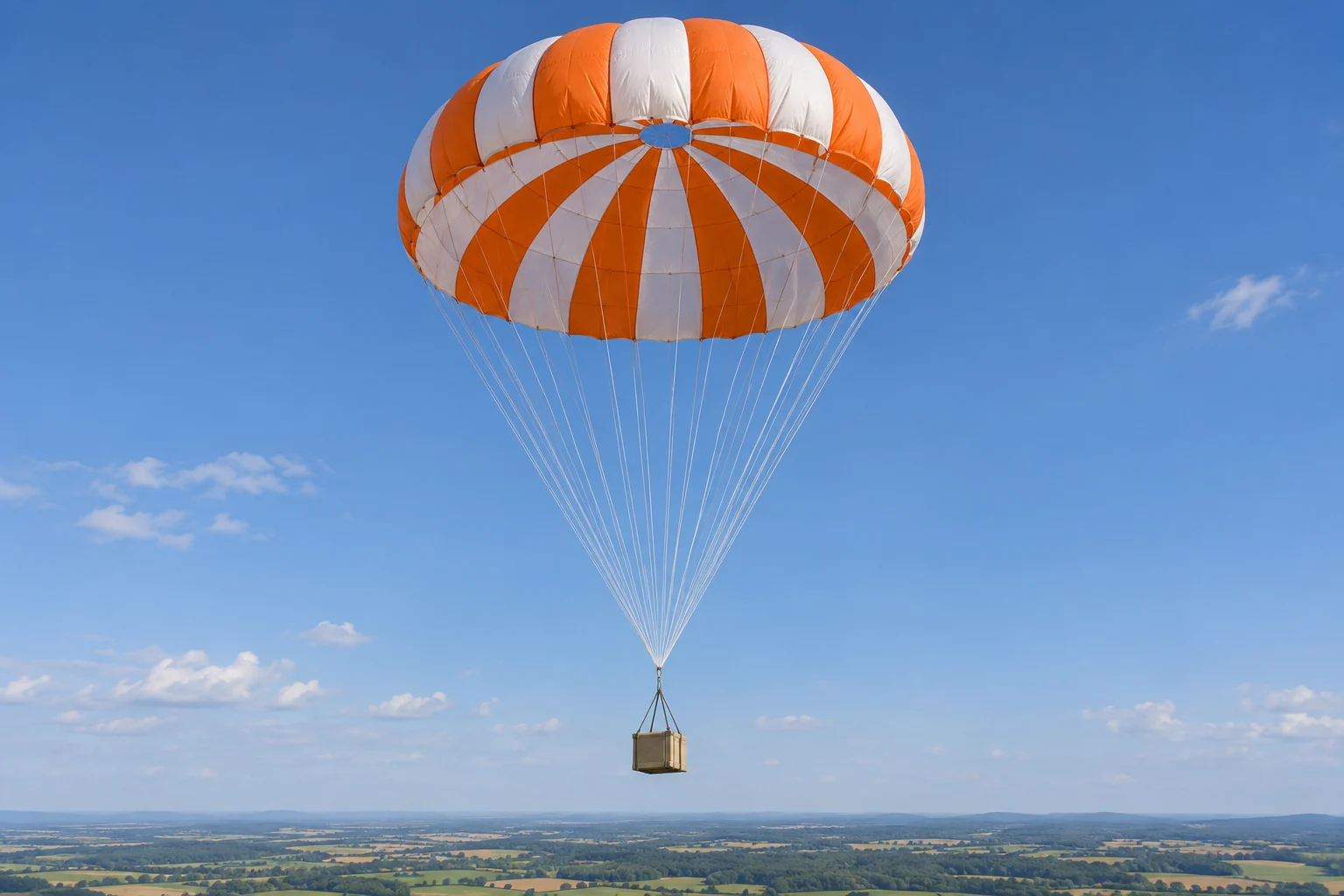
A parachute slows a fall by producing much more aerodynamic resistance than the falling payload would produce alone. Airflow around an inflated canopy creates a force that opposes the motion. When the upward component of the aerodynamic force balances the system’s weight, its downward speed can become approximately steady. Gravity remains active throughout. Some parachutes also generate useful lift and glide forward rather than descending almost vertically. [1][2]
The canopy changes what the moving system presents to the air. That is why a comparatively light piece of fabric can have such a large effect on a much heavier load. Its importance lies in the shape it holds and the airflow it creates, not simply in adding material to the falling object.
What the canopy makes the air do
A descending canopy must displace and redirect air. Pressure differs across its surface, and air separates and circulates around its edges and wake. The resulting aerodynamic forces are transmitted through the suspension system to the load.
Describing this as “catching air” is a useful first impression. It should not suggest that a round canopy becomes a sealed bag holding one permanent cushion of trapped air. Air continues moving through and around the system as it descends. [3]
Fabric permeability, openings, canopy geometry and the arrangement of the lines all influence that flow. Two canopies with equal amounts of cloth can therefore behave differently. What matters is their inflated aerodynamic shape and operating conditions, not only the area of fabric laid flat on a table.
Why larger area usually means more drag
A common simplified drag model is D = one-half × air density × speed squared × drag coefficient × reference area. It organizes several influences on the force: the surrounding gas, the relative speed, the size of the system and its aerodynamic shape. [1]
If the other terms stay the same, increasing area increases drag at a given speed. That is the basic reason a deployed canopy can slow a compact payload so effectively. It presents a much larger aerodynamic surface to the moving air.
The drag coefficient summarizes behaviour that area alone cannot describe. An inflated round canopy, a flat plate and a streamlined body do not all produce the same drag when assigned the same reference area. Published coefficients also need their definitions and operating conditions; a number without those details can be misleading.
Terminal speed is a force balance
Imagine a simple vertical descent after the parachute has fully opened. If the system is falling so quickly that drag exceeds its weight, the downward motion slows. As speed decreases, aerodynamic resistance decreases too, until the forces can balance.
At that balance, acceleration is zero even though downward velocity is not. The payload can continue moving toward the ground at a nearly constant terminal speed. “No acceleration” is different from “not moving.” [1]
The idealized formula also gives useful comparisons. With the same canopy and air conditions, four times the weight would imply twice the terminal speed. With the same weight and shape, four times the reference area would imply half the terminal speed. These are model relationships, not performance estimates for an actual parachute system.
Slowing down is different from opening safely
The steady descent is only one stage. Before it occurs, fabric must leave its container, suspension elements must extend and the canopy must inflate. The forces during that transition can differ greatly from the forces during the later descent.
A fast-moving payload may encounter a large aerodynamic force as the effective area increases. Engineers therefore consider the rate and sequence of inflation as well as the desired final drag. Canopy strength, attachment loads and stability belong to the same design problem. [4]
This is why choosing a large sheet from a terminal-speed equation does not specify a complete recovery system. The deployment process, the material’s behaviour and the interaction with the payload all need testing. A successful final shape is only useful if the system can reliably reach it.
Why there may be a hole in the middle
Some round parachutes have a vent or other designed openings. These influence the escape of air and the canopy’s stability. An opening is not automatically a defect or proof that the fabric is failing to “hold the air in.” [4]
The wake and pressure distribution around a bluff canopy can produce unsteady motion. Designers can change those patterns through shape, porosity and vent arrangement. A feature that reduces a little drag may still be useful if it improves the behaviour of the complete descent system.
That trade-off illustrates a wider engineering principle: the maximum possible value of one force is rarely the only objective. Stability, predictable deployment and manageable loads can matter alongside the speed of descent.
Why rectangular parachutes can glide
The familiar dome-shaped drag canopy is not the only kind. A ram-air parachute inflates into an airfoil-like shape. Air entering its cells helps maintain the wing, and the wing generates lift as it moves through the air. [5]
The system can then travel forward while descending. Its gravitational potential energy supplies the energy associated with that unpowered glide, while aerodynamic forces determine its path and rate of descent.
A round cargo canopy and a ram-air wing therefore answer the slowing problem differently. Both interact with the atmosphere, but they need not have the same trajectory, control response or balance of lift and drag. A single drawing of a circular parachute cannot represent every design.
Air density changes what the canopy can achieve
The same shape at the same relative speed does not produce the same aerodynamic force in every atmosphere. Density appears directly in the simplified drag equation. In thinner gas, a system generally needs different area, speed or other design choices to produce the required force.
Mars illustrates the challenge. NASA’s Mars 2020 entry system used a parachute designed and tested for a thin atmosphere and demanding deployment conditions. Its design belongs to an entire entry, descent and landing sequence rather than to a parachute working in isolation. [6]
A parachute cannot provide aerodynamic braking in an ideal vacuum. It needs a surrounding gas to exchange momentum with. This limit is different from whether the system can slow a payload enough in a particular thin atmosphere.
What wind changes
A canopy responds to motion relative to the surrounding air. Air moving across the landscape can carry the descending system sideways. That ground-relative drift is different from the speed through the local air.
This distinction also explains why a nearly steady descent does not guarantee a fixed landing point. The atmosphere itself moves, and its motion can vary with position and height. Predicting the full path requires more information than a vertical drag balance.
Common questions
### Does a parachute make the payload lighter? It does not remove the payload’s mass or switch off its weight. It adds aerodynamic forces that change the resulting acceleration and trajectory.
Why not use the largest possible canopy every time?
A larger system brings different deployment, structural, packaging and stability requirements. Designers select a complete system for a specified load and environment rather than maximizing cloth area alone.
Is terminal speed always constant during the whole fall?
No. The system may be accelerating, inflating or moving through changing air density and winds. A terminal-speed calculation describes a particular force balance under stated conditions.
Is a dandelion fruit a tiny copy of a cargo parachute?
Both can slow a descent by interacting with air, but their structures and detailed flow patterns differ. A porous crown of fine bristles and an inflated fabric canopy are distinct solutions to a related physical problem.
Keep exploring
Sources and further reading
- NASA Glenn Research Center — Velocity during recovery
- Washington State University — How do parachutes work?
- NASA JPL Education — Parachute design
- Embry-Riddle Aeronautical University — Bluff body flows (textbook overview)
- City College of New York — Parachute types and their parts
- NASA Ames — Contributions to the Mars 2020 mission
Reference review: November 12, 2026.
Keep exploring.
One remarkable idea at a time—nature, science, history and beyond.
Last updated November 14, 2026.

Barnakle Editorial Team
Barnakle Editorial Team is the collective byline used for Barnakle’s editorial articles. The contributor profile explains the team identity and links to the publication’s editorial policies.
More from the editorial team →