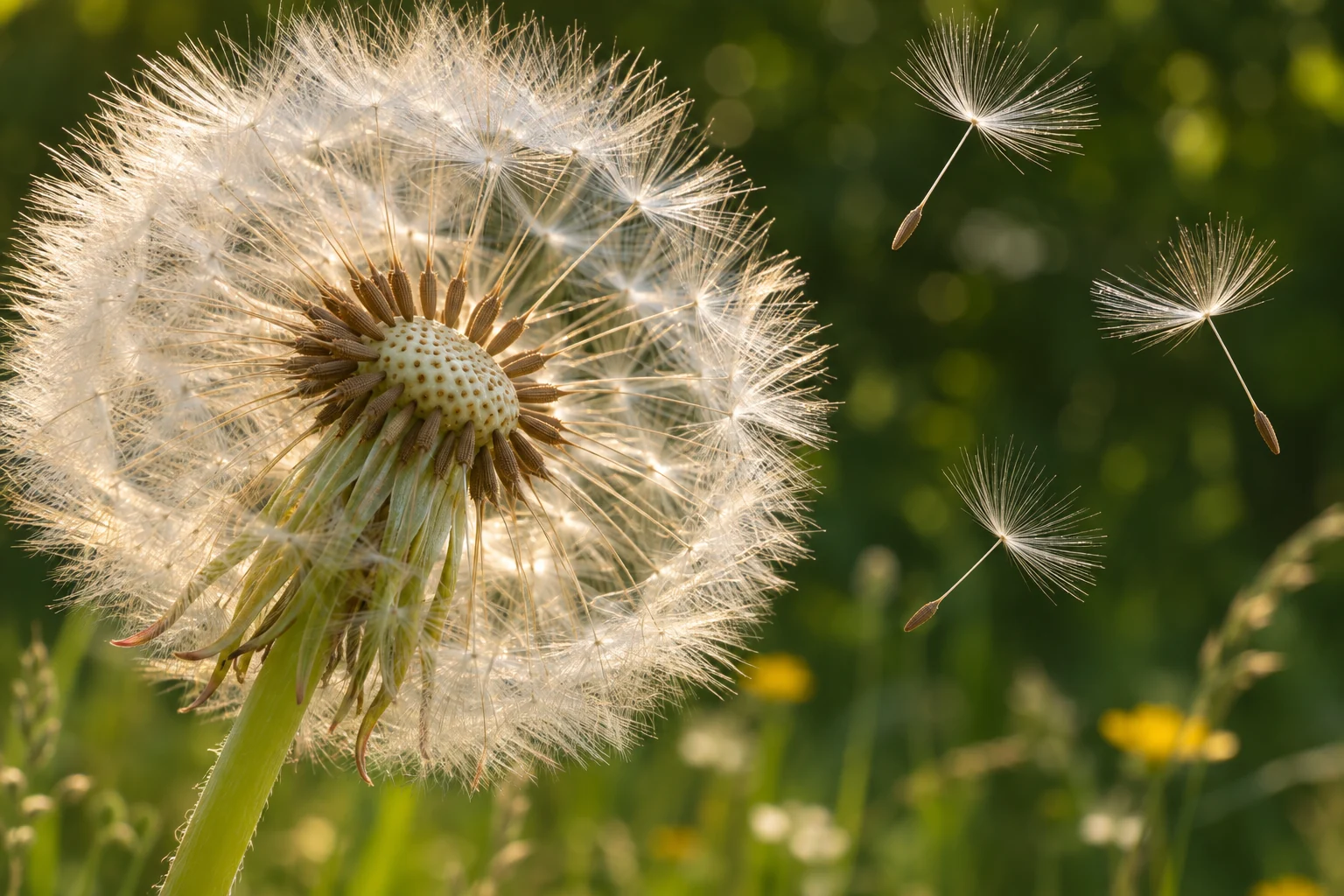
The white fluff is not just a miniature solid parachute. Its carefully spaced hairs organize the air around it.
Quick answer
Dandelion fruits travel with the wind because a crown of fine bristles, called a pappus, produces drag that slows their fall. Air passing through and around the porous crown can form a separated vortex ring in its wake. Slow descent gives horizontal winds more time to carry the fruit. Moisture changes the pappus shape and its dispersal behaviour.
A puff of breath turns a white dandelion globe into a cloud of tiny travellers. Each departing unit seems almost too delicate to be a flying structure: a brown speck, a long narrow stalk and a few translucent threads.
Yet the threads are doing more than adding area. The spaces between them are part of the aerodynamic design. Researchers studying these familiar plants found a flow pattern that makes the phrase “little parachute” useful but incomplete.
What is actually floating?
The object commonly called a dandelion seed is a small dry fruit containing the seed. The featherlike crown is the pappus, connected to the fruit by a slender stalk. Ontario’s identification guide describes these distinct parts, while Kew identifies the pappus as a structure assisting wind distribution. [5] [6]
Botanists use “diaspore” for a dispersal unit. Here, the useful unit includes both the reproductive cargo and its travelling apparatus. Looking only at the brown fruit would miss the structure responsible for much of its distinctive falling behaviour.
The distinction is like separating a parcel from its packaging. Both travel together, but different parts perform different functions. The pappus does not become the new plant’s roots or leaves; it helps deliver the seed-containing fruit to another location.
The basic physics: fall slowly, travel longer
Gravity acts downward. As the fruit falls relative to the air, aerodynamic forces oppose that relative motion. A broad bristly crown increases resistance compared with the small fruit falling alone. Under suitable steady conditions, the forces can balance at a terminal falling speed.
“Terminal” does not mean the end of the journey. It means the speed is no longer increasing under those conditions. The fruit may still travel horizontally with the air, and a rising air current can change its vertical movement relative to the ground.
Consider a simple imaginary comparison: two dispersal units start at the same height in a steady sideways wind. If one takes twice as long to reach the ground, that wind has twice as long to carry it horizontally. Real wind is neither perfectly steady nor uniform, but the example explains why reducing descent speed can improve dispersal without providing any powered forward thrust.
Why the holes between the hairs matter
A solid disk and a very porous crown do not make the same surrounding airflow. In 2018, researchers visualized air around dandelion pappi and identified a ring of recirculating flow separated from the bristles. They called it a separated vortex ring. The porous structure was central to maintaining that flow pattern. [1]
The University of Edinburgh’s account emphasizes the combination of open space, bristles and a stable wake. The finding helps explain how a structure made from very little material can exert useful aerodynamic resistance. It is not necessary to replace all the empty area with a fabric sheet. [2]
This is a valuable change in perspective. We often judge an object only by the solid material visible in a photograph. In fluid mechanics, the arrangement of the empty spaces can be equally consequential because it determines how fluid moves through the structure.
What is a separated vortex ring?
A vortex is rotating fluid. Here, the ring-shaped recirculation is detached from the pappus, rather than attached to it. It has no solid boundary. [1]
It is also not a sealed bubble of special gas. Descriptions that call it an “air bubble” are trying to make an invisible flow structure easier to picture. The mechanism involves moving ordinary air, not the fruit trapping a tiny helium balloon.
The ring belongs to the wake created by the interaction between the pappus and relative airflow. It should not be interpreted as an independent engine pulling the seed upward. Gravity, drag, surrounding winds and the structure of the dispersal unit still set the motion.
How scientists made the invisible flow visible
Wind-tunnel imaging and comparisons with fabricated porous disks helped the team test how porosity changed the wake. [1]
That experimental logic matters. Seeing a seed float establishes that it falls slowly; it does not, by itself, identify why. Flow visualization and controlled comparison provide evidence about the mechanism rather than just a description of the outcome.
What damp weather does to the parachute
The pappus can partially close in humid conditions and close further when wet. Research published in eLife in 2022 found that this shape change altered drag and increased falling speed. It also reduced detachment from the parent plant under the conditions studied. [3]
Those changes have different consequences. A released fruit with a closed pappus can descend faster, while reduced release can keep more fruits attached until conditions change. Measuring only falling speed would therefore miss part of the overall dispersal story.
A related 2022 study investigated the moisture-responsive actuator at the base of the pappus. Its research abstract describes patterned swelling of cell-wall materials as the basis for the movement. This is a material response to water, not a plant making a conscious weather forecast. [4]
Does the plant choose where to land?
No. The researchers’ phrase “informed dispersal” describes a physical response to environmental conditions that changes release and flight properties. It does not mean the plant has thoughts or picks a destination. Their modelling considered how those changes could influence dispersal distances. [3]
It is helpful to distinguish sensitivity from intention. A thermostat responds to temperature without understanding a weather report. Likewise, a structure that changes shape with moisture can alter an organism’s interaction with its environment without requiring a nervous system.
Why there is no single dandelion flight distance
Many fruits land nearby; others travel farther. Release height, surrounding air movement and obstacles affect the journey. A laboratory descent speed alone does not specify a field dispersal distance. [1]
The most useful conclusion is therefore a mechanism rather than a record: slow descent creates opportunities for transport, and a porous, moisture-responsive structure changes those opportunities. A familiar weed offers a compact lesson in how fluid flow and material properties interact.
Frequently asked questions
Do dandelion seeds fly by lift or drag?
The pappus is principally described as a drag-enhancing structure that slows descent. Upward-moving air can carry the whole unit upward relative to the ground. That is different from powered flight.
Would a completely solid pappus work the same way?
No. Porosity changes the airflow. The separated vortex ring observed around the real structure depends on the interaction between its open spaces and surrounding flow. [2]
Why do wet dandelion heads look narrower?
Moisture causes the pappus bristles to draw inward through a swelling-based mechanism at their base. Drying can reverse the response. [4]
Does every drifting fruit contain a seed?
The dispersal structure is a fruit with a seed inside in normal development. Whether a particular seed is viable is a separate biological question; an intact-looking parachute cannot establish that by appearance alone.
Keep exploring
Sources and further reading
- Cummins and colleagues (2018) — A separated vortex ring underlies the flight of the dandelion (accepted manuscript, PDF)
- University of Edinburgh — Dandelion seeds reveal a newly discovered form of natural flight
- Seale and colleagues (2022) — Environmental morphing enables informed dispersal of the dandelion diaspore
- Seale and colleagues (2022) — Dandelion pappus morphing is actuated by radially patterned material swelling (research abstract)
- Ontario Ministry of Agriculture — Dandelion identification
- Royal Botanic Gardens, Kew — Dandelion
Reference review: November 9, 2026.
Keep exploring.
One remarkable idea at a time—nature, science, history and beyond.
Last updated November 9, 2026.

Barnakle Editorial Team
Barnakle Editorial Team is the collective byline used for Barnakle’s editorial articles. The contributor profile explains the team identity and links to the publication’s editorial policies.
More from the editorial team →