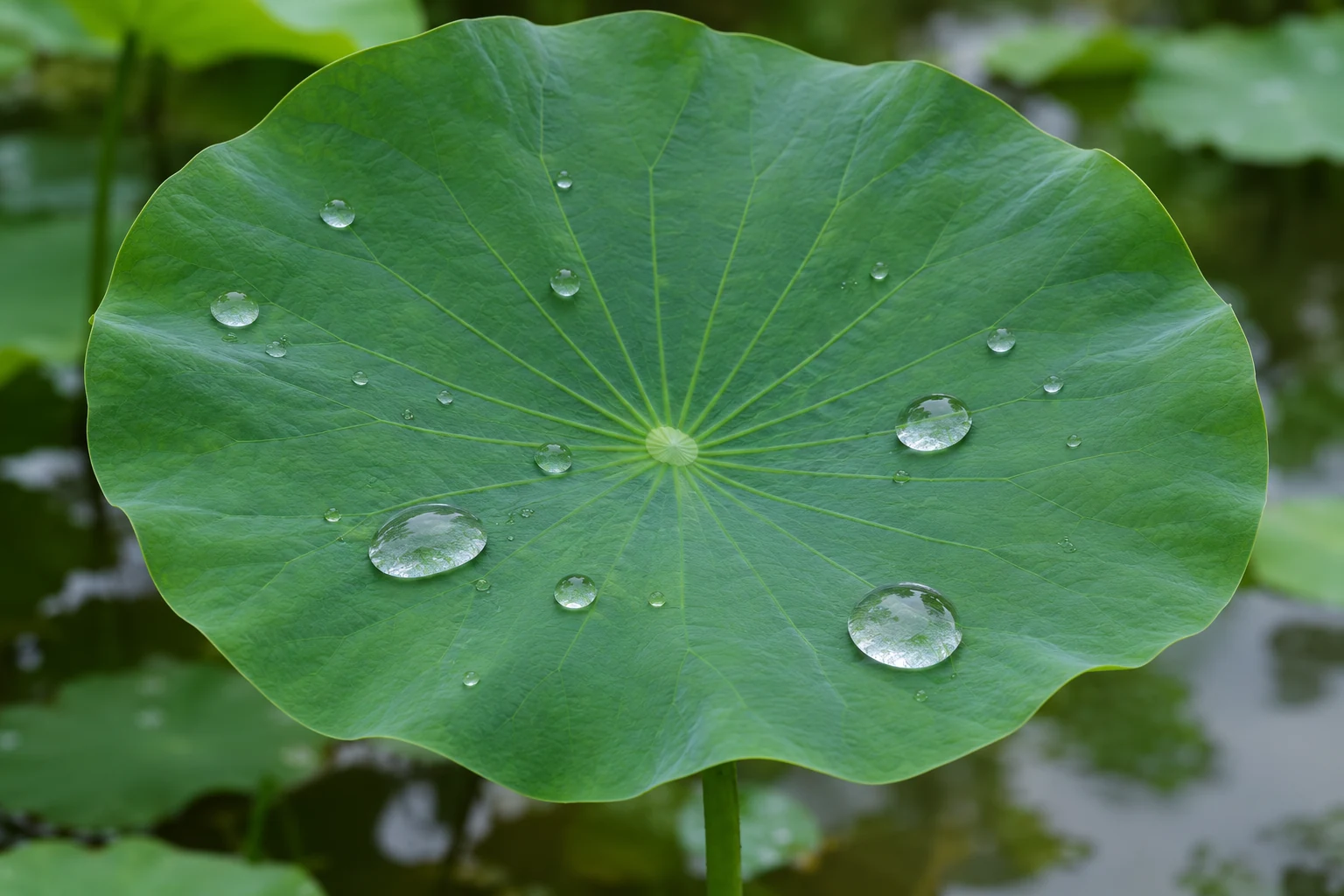
A leaf’s microscopic roughness helps rolling water carry loose dirt away.
Quick answer
Lotus leaves shed water because their waxy surface has tiny bumps covered with even finer structures. Water rests on a limited fraction of that textured surface and can roll off readily. Moving droplets can collect loosely attached particles, producing the lotus effect. Water repellency and self-cleaning are related, but a rounded droplet alone does not prove that a surface cleans itself.
A lotus leaf emerging above muddy water can look almost improbably clean. After rain, droplets sit on it like small beads instead of spreading into a flat wet patch. When the leaf tilts or moves, a droplet can roll across it and carry particles along.
The explanation challenges a familiar intuition. We often associate a cleanable surface with polished smoothness. A lotus leaf works through a combination of surface chemistry and carefully arranged roughness that is largely invisible to the unaided eye.
What scientists mean by the lotus effect
The lotus effect describes self-cleaning associated with a strongly water-repellent, structured surface. The sacred lotus, Nelumbo nucifera, is the classic example. Its upper leaf surface includes projecting epidermal cells with tiny wax structures on top. These different scales of texture work together. [1]
The name should not be applied indiscriminately to any plant growing in a pond. Sacred lotus and water lilies belong to different groups. A circular leaf with a familiar pond-plant appearance is not enough to identify the same surface structure or wetting behaviour. The botanical distinction matters when interpreting photographs and demonstrations. [2]
The effect also requires movement for cleaning to occur. A bead of water sitting motionless is evidence about wetting; a bead departing with particles provides evidence about cleaning. These are two different observations.
Why water beads up in the first place
Water’s behaviour at a solid surface depends on competing interactions at the boundaries between water, solid and air. A waxy, water-repellent surface favours limited spreading. On lotus leaves, microscopic bumps and the finer wax layer further reduce the solid area contacted by a droplet. [1] [3]
Picture a sheet supported by many small posts. It can bridge over spaces instead of touching every part of the floor below. A water droplet is not a sheet, and the geometry involves forces at a liquid interface, but the analogy makes the limited-contact idea easier to visualize.
It is misleading to say the leaf “pushes water away” as if it actively squeezes each droplet. The behaviour emerges from the materials and geometry at the interface. The plant does not need to detect a raindrop and operate a separate cleaning muscle.
Roughness is helpful only in the right combination
“Rough surfaces repel water” is too broad a rule. Texture can produce very different outcomes depending on the surface chemistry and whether liquid penetrates the spaces. The lotus example involves a hierarchy of features and a water-repellent coating, rather than roughness by itself. [3]
A useful imaginary comparison uses three samples: a smooth material, a textured version of the same material and a textured sample with different surface chemistry. Observing different droplets would not let us assign every change to roughness. The experiment changes more than one potentially important factor unless it is carefully controlled.
That is why research on artificial lotus-like surfaces measures multiple properties. A visually convincing pattern of bumps is not enough to establish that a manufactured material behaves like a living leaf.
A high contact angle is only part of the story
The contact angle describes the angle where a droplet meets a surface. A large angle means the droplet is comparatively rounded rather than spread flat. Lotus leaves are known for very high water contact angles, but the ease with which a droplet starts moving is another important measurement. [4]
A droplet can look beautifully rounded and still stick. Imagine two marbles with the same shape, one free to move and one held in place by adhesive. The comparison does not reproduce wetting physics, but it separates shape from mobility. In a real droplet, the edge can be pinned by interactions with the surface.
Researchers use contact-angle hysteresis to describe a difference between advancing and receding contact conditions. A surface can combine a large apparent angle with substantial resistance to motion. Consequently, “water beads up” and “water rolls away with dirt” are not interchangeable claims. [4] [5]
How a moving droplet picks up dirt
The structured surface limits how strongly some particles contact the leaf. As a droplet moves, loosely adhering particles can attach to it and leave with the water. TU Dresden’s botanical explanation emphasizes precisely this combination: low water adhesion and removal of loose contamination along the droplet’s path. [1]
The word “loose” is doing real work. A surface carrying a few dry dust grains is not the same challenge as one coated in a strongly adhering deposit. Self-cleaning should be tested with a specified contaminant, amount of water and movement, rather than treated as a promise that every unwanted substance disappears.
Consider a simple thought experiment. Place ten visible, removable grains along a droplet’s path and count how many remain after it passes. That count measures one cleaning event for those grains. It does not establish resistance to oils, bacterial sterility or performance after years of abrasion. Each broader claim needs its own evidence.
Why condensation can behave differently from rain
A droplet landing on top of a leaf and water forming through condensation do not necessarily follow the same route into its texture. A study of lotus leaves reported that condensed droplets could become sticky and show much greater contact-angle hysteresis than droplets in the familiar water-shedding state. The authors described an intermediate wetting condition rather than a uniformly wetted surface. [4]
This result is a valuable limit on the popular explanation. The leaf has not stopped being a lotus leaf; the way water reached the surface has changed. A coating that performs impressively in a rain demonstration may therefore need separate testing for dew or fog.
The practical question becomes specific: under which forms of wetting does a droplet remain mobile? That is a more informative engineering target than “make everything waterproof.”
Does self-cleaning mean sterile?
No. Particle removal and sterility describe different outcomes. The research history connects structured plant surfaces with reduced contamination, but a water-shedding demonstration cannot establish that all microorganisms have been removed or killed. [2]
Suppose a demonstration removes visible clay. The observation is about that clay under those conditions. Concluding that invisible biological material is absent would require an additional measurement. The same logic applies outside botany: a clear-looking window is not automatically chemically clean, and a glossy surface is not automatically disinfected.
The leaf remains a living interface with a changing environment. Scientific language is stronger when it says exactly what was removed, rather than converting an impressive visual effect into a universal claim.
What engineers borrow from lotus leaves
The combination of surface texture and chemistry has inspired manufactured coatings and materials. TU Dresden lists applications including facade paints and textiles. A study of artificial replicas examined hierarchical structures, wax deposition, contact angles, tilt angles and adhesion rather than judging performance from appearance alone. [1] [3]
Copying a principle is different from copying every biological detail. A paint does not need living leaf cells to exploit a structured, water-repellent surface. But a useful product must also survive the environment in which it will be used.
For an outdoor material, the right questions include whether its texture persists and whether contaminants change its behaviour. Those are testable design questions, not reasons to dismiss biomimicry. A short demonstration establishes a starting result; durability testing establishes how long that result remains useful.
How to interpret a lotus demonstration
Watch the droplet rather than only the photograph. Does it spread, stay pinned, bounce or roll? Does it actually remove particles? Are the droplets falling onto the leaf, or forming on it? Is the material a real lotus leaf, another plant or a manufactured surface?
These questions separate identification, wetting and cleaning. They also reveal why the best demonstrations explain their conditions. A successful video can show a mechanism clearly without proving that the same result occurs for every liquid, surface age or kind of dirt.
Frequently asked questions
Are lotus leaves completely smooth?
No. Their apparently smooth appearance hides a textured outer surface with structures at multiple scales.
Is wax alone the whole explanation?
No. The chemistry and the surface architecture work together. Describing either one in isolation leaves out an important part of the mechanism.
Does every water-repellent coating clean itself?
No. Droplet mobility and particle adhesion matter. A rounded droplet may remain attached instead of rolling away.
Is the lotus effect the same as soap cleaning grease?
No. Soap changes interactions in a liquid cleaning system. Lotus-like shedding depends on the structure and chemistry of the solid surface.
Explore another water interface
The surface of water also supports a very different biological trick: water striders walking without sinking. For a contrasting approach to contamination, read how soap removes grease.
Sources and further reading
Reference review: November 8, 2026.
- TU Dresden Botanical Garden — Self-cleaning surfaces: the lotus effect
- Barthlott — The purity of sacred lotus: superhydrophobic self-cleaning plant surfaces and the consequences revisited (2026 perspective)
- Koch and colleagues — Fabrication of artificial Lotus leaves and significance of hierarchical structure (research abstract)
- Liu and Choi — Condensation-induced wetting state and contact angle hysteresis on superhydrophobic lotus leaves (institutional research abstract)
- Why a Lotus-like Superhydrophobic Surface Is Self-Cleaning? An Explanation from Surface Force Measurements and Analysis (research abstract)
Keep exploring.
One remarkable idea at a time—nature, science, history and beyond.
Sources and further reading
Barnakle uses credible primary and authoritative sources wherever possible.
- TU Dresden Botanical Garden — Self-cleaning surfaces: the lotus effect
- https://tu-dresden.de/bg/standorte/dresden/transl/bionik/selbstreinigende-oberflaechen?set_language=en
- Barthlott — The purity of sacred lotus: superhydrophobic self-cleaning plant surfaces and the consequences revisited (2026 perspective)
- https://link.springer.com/article/10.1007/s00425-026-04937-9
- Koch and colleagues — Fabrication of artificial Lotus leaves and significance of hierarchical structure (research abstract)
- https://pubs.rsc.org/en/content/articlehtml/2009/sm/b818940d
- Liu and Choi — Condensation-induced wetting state and contact angle hysteresis on superhydrophobic lotus leaves (institutional research abstract)
- https://researchwith.stevens.edu/en/publications/condensation-induced-wetting-state-and-contact-angle-hysteresis-o/
- Why a Lotus-like Superhydrophobic Surface Is Self-Cleaning? An Explanation from Surface Force Measurements and Analysis (research abstract)
- https://pubs.acs.org/doi/10.1021/la5041272
Last updated November 8, 2026.

Barnakle Editorial Team
Barnakle Editorial Team is the collective byline used for Barnakle’s editorial articles. The contributor profile explains the team identity and links to the publication’s editorial policies.
More from the editorial team →