Surface support and rowing explain two different feats
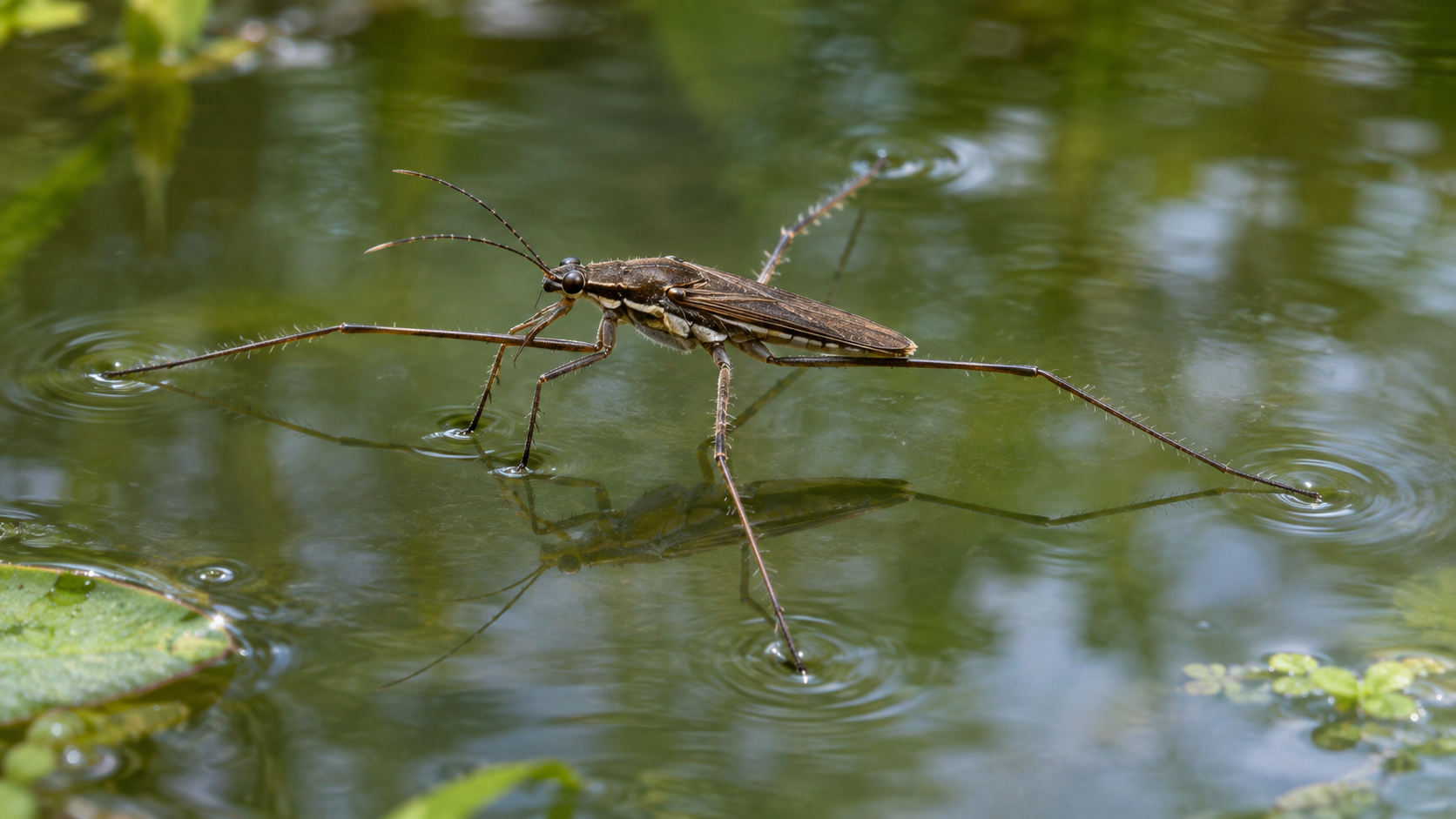
A water strider seems to stand on a floor that other animals would fall through. Its feet leave small dimples, and a quick stroke carries it across the pond without a swimming motion beneath the surface.
Two problems are hidden in that performance. First, how is its weight supported? Second, how does it push itself forward? Surface tension belongs in both stories, but saying “the water has a skin” leaves out the structure and forces that make the behaviour possible.
Follow the mechanism
- Water-repellent legs contact the surface without readily becoming wetted.
- The surface deforms into dimples around the contacts.
- Forces associated with those interfaces support the small insect.
- Rowing strokes transfer momentum to the water and drive the body forward.
The surface is an interface, not a separate solid sheet
Water molecules interact with one another, and creating additional surface area has an energetic cost. Surface tension describes the resulting tendency of the interface to resist being enlarged. It gives small-scale objects a world of forces very different from the one a person experiences beside a pond.
The US Geological Survey uses water striders as an example of this property. Their long, hydrophobic legs and distributed weight help them remain above the surface. The water deforms instead of behaving like a rigid platform.
The same interfacial property helps explain why bubbles become round, although the force balance is different. The familiar “skin” analogy is useful only up to a point. There is no detachable transparent floor that the insect stands on. The curved interface and the way it meets the legs are part of the supporting arrangement.
Sources: [1]
Why the dimples matter
A leg pressing down on the interface makes a depression. The direction of the surface-tension force around the contact is related to that surface shape. The resulting support is a force balance, not an exemption from gravity.
Hu, Chan and Bush’s 2003 study describes the insects’ weight being supported by the surface-tension force associated with curvature of the free surface. The body’s small size and leg configuration matter to that balance. “It is light” is part of an answer, but it does not describe the contact mechanics.
Look at the shadow or reflection near a resting leg and the deformation can become more visible than the leg itself. That optical clue shows the water changing shape under load. It does not, by itself, measure how much force each contact carries.
Sources: [2]
Fine structures help the legs resist wetting
A water strider’s leg surface is not a smooth miniature drinking straw. Research has examined the microscopic hairs and finer structures that help produce strong water repellency. Their surface properties and structure work together.
The 2007 study of hierarchical leg structures analysed the contribution of microsetae, nanogrooves and wax to water repellency. The result is more specific than saying the legs are simply “oily”. It concerns how water meets a structured surface.
This is also a reminder that water resistance and weight support are related but different. Resisting wetting helps preserve the useful contact arrangement. It does not mean the leg has created a new source of upward energy or that an insect can carry an unlimited load.
Sources: [3]
| Part or idea | What it does | Common misunderstanding |
|---|---|---|
| Surface tension | Makes the water-air interface mechanically important. | The pond has a separate solid skin. |
| Water-repellent leg structure | Helps resist wetting at the contacts. | A coat of wax alone explains every detail. |
| Long, spread legs | Arrange multiple supporting contacts. | Small size alone guarantees water walking. |
| Rowing motion | Transfers momentum into the water. | Standing and propulsion are the same problem. |
How a stroke pushes the insect forward
A strider can use its middle pair of legs in a sculling motion. The stroke deforms the surface and drives water backward. The body gains forward momentum as momentum is transferred to the surrounding fluid.
The 2003 experiments used high-speed video and flow visualisation to investigate that transfer. They found that underwater vortices, rather than surface waves alone, were central to the propulsion in the studied striders.
The important distinction is between something visible and something mechanically dominant. Ripples are easy to see, so it is tempting to assign the entire push to them. Tracing the water’s motion revealed a substantial part of the action below the interface.
The puzzle posed by very young striders
Earlier accounts emphasised propulsion through surface waves. That created a problem: very young striders can move even when their legs are too slow to generate the relevant waves in the expected way. This became known as Denny’s paradox.
MIT’s account of the research explains how the rowing and vortex evidence addressed the puzzle. The researchers also built a small mechanical strider guided by their interpretation. Its movement provided a practical demonstration of a related propulsion principle.
The lesson is not that waves never occur. It is that a mechanism must explain the difficult observations as well as the familiar ones. A theory that describes adult ripples but cannot account for the motion of small young insects is missing something important.
Sources: [4]
Why a person cannot simply copy the stance
Making an animal larger changes more than its outline. For geometrically similar objects, mass grows with volume, while many contact-related dimensions grow more slowly. The balance between weight and interface forces therefore changes with scale.
Imagine doubling every linear dimension of a simplified solid model while keeping its density the same. Its volume becomes eight times larger. A comparable length around a contact only doubles. This teaching comparison is not a biological growth law, but it explains why shrinking or enlarging a drawing does not preserve all its mechanics.
The strider’s success belongs to a particular combination of size, leg structure, wetting behaviour and movement. A human arrangement that merely resembles its pose does not recreate that combination.
Observation can separate support from motion
At a safe pond edge, watch a strider while it rests and then while it moves. During rest, look for the arrangement of the contacts and the surface dimples. During a stroke, watch which legs move and what happens to the body immediately afterward.
A short video can help separate the push from the subsequent glide. It is easy to combine both into a single impression of effortless skating. Recording the sequence shows that propulsion is an event and gliding is a later phase.
Observe without handling the insects or adding substances to the water. The question can be explored without disturbing the surface conditions on which the animals depend. A casual video can show behaviour, but laboratory force and flow measurements are needed to quantify the mechanics.
Questions readers ask
Are water striders floating like boats?
The water-air interface and leg contacts are central to their support. Treating them as little submerged hulls misses the distinctive role of surface tension and wetting.
Do they have waterproof feet?
Their legs strongly resist wetting through surface chemistry and microscopic structure. “Water-repellent” is more useful here than imagining a completely impenetrable boot.
Do ripples provide all their thrust?
No. Experiments on strider locomotion showed that subsurface vortices carry an important share of the transferred momentum.
Why do the feet make dark spots on the water?
The deformed surface changes how light is reflected and transmitted. A visible spot or shadow is an optical sign of the dimple, not a hole punched through a solid sheet.
Do all water-walking animals use this exact mechanism?
No. Body size, contacts and propulsion strategies differ. The evidence described here concerns water striders and the systems studied by the cited researchers.
A pond surface is a mechanical environment
A water strider does not avoid the laws of mechanics. Its body is adapted to a scale at which the water-air interface can supply substantial support, and its strokes use that interface to move the fluid.
The result connects microscopic surface structure with visible animal behaviour. A dimple under a leg and a brief rowing stroke are the outward signs of a carefully balanced physical system.
Continue exploring
Sources and further reading
Keep exploring.
One remarkable idea at a time—nature, science, history and beyond.
Last updated November 6, 2026.

Barnakle Editorial Team
Barnakle Editorial Team is the collective byline used for Barnakle’s editorial articles. The contributor profile explains the team identity and links to the publication’s editorial policies.
More from the editorial team →