
Millions of microscopic contacts turn weak forces into remarkable grip
The short answer
Many geckos cling without glue or suction cups. Microscopic hairs called setae branch into nanoscale tips that make extremely close contact with a surface. Vast numbers of weak van der Waals interactions combine to provide useful adhesion, while toe motion lets the animal attach and release rapidly.
The explanation of how do geckos walk on walls becomes clearer when the process is followed in order: initial conditions establish what is possible, interactions change matter or energy, and the resulting structure leaves measurements that can be compared with predictions. That sequence is more reliable than a single slogan because it explains both the familiar result and the exceptions.
Scientists test claims about how do geckos walk on walls at several scales. Direct observations establish what happens, laboratory or computational models isolate mechanisms, and comparisons across environments reveal which factors matter most. Where evidence remains incomplete, this article distinguishes a working explanation from a settled measurement.
The grip is dry, directional and reversible
A gecko can attach in milliseconds, carry its body on vertical glass and peel a toe away without leaving obvious glue. That combination rules out many everyday analogies. The system depends on structure, contact mechanics and controlled movement rather than a permanently sticky secretion.
In the context of the grip is dry, directional and reversible, this evidence matters because it links an observable feature to a process that can be tested independently. A useful explanation also makes a prediction: changing the relevant condition should change the outcome in a specific direction.
For readers evaluating the grip is dry, directional and reversible, the best question is not merely whether the claim sounds plausible, but what observation would distinguish it from a competing explanation. Here, the combination of structure, environment and measured response provides that test. The conclusion remains open to refinement without making the core evidence arbitrary.
Toe pads are hierarchical structures
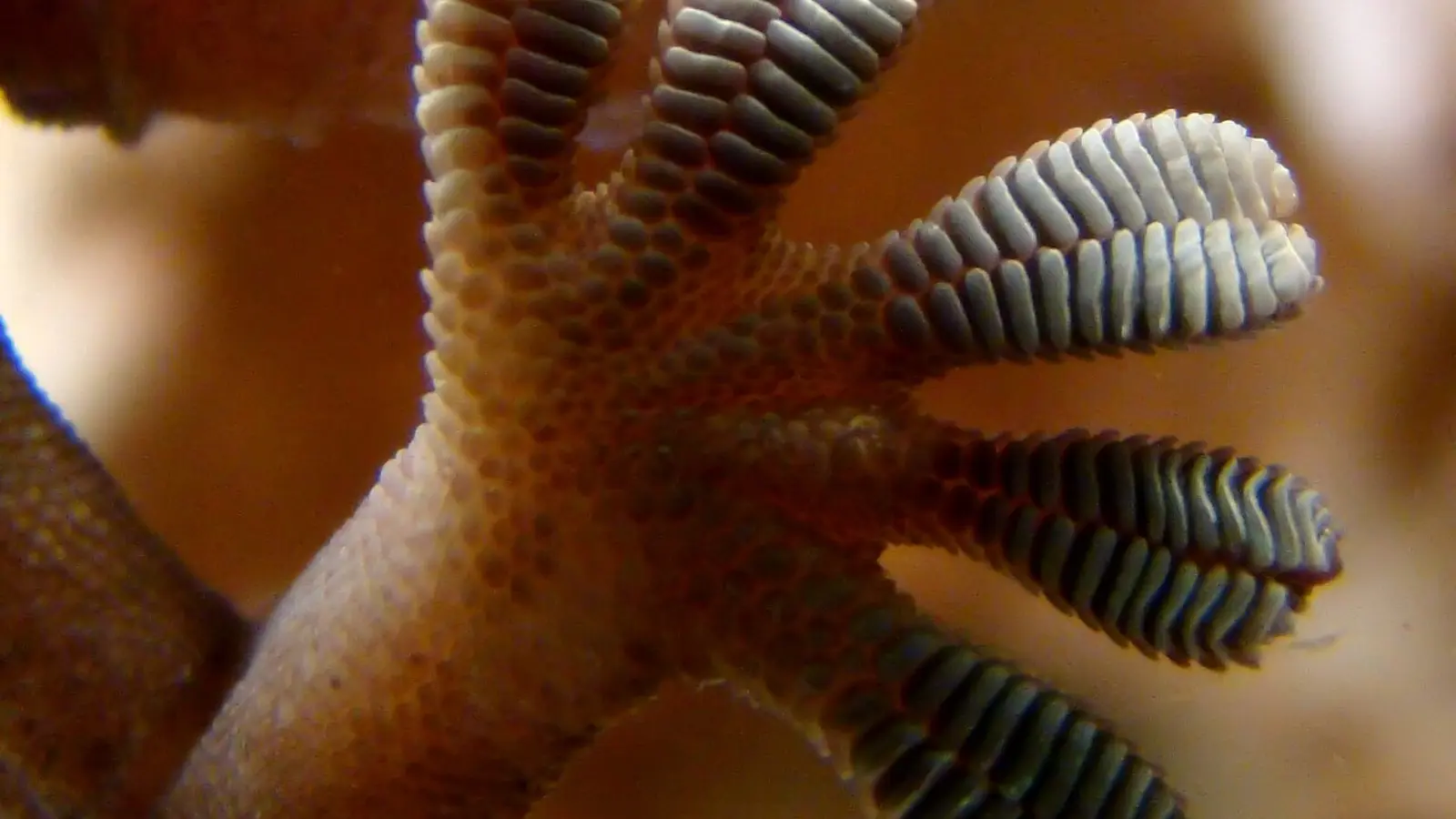
Under a microscope, adhesive pads carry rows of lamellae covered by setae. Each seta branches toward much finer terminal structures often called spatulae. Hierarchy allows the pad to conform across several scales, bringing a huge total area close to an uneven surface.
In the context of toe pads are hierarchical structures, the important qualification is that one pattern can have several contributing causes, so context and scale must be recorded. Natural variation is informative rather than inconvenient, because limits and exceptions reveal which part of the mechanism is essential.
For readers evaluating toe pads are hierarchical structures, the best question is not merely whether the claim sounds plausible, but what observation would distinguish it from a competing explanation. Here, the combination of structure, environment and measured response provides that test. The conclusion remains open to refinement without making the core evidence arbitrary.
Weak forces add up
Atoms and molecules exhibit temporary fluctuations in charge distribution. At very small separations these produce van der Waals attractions. One interaction is tiny, but millions of nanoscale contacts acting together can generate substantial shear force. Close approach, not a mysterious biological glue, is the crucial condition.
In the context of weak forces add up, researchers therefore compare multiple lines of evidence rather than treating one striking example as the whole story. The chronology matters. Similar-looking endpoints can arise by different routes, and only dated or time-resolved evidence can separate them.
For readers evaluating weak forces add up, the best question is not merely whether the claim sounds plausible, but what observation would distinguish it from a competing explanation. Here, the combination of structure, environment and measured response provides that test. The conclusion remains open to refinement without making the core evidence arbitrary.
Why ordinary skin cannot do the same
A smooth-looking wall is rough at microscopic scales. A flat, stiff surface touches only the highest points. Flexible branching hairs bend and distribute load, allowing far more tips to approach closely. Contact splitting also helps prevent one local defect from causing the entire pad to fail.
In the context of why ordinary skin cannot do the same, seen this way, the feature is not an isolated curiosity but the outcome of physical and biological constraints acting together. Measurements are strongest when sampling, calibration and uncertainty are reported, allowing another team to check the inference.
For readers evaluating why ordinary skin cannot do the same, the best question is not merely whether the claim sounds plausible, but what observation would distinguish it from a competing explanation. Here, the combination of structure, environment and measured response provides that test. The conclusion remains open to refinement without making the core evidence arbitrary.
Attachment is directional
Setae are angled and respond strongly when loaded in a preferred direction. A gecko places its toes, drags them slightly and applies shear so many tips engage. Directionality supplies grip when needed while preventing the animal from becoming permanently trapped by its own feet.
In the context of attachment is directional, this evidence matters because it links an observable feature to a process that can be tested independently. A useful explanation also makes a prediction: changing the relevant condition should change the outcome in a specific direction.
For readers evaluating attachment is directional, the best question is not merely whether the claim sounds plausible, but what observation would distinguish it from a competing explanation. Here, the combination of structure, environment and measured response provides that test. The conclusion remains open to refinement without making the core evidence arbitrary.
Peeling makes release easy
Detachment begins by changing toe angle and peeling from an edge. Peeling concentrates separation at a moving front rather than requiring every contact to break simultaneously. Geckos hyperextend their toes during rapid running, a motion that coordinates attachment and release step by step.
In the context of peeling makes release easy, the important qualification is that one pattern can have several contributing causes, so context and scale must be recorded. Natural variation is informative rather than inconvenient, because limits and exceptions reveal which part of the mechanism is essential.
For readers evaluating peeling makes release easy, the best question is not merely whether the claim sounds plausible, but what observation would distinguish it from a competing explanation. Here, the combination of structure, environment and measured response provides that test. The conclusion remains open to refinement without making the core evidence arbitrary.
It is not suction
Suction requires a sealed pressure difference. Gecko pads still work in conditions and on surfaces inconsistent with suction, and their microscopic architecture has no forest of tiny sealed cups. Experiments measuring single hairs and whole toes support contact-force explanations instead.
In the context of it is not suction, researchers therefore compare multiple lines of evidence rather than treating one striking example as the whole story. The chronology matters. Similar-looking endpoints can arise by different routes, and only dated or time-resolved evidence can separate them.
For readers evaluating it is not suction, the best question is not merely whether the claim sounds plausible, but what observation would distinguish it from a competing explanation. Here, the combination of structure, environment and measured response provides that test. The conclusion remains open to refinement without making the core evidence arbitrary.
It is not ordinary glue
Adhesive geckos generally do not coat each step with a wet, tacky film. Dry adhesion avoids curing time and residue. Some animals use secretions in other adhesive systems, so the distinction should not be generalized to every climbing species or even every lizard.
In the context of it is not ordinary glue, seen this way, the feature is not an isolated curiosity but the outcome of physical and biological constraints acting together. Measurements are strongest when sampling, calibration and uncertainty are reported, allowing another team to check the inference.
For readers evaluating it is not ordinary glue, the best question is not merely whether the claim sounds plausible, but what observation would distinguish it from a competing explanation. Here, the combination of structure, environment and measured response provides that test. The conclusion remains open to refinement without making the core evidence arbitrary.
Water changes the problem
Humidity and wet surfaces can alter both material properties and contact. Results depend on species, substrate and whether water forms a film that blocks close approach. Some geckos retain impressive performance in humid habitats, but a submerged or contaminated pad is not equivalent to clean dry glass.
In the context of water changes the problem, this evidence matters because it links an observable feature to a process that can be tested independently. A useful explanation also makes a prediction: changing the relevant condition should change the outcome in a specific direction.
For readers evaluating water changes the problem, the best question is not merely whether the claim sounds plausible, but what observation would distinguish it from a competing explanation. Here, the combination of structure, environment and measured response provides that test. The conclusion remains open to refinement without making the core evidence arbitrary.
How feet stay clean
Particles can adhere more strongly to a surface than to the toe as the gecko walks, allowing passive self-cleaning. Repeated steps and changes in contact geometry help shed dirt. Self-cleaning is effective, not perfect; oils and certain contaminants can reduce performance.
In the context of how feet stay clean, the important qualification is that one pattern can have several contributing causes, so context and scale must be recorded. Natural variation is informative rather than inconvenient, because limits and exceptions reveal which part of the mechanism is essential.
For readers evaluating how feet stay clean, the best question is not merely whether the claim sounds plausible, but what observation would distinguish it from a competing explanation. Here, the combination of structure, environment and measured response provides that test. The conclusion remains open to refinement without making the core evidence arbitrary.
Different geckos use different strategies
Adhesive toe pads evolved and were lost multiple times within gecko lineages. Habitat, body size and locomotion influence pad form. Some species climb smooth leaves or rock, while others live mainly on the ground and lack elaborate pads. There is no single universal gecko foot.
In the context of different geckos use different strategies, researchers therefore compare multiple lines of evidence rather than treating one striking example as the whole story. The chronology matters. Similar-looking endpoints can arise by different routes, and only dated or time-resolved evidence can separate them.
For readers evaluating different geckos use different strategies, the best question is not merely whether the claim sounds plausible, but what observation would distinguish it from a competing explanation. Here, the combination of structure, environment and measured response provides that test. The conclusion remains open to refinement without making the core evidence arbitrary.
How researchers measure a seta
Scientists isolate setae or fabricate probes, control angle and preload, then measure normal and shear forces. Electron microscopy reveals branching geometry. Whole-animal experiments test whether mechanisms inferred at the nanoscale still explain real running, turning and recovery on varied surfaces.
In the context of how researchers measure a seta, seen this way, the feature is not an isolated curiosity but the outcome of physical and biological constraints acting together. Measurements are strongest when sampling, calibration and uncertainty are reported, allowing another team to check the inference.
For readers evaluating how researchers measure a seta, the best question is not merely whether the claim sounds plausible, but what observation would distinguish it from a competing explanation. Here, the combination of structure, environment and measured response provides that test. The conclusion remains open to refinement without making the core evidence arbitrary.
What engineers copy
Gecko-inspired adhesives aim for reusable dry grip in robots, manufacturing and medical devices. Successful designs copy principles—contact splitting, compliance, directionality and peeling—rather than merely imitating a toe’s appearance. Scaling and contamination remain serious engineering challenges.
In the context of what engineers copy, this evidence matters because it links an observable feature to a process that can be tested independently. A useful explanation also makes a prediction: changing the relevant condition should change the outcome in a specific direction.
For readers evaluating what engineers copy, the best question is not merely whether the claim sounds plausible, but what observation would distinguish it from a competing explanation. Here, the combination of structure, environment and measured response provides that test. The conclusion remains open to refinement without making the core evidence arbitrary.
Limits reveal the mechanism
Very rough surfaces reduce the number of contacts; soft or dusty materials behave differently from clean glass. Load direction matters, and performance changes with pad area and body orientation. These predictable failures help distinguish the accepted mechanism from vague claims that geckos can stick to anything.
In the context of limits reveal the mechanism, the important qualification is that one pattern can have several contributing causes, so context and scale must be recorded. Natural variation is informative rather than inconvenient, because limits and exceptions reveal which part of the mechanism is essential.
For readers evaluating limits reveal the mechanism, the best question is not merely whether the claim sounds plausible, but what observation would distinguish it from a competing explanation. Here, the combination of structure, environment and measured response provides that test. The conclusion remains open to refinement without making the core evidence arbitrary.
How to evaluate new claims about how do geckos walk on walls
New discoveries about how do geckos walk on walls are often announced with a dramatic headline, but the durable question is whether the new result changes the mechanism described above. Check what was actually measured, how large and representative the sample was, whether the work passed expert review, and whether the uncertainty is visible. A result can be interesting without overturning everything previously known. Replication, improved instruments and a better chronological or environmental record usually strengthen knowledge by degrees.
For how do geckos walk on walls, source type matters as well. A research paper reports methods and results, an institution may provide accessible context, and a news story interprets the work for a broad audience. These roles are useful but not interchangeable. Barnakle links to the most authoritative available records so readers can follow the evidence beyond the summary. When later measurements disagree, the responsible response is to examine methods and scope—not to choose whichever claim sounds more surprising.
Frequently asked questions
What is the simplest accurate explanation?
In brief: Many geckos cling without glue or suction cups. Microscopic hairs called setae branch into nanoscale tips that make extremely close contact with a surface. Vast numbers of weak van der Waals interactions combine to provide useful adhesion, while toe motion lets the animal attach and release rapidly.
Is there one cause?
Usually not. For how do geckos walk on walls, the central mechanism operates within a system whose history, environment and geometry affect the result. A good explanation names the dominant cause without pretending that secondary influences disappear.
How do scientists know?
Researchers studying how do geckos walk on walls combine observation with measurements that test specific predictions. Independent methods have different sources of error, so agreement among them is more persuasive than repetition of the same method.
Can photographs be misleading?
A photograph related to how do geckos walk on walls records a particular place, time, scale and processing choice. It can document real evidence while still omitting motion, depth, invisible wavelengths or surrounding conditions. Captions and source records provide essential context.
What remains uncertain?
For how do geckos walk on walls, fine details, boundary cases and historical reconstruction remain active research areas. Uncertainty is not equivalent to ignorance: well-supported mechanisms can coexist with unanswered questions about timing, variation or relative importance.
Key takeaways
- Many geckos cling without glue or suction cups. Microscopic hairs called setae branch into nanoscale tips that make extremely close contact with a surface. Vast numbers of weak van der Waals interactions combine to provide useful adhesion, while toe motion lets the animal attach and release rapidly.
- The mechanism is supported by multiple forms of evidence rather than appearance alone.
- Variation and exceptions help researchers test where simplified explanations stop working.
- Source quality, scale and uncertainty should travel with every scientific claim.
Continue exploring
What researchers will test next
Progress now depends on measurements that connect controlled experiments with the complexity of the wider world. Researchers need observations collected across different locations, instruments and timescales, with methods described clearly enough for independent teams to repeat them. Larger samples can reveal whether an apparent pattern is widespread or driven by a few unusual cases. Longer records can separate temporary variation from a durable change.
New instruments may improve precision, but precision alone does not guarantee a better explanation. Scientists must still test alternative causes, disclose uncertainty and check whether an analysis gives the same answer when reasonable assumptions change. Open data and carefully documented methods allow other researchers to find errors, reproduce results and combine evidence that was gathered for different purposes.
The most useful future studies will make competing explanations face distinct predictions. When several independent tests agree, confidence can grow. When they disagree, the mismatch becomes evidence about what the original account was missing. Barnakle treats this process as a strength of science: conclusions can be reliable without being final, and responsible reporting should explain both what is known and what observation could change the picture.
Sources and further reading
Keep exploring.
One remarkable idea at a time—nature, science, history and beyond.
Sources and further reading
Barnakle uses credible primary and authoritative sources wherever possible.
- PNAS — Evidence for van der Waals adhesion in gecko setae
- https://doi.org/10.1073/pnas.121932299
- National Science Foundation — Gecko adhesion research
- https://www.nsf.gov/news/special_reports/science_nation/geckoadhesion.jsp
- Journal of Experimental Biology — Gecko adhesion and locomotion
- https://doi.org/10.1242/jeb.015362
- UC Berkeley — Full, Messersmith and Autumn gecko research
- https://ib.berkeley.edu/labs/full/
- Royal Society Interface — Biological adhesive systems
- https://doi.org/10.1098/rsif.2007.1201
Last reviewed October 1, 2026.

Barnakle Editorial Team
A member of the Barnakle editorial team, exploring remarkable ideas with clarity, curiosity and care.
More from this author →