
The spectrum beyond human sight
What to know
- Many birds possess tetrachromatic rather than trichromatic daylight color vision.
- Ultraviolet-sensitive and violet-sensitive systems differ among species.
- Feather or fruit spectra must be modeled through the receiving bird’s eye.
- False-color images translate measurements; they cannot reproduce subjective avian experience.
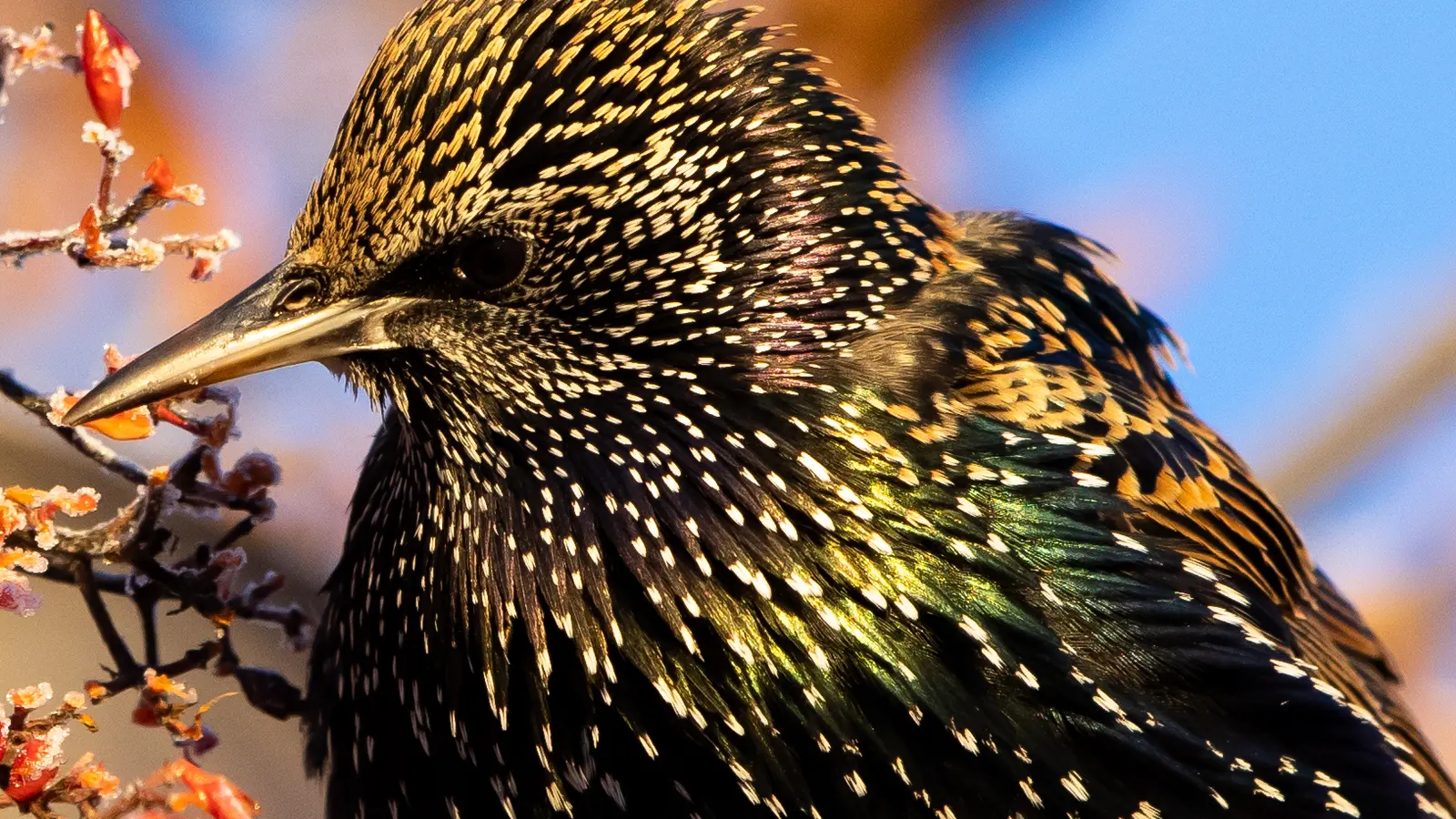
A starling’s black feathers can flash with spectral structure a human eye compresses into “dark.” Two birds that appear alike to us may present different plumage contrasts to one another. Fruit, eggs, flowers and sky can also occupy regions of visual space outside normal human color vision. The reason is not that birds possess a mystical filter. Their eyes sample light differently.
Many birds have four types of single cone photoreceptor used in color vision, compared with three in most humans. One cone is tuned toward violet or ultraviolet wavelengths. Colored oil droplets inside the retina further filter the incoming spectrum, and the cornea and lens decide how much short-wave light arrives. Together, these components create a visual system whose distinctions cannot be reproduced perfectly on a human screen.
Visible light is a biological window
Light spans many wavelengths, but an eye detects only the band its receptors and transparent tissues admit. Human daylight vision uses three cone classes; many birds use four single-cone classes and can sample ultraviolet or violet wavelengths.
How scientists know: Microspectrophotometry measures pigment sensitivity in individual photoreceptors, while molecular studies identify the opsin proteins that absorb light. Measurements of cornea and lens transmission show which wavelengths can reach the retina.
What it does—and does not—mean: “Visible” is not a universal property of light. It describes the wavelengths an animal can convert into neural signals.
The useful question is not whether visible light is a biological window sounds remarkable, but what observation would distinguish the proposed mechanism from its alternatives. That keeps explanation tied to evidence rather than analogy.
A fourth cone changes the problem
Adding a fourth cone does more than extend a rainbow. Color is computed from the relative responses of receptor classes, so a tetrachromatic bird can distinguish spectral combinations that produce the same three-cone response in a human.
How scientists know: Behavioral discrimination tests train birds to choose between lights or colored targets. Models built from measured cone sensitivities predict which targets should be distinguishable.
What it does—and does not—mean: The extra channel expands possible color contrasts, but it does not mean every bird experiences one identical ultraviolet color.
A fourth cone changes the problem also illustrates why scale and context matter. A mechanism demonstrated in one species, location or instrument cannot be transferred automatically to every case; researchers test where it applies and where it fails.
UVS and VS visual systems
Birds are commonly grouped as ultraviolet-sensitive, with an SWS1 cone shifted farther into UV, or violet-sensitive, with that cone peaking at longer wavelengths. Small changes around the opsin molecule help tune the shift.
How scientists know: Opsin gene sequences, retinal pigment measurements and evolutionary comparisons map repeated transitions between UVS and VS systems across bird lineages.
What it does—and does not—mean: There is no clean split between “birds see UV” and “birds do not.” Sensitivity varies with receptor tuning and ocular transmission.
Independent methods strengthen this part of the story. When laboratory measurements, field observations and quantitative models converge on uvs and vs visual systems, the conclusion becomes less dependent on any one instrument or assumption.
Oil droplets refine color signals
Most avian cone types contain colored oil droplets that filter incoming light before it reaches the visual pigment. The filters reduce overlap between cone responses and can improve color discrimination, though they also discard photons.
How scientists know: Researchers measure droplet absorbance and incorporate those cut-off wavelengths into receptor-noise models. Retinal anatomy shows which droplet type accompanies each cone.
What it does—and does not—mean: Oil droplets are spectral filters, not pigments painted onto the scene. They change the information reaching receptors.
Uncertainty here is informative rather than embarrassing. Scientists can be confident about the central mechanism of oil droplets refine color signals while continuing to refine its limits, history and relative importance.
The lens can hide ultraviolet
A UV-sensitive opsin is useful only if ultraviolet photons cross the cornea, lens and other ocular media. Species differ greatly in short-wavelength transmission, partly reflecting ecology, eye size and protection from damaging radiation.
How scientists know: Spectrophotometers pass calibrated light through excised ocular media, allowing researchers to calculate transmission curves and compare them with retinal sensitivity.
What it does—and does not—mean: A genetic sequence alone cannot establish an animal’s usable visual range. The entire optical pathway matters.
A careful headline should preserve that distinction: the evidence supports a defined claim about the lens can hide ultraviolet, not every broader interpretation that can be attached to it.
Bird plumage can conceal signals from us
Feathers that look nearly identical to people may differ strongly in ultraviolet reflectance. Such differences can make males and females, age classes or individuals more distinct to birds than museum labels based on human sight suggest.
How scientists know: Reflectance spectrometry records wavelengths bounced from feathers, and visual models translate spectra into estimated avian cone contrasts. Choice experiments test whether birds respond to those contrasts.
What it does—and does not—mean: A UV difference is not automatically a mating signal; it must be perceptible, variable and connected to behavior in the relevant species.
The useful question is not whether bird plumage can conceal signals from us sounds remarkable, but what observation would distinguish the proposed mechanism from its alternatives. That keeps explanation tied to evidence rather than analogy.
Sexual dichromatism may be cryptic
Some species described as sexually monochromatic to humans possess sex-linked differences in avian visual space. Reanalysis with objective spectra has revealed hidden dichromatism in multiple groups.
How scientists know: Researchers sample comparable feather patches, control illumination and use species-appropriate receptor sensitivities to estimate just-noticeable differences.
What it does—and does not—mean: Visual models predict detectability; they do not by themselves prove what a bird attends to during courtship.
Sexual dichromatism may be cryptic also illustrates why scale and context matter. A mechanism demonstrated in one species, location or instrument cannot be transferred automatically to every case; researchers test where it applies and where it fails.
Fruit and flowers create different contrasts
Many fruits, waxy coatings and flowers reflect short wavelengths differently from surrounding leaves. Birds may use chromatic and brightness contrast together when searching for food.
How scientists know: Field spectra of fruits and foliage are combined with irradiance measurements and avian visual models; controlled foraging experiments test detection under realistic backgrounds.
What it does—and does not—mean: Ultraviolet is not a magical beacon. Whether it helps depends on the full spectrum, lighting, distance and visual background.
Independent methods strengthen this part of the story. When laboratory measurements, field observations and quantitative models converge on fruit and flowers create different contrasts, the conclusion becomes less dependent on any one instrument or assumption.
Urine trails are an incomplete popular story
A common claim says raptors locate rodents by following UV-reflective urine. Some small-mammal scent marks can reflect UV, but evidence that wild raptors routinely use this cue is mixed and species-specific.
How scientists know: Researchers compare spectral reflectance, raptor ocular sensitivity and hunting behavior under manipulated cues. Results do not justify a universal claim for all birds of prey.
What it does—and does not—mean: A plausible cue is not established merely because both the target and the eye interact with ultraviolet wavelengths.
Uncertainty here is informative rather than embarrassing. Scientists can be confident about the central mechanism of urine trails are an incomplete popular story while continuing to refine its limits, history and relative importance.
Forest light is spectrally complex
Sunlit gaps, deep shade and leaves produce rapidly changing spectra. Birds must recognize objects despite changes in illumination, and UV or violet channels may contribute differently across habitats.
How scientists know: Portable spectrometers measure ambient irradiance and backgrounds, while field-calibrated models estimate signal contrast at times and places birds actually use.
What it does—and does not—mean: Laboratory colors on a uniform background can overstate how simple a natural visual task is.
A careful headline should preserve that distinction: the evidence supports a defined claim about forest light is spectrally complex, not every broader interpretation that can be attached to it.
Double cones probably serve other tasks
Bird retinas contain double cones as well as single cones. Evidence connects double cones mainly with luminance, motion and pattern processing rather than the four-channel color comparisons attributed to single cones.
How scientists know: Anatomy, receptor abundance, neural connections and behavioral flicker experiments help separate chromatic from achromatic pathways.
What it does—and does not—mean: Calling every cone a separate color channel would exaggerate avian color dimensionality.
The useful question is not whether double cones probably serve other tasks sounds remarkable, but what observation would distinguish the proposed mechanism from its alternatives. That keeps explanation tied to evidence rather than analogy.
Vision also runs at a different speed
Many birds resolve faster flicker than humans under suitable light. Rapid temporal resolution can sharpen motion and communication, while color sensitivity changes with photon availability.
How scientists know: Behavioral critical-flicker tests and retinal recordings measure the frequency at which flashes merge into steady light.
What it does—and does not—mean: Fast vision and ultraviolet vision are distinct abilities even though both shape an animal’s visual world.
Vision also runs at a different speed also illustrates why scale and context matter. A mechanism demonstrated in one species, location or instrument cannot be transferred automatically to every case; researchers test where it applies and where it fails.
Color models estimate—not recreate—experience
Receptor-noise limited models calculate contrasts from spectra, illumination and cone sensitivities. They are powerful for predicting whether two objects may be discriminable.
How scientists know: Predictions can be tested against trained choices, mate preferences or foraging outcomes and revised when behavior does not match.
What it does—and does not—mean: A false-color photograph is an educational translation, not a literal picture of subjective avian experience.
Independent methods strengthen this part of the story. When laboratory measurements, field observations and quantitative models converge on color models estimate—not recreate—experience, the conclusion becomes less dependent on any one instrument or assumption.
Evolution tunes eyes to trade-offs
Short wavelengths can improve contrast and signaling opportunities, but scatter strongly and can damage tissues. Receptor tuning, filtering and behavior reflect compromises rather than a march toward “better” vision.
How scientists know: Comparative phylogenetic studies test whether visual-system shifts correspond with habitat, activity, plumage or ancestry while accounting for related species.
What it does—and does not—mean: More receptor classes do not make birds superior at every visual task; humans retain strengths suited to our own ecology.
Uncertainty here is informative rather than embarrassing. Scientists can be confident about the central mechanism of evolution tunes eyes to trade-offs while continuing to refine its limits, history and relative importance.
Courtship signals are receiver-dependent
A feather patch becomes a signal only through the receiver’s eye, lighting and behavior. Selection can act on plumage reflectance and on the sensory system interpreting it.
How scientists know: Studies combine spectrometry, visual models, manipulations of plumage and measurements of mate choice or territorial response.
What it does—and does not—mean: Correlation between UV reflectance and mating success does not reveal causation unless competing traits and condition are addressed.
A careful headline should preserve that distinction: the evidence supports a defined claim about courtship signals are receiver-dependent, not every broader interpretation that can be attached to it.
Navigation uses different wavelengths too
Near sunrise and sunset, patterns of polarized skylight can provide compass information to some birds. This ability involves polarization sensitivity and celestial calibration, not simply seeing an ultraviolet color.
How scientists know: Orientation funnels, clock-shift experiments and controlled skylight conditions test how migrants recalibrate compass systems.
What it does—and does not—mean: UV sensitivity may contribute to skylight detection, but animal navigation combines multiple cues and varies by species.
The useful question is not whether navigation uses different wavelengths too sounds remarkable, but what observation would distinguish the proposed mechanism from its alternatives. That keeps explanation tied to evidence rather than analogy.
Artificial light can reshape signals
Windows, LEDs and urban lighting alter intensity and spectrum. Glass may remove UV; artificial sources may create colors that differ from daylight; collisions and disrupted rhythms add separate risks.
How scientists know: Researchers measure lamp spectra, bird behavior and collision patterns under different built environments.
What it does—and does not—mean: A lamp that looks white to people need not be spectrally neutral to a bird.
Artificial light can reshape signals also illustrates why scale and context matter. A mechanism demonstrated in one species, location or instrument cannot be transferred automatically to every case; researchers test where it applies and where it fails.
Cameras need calibration
Ordinary cameras block or misrecord ultraviolet. Scientific imaging uses UV-sensitive equipment, known reflectance standards and separate filters, then maps measurements into display colors people can see.
How scientists know: Calibration against spectrometer data checks whether images preserve relative reflectance rather than camera-specific processing.
What it does—and does not—mean: Online “bird vision” images without methods should be treated as illustrations, not measurements.
Independent methods strengthen this part of the story. When laboratory measurements, field observations and quantitative models converge on cameras need calibration, the conclusion becomes less dependent on any one instrument or assumption.
Birds are not all visual copies
Nocturnal species, aquatic hunters, open-country migrants and forest songbirds face different optical conditions. Retinal organization, eye size, oil droplets and short-wave transmission differ accordingly.
How scientists know: Cross-species datasets and ecological experiments reveal broad patterns while also documenting exceptions.
What it does—and does not—mean: The safest statement is that many birds possess tetrachromatic color systems extending beyond human vision—not that every bird sees the same secret world.
Uncertainty here is informative rather than embarrassing. Scientists can be confident about the central mechanism of birds are not all visual copies while continuing to refine its limits, history and relative importance.
What the discovery changes
Recognizing avian visual space changes how researchers study camouflage, mate choice, food signals, conservation lighting and collisions. Human-looking colors are an unreliable measure of what a bird can detect.
How scientists know: Modern studies report spectra and viewer-specific models rather than relying only on color names or photographs.
What it does—and does not—mean: The insight is methodological: to understand a signal, measure both the object and the sensory system receiving it.
A careful headline should preserve that distinction: the evidence supports a defined claim about what the discovery changes, not every broader interpretation that can be attached to it.
Human and avian daylight color vision
| Feature | Most humans | Many birds |
|---|---|---|
| Single-cone classes used for color | Three | Four |
| Shortest-wave channel | Usually blue-sensitive | Violet-sensitive or ultraviolet-sensitive |
| Retinal spectral filters | No comparable cone oil-droplet system | Colored oil droplets in major cone classes |
| Scientific reconstruction | Standard RGB often approximates display needs | Spectra and receptor models required |
The world is not colored once
Color emerges when a nervous system compares receptor responses to the light reflected from a scene. Change the receptors, filters or illumination and the useful distinctions change. That is why a human photograph cannot settle whether two feathers match for a bird. The scientific route is slower and more revealing: measure the spectrum, measure the eye, build a perceptual prediction and test behavior.
Bird ultraviolet vision matters because it corrects a deep human habit—the assumption that our sensory window is the scene itself. Birds do not merely add a decorative ultraviolet stripe to our rainbow. Many divide natural spectra along an additional dimension, then use those signals alongside motion, brightness, memory and context. Their world is not more real than ours, but it is demonstrably different.
For conservation, this perspective has practical consequences. A window coating, nest-box paint or restoration planting chosen by human appearance may alter contrasts in ways people cannot judge unaided. Measuring reflectance and local illumination can reveal whether a design preserves food cues, courtship signals or safe visual boundaries. The same discipline also prevents exaggerated claims: an ultraviolet photograph is only useful when calibration, receptor assumptions and behavior are reported together.
Sources and further reading
- Ödeen & Håstad (2010), The phylogenetic distribution of ultraviolet sensitivity in birds
- Lind et al. (2014), Ultraviolet vision in birds: the importance of transparent eye media
- Hart & Hunt (2007), Avian visual pigments, oil droplets and ocular media
- Vorobyev et al. (1998), Tetrachromacy and oil droplets in bird color vision
- Eaton (2005), Human vision fails to distinguish widespread sexual dichromatism among birds
- Cuthill et al. (2000), Ultraviolet vision in birds
How Barnakle selects and verifies sources · Corrections and updates
Keep exploring.
One remarkable idea at a time—nature, science, history and beyond.
Sources and further reading
Barnakle uses credible primary and authoritative sources wherever possible.
- Ödeen & Håstad (2010), The phylogenetic distribution of ultraviolet sensitivity in birds
- https://doi.org/10.1186/1471-2148-10-317
- Lind et al. (2014), Ultraviolet vision in birds: the importance of transparent eye media
- https://doi.org/10.1098/rspb.2013.2209
- Hart & Hunt (2007), Avian visual pigments, oil droplets and ocular media
- https://doi.org/10.1016/j.preteyeres.2007.05.003
- Vorobyev et al. (1998), Tetrachromacy and oil droplets in bird color vision
- https://doi.org/10.1152/jn.1998.80.4.2039
- Eaton (2005), Human vision fails to distinguish widespread sexual dichromatism among birds
- https://doi.org/10.1073/pnas.0501891102
- Cuthill et al. (2000), Ultraviolet vision in birds
- https://doi.org/10.1016/S0065-3454(08)60105-9
Last reviewed September 17, 2026.

Barnakle Editorial Team
A member of the Barnakle editorial team, exploring remarkable ideas with clarity, curiosity and care.
More from this author →