
Back from the unknown
Species sometimes reappear after decades without a verified record. They were not literally extinct and revived; they survived undetected, were confused with relatives or persisted in a tiny unsurveyed range. Rediscovery is evidence of survival, not evidence of safety.
- “Extinct” is a formal conclusion based on evidence and exhaustive surveys, not a synonym for rarely seen.
- Genetics, photographs, specimens and expert examination can turn a sighting into a verified rediscovery.
- The Fernandina giant tortoise was found in 2019 and genomically linked to the only earlier specimen.
- Publicity can unlock protection but can also expose a tiny population to disturbance.
On Fernandina Island in 2019, a field team found a female giant tortoise. The island had not produced a confirmed living member of its named tortoise lineage for more than a century. One earlier specimen, collected in 1906, sat at the center of the mystery.
The discovery made a perfect “back from extinction” headline. The science was more careful. Was the animal truly the same lineage? Could it be a tortoise transported from another island? Genome-wide evidence published in 2022 compared the living female with the museum specimen and supported their close relationship. Chelonoidis phantasticus had not vanished after all.
Extinction is difficult to prove
Absence is not a thing researchers can simply observe. A survey can fail to find a species because the species is gone, but also because it is quiet, seasonal, nocturnal, underground, deep underwater or restricted to a difficult patch of habitat. Search effort and detection probability matter.
The IUCN Red List uses “Extinct” when there is no reasonable doubt that the last individual has died, after exhaustive surveys in known or expected habitat at appropriate times. “Possibly Extinct” can flag a serious case while uncertainty remains. Popular coverage often flattens these categories into “thought extinct,” so readers should ask what the formal assessment actually said.
The museum specimen that solved a living mystery
Natural-history collections are libraries of biological evidence. A shell or tissue collected long ago can preserve morphology, location and DNA. In the Fernandina case, the 1906 specimen allowed scientists to test whether the 2019 tortoise belonged to the same lineage.
Genomic comparisons are powerful, but they still require interpretation. Researchers compare patterns of variation across the genome, include tortoises from other islands and evaluate relationships statistically. The conclusion was not “they look alike.” It was that the modern and historical individuals grouped as the same distinct lineage.
One confirmed female does not make a secure population. Expeditions have continued to look for tracks, droppings and other animals. The immediate conservation questions are whether additional tortoises survive, whether breeding is possible and how invasive species and volcanic terrain affect them.
The coelacanth: a lineage leaves the fossil record
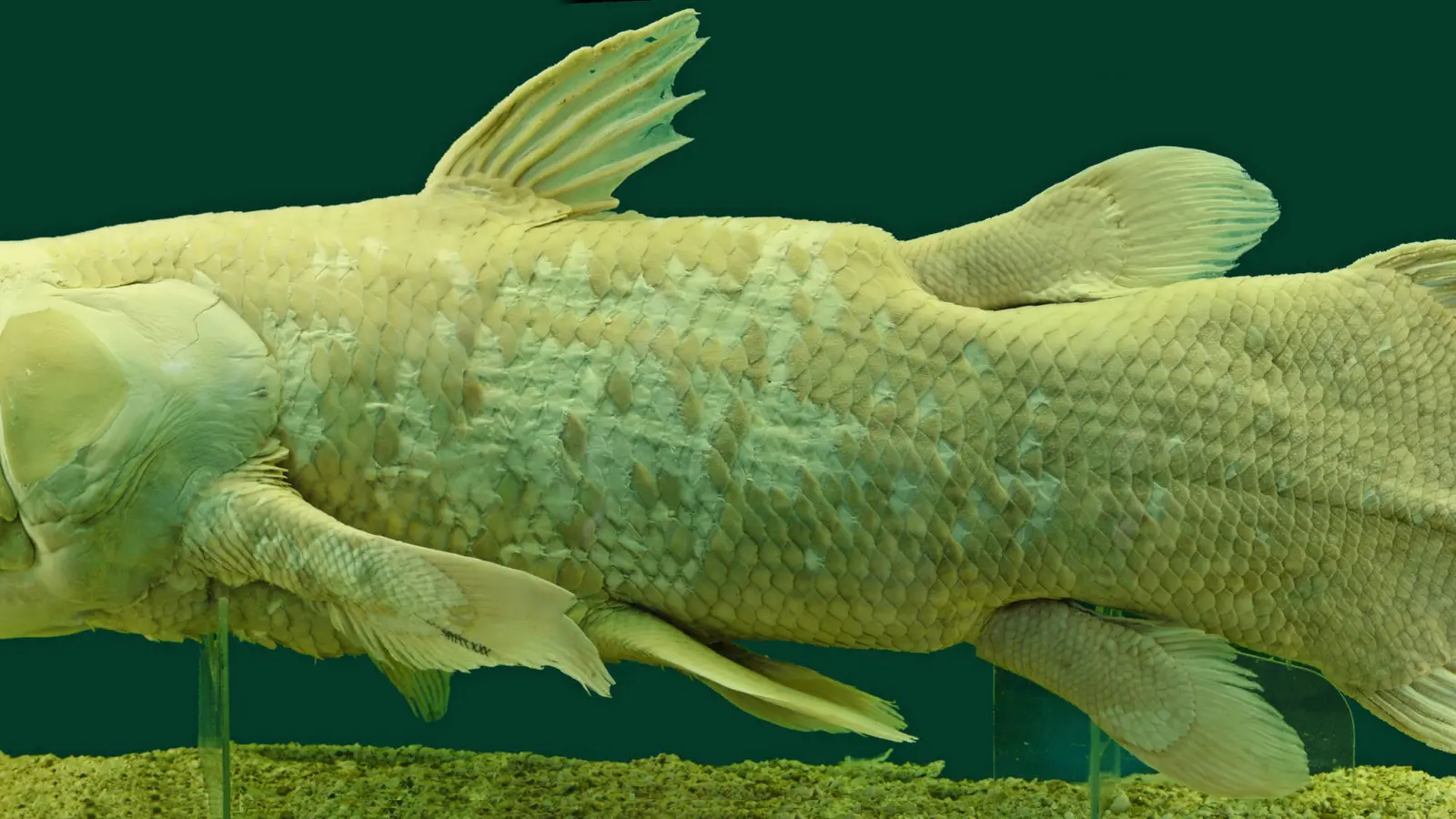
Coelacanths were familiar from fossils and once thought to have disappeared by the end of the Cretaceous. In 1938, a living fish obtained from a catch off South Africa was recognized as extraordinary. Later, additional populations and a second living species were identified.
The phrase “living fossil” is catchy but can mislead. Living coelacanths have continued to evolve; they are not unchanged specimens from deep time. Their rediscovery instead shows the incompleteness of both fossil preservation and human observation in the deep ocean.
The Lord Howe Island stick insect
After rats arrived at Lord Howe Island, its large flightless stick insect disappeared from the main island and was considered extinct. Climbers later reported insects on Ball’s Pyramid, a steep volcanic remnant offshore. A tiny population was confirmed in 2001 beneath a shrub.
Captive breeding created an insurance population, while genetic work helped test whether the Ball’s Pyramid insects matched historical museum specimens. The story illustrates a rediscovery pathway that extends beyond finding: verify identity, protect the remnant habitat, manage threats, build a conservation population and assess whether reintroduction can be responsible.
The Bermuda petrel returns to scientific view
The Bermuda petrel, or cahow, was known historically and then went unconfirmed for centuries. In 1951, breeding birds were found on small rocky islets. Long-term conservation involved habitat work, artificial nest burrows, predator control, monitoring and the creation of a new colony on Nonsuch Island.
Its recovery remains a human project measured across generations. A rediscovery headline records one day; conservation is the less dramatic work that follows every breeding season.
What counts as proof?
| Evidence | Strength | Limitation |
|---|---|---|
| Clear photograph or audio | Can document diagnostic features or calls | Location, scale or identification may be uncertain |
| Expert observation | Uses field experience and behavior | Needs independent documentation when possible |
| Specimen or tissue | Supports anatomy and genetic testing | Collection may be harmful or inappropriate |
| Environmental DNA | Detects genetic traces without seeing the animal | Contamination and transport must be excluded |
| Repeated surveys | Establishes persistence and distribution | Costly; detectability remains imperfect |
A plausible report is the beginning. Verification compares the evidence against similar species, evaluates provenance and seeks independent confirmation. For a species known from one old specimen, even its diagnostic features may be uncertain. Modern taxonomy can also reveal that two named species are one, or that one name hides several lineages.
Why species disappear from view
Some inhabit places that are hard to reach: cloud forests, caves, deep reefs, isolated mountains. Political conflict or lack of funding can stop surveys. A species may call only during a short season. Individuals may shift habitat as climate and land use change. Scientists may simply search in the wrong place.
Local and Indigenous knowledge can preserve observations overlooked by formal science. Responsible projects treat residents as partners and knowledge holders, not merely guides to be quoted after outsiders arrive.
Rediscovery can create a new threat
Announcing a location can draw collectors, photographers and crowds. Pathogens can travel on boots and equipment. A narrow habitat can be damaged by repeated visits. Researchers and conservation agencies may therefore delay details, generalize maps or restrict access.
That is not secrecy for its own sake. Evidence should be available to qualified assessors while sensitive location data receive protection proportional to the risk.
The Romeo error
Conservationists sometimes use “Romeo error” for giving up on a species too soon because it is assumed extinct. The term captures a real danger: protection can stop, habitat can be surrendered and surveys can lose funding. Yet refusing ever to declare extinction has costs too. Resources are limited, and status categories must reflect evidence.
The solution is transparent uncertainty. Publish the search effort, detection assumptions and reasons for the classification. Preserve samples and records so future researchers can reassess the conclusion.
Rediscovered does not mean recovered
A species known from one individual or one site can disappear through a storm, fire, disease or development project. Small populations may suffer low genetic diversity and difficulty finding mates. The pressures that caused decline usually remain after rediscovery.
Recovery requires habitat protection, threat reduction, local partnership, monitoring and sometimes captive breeding or translocation. Each intervention carries risks and needs species-specific expertise.
A better way to read the headline
When a “lost species returns,” ask five questions. What was its previous formal status? When and where was the last verified record? What new evidence confirms the identification? How many individuals or populations are known? What protection follows?
The honest wonder is not resurrection. It is survival at the edge of our attention—and the sudden return of responsibility when we finally notice.
Sources and further reading
- Jensen et al. (2022), Fernandina giant tortoise genomics
- IUCN Red List Categories and Criteria
- Australian Museum: Lord Howe Island stick insect
- Bermuda Government: Cahow recovery programme
How Barnakle selects and verifies sources · Corrections and updates
Keep exploring.
One remarkable idea at a time—nature, science, history and beyond.
Sources and further reading
Barnakle uses credible primary and authoritative sources wherever possible.
- Jensen et al. 2022; IUCN Red List; Australian Museum; Bermuda Government
Last reviewed September 17, 2026.

Barnakle Editorial Team
A member of the Barnakle editorial team, exploring remarkable ideas with clarity, curiosity and care.
More from this author →