
The precise science behind an indestructible myth
What to know
- Tun formation is a regulated transition, not instant invulnerability.
- CAHS proteins can form protective networks as water disappears.
- Dsup contributes to DNA protection in some studied systems but is not universal.
- Recovery and reproduction are stronger evidence than immediate movement alone.
Tardigrades are microscopic animals with a reputation larger than their bodies. They have survived laboratory drying, freezing, intense radiation, high pressure and even carefully controlled exposure to space. The familiar summary—“tardigrades can survive anything”—is memorable and wrong. Different species survive different stresses, usually only after entering specialized dormant states, and every tolerance has limits.
The central achievement is controlled biological shutdown. As water disappears, some tardigrades reshape into a tun, suppress activity and stabilize vulnerable molecules. Heat-soluble proteins, antioxidants, DNA protection and repair contribute in combinations researchers are still mapping. Survival is measured not by enduring every condition, but by recovering coordinated life and, ideally, reproduction after a specified exposure.
The tun is a reversible survival state
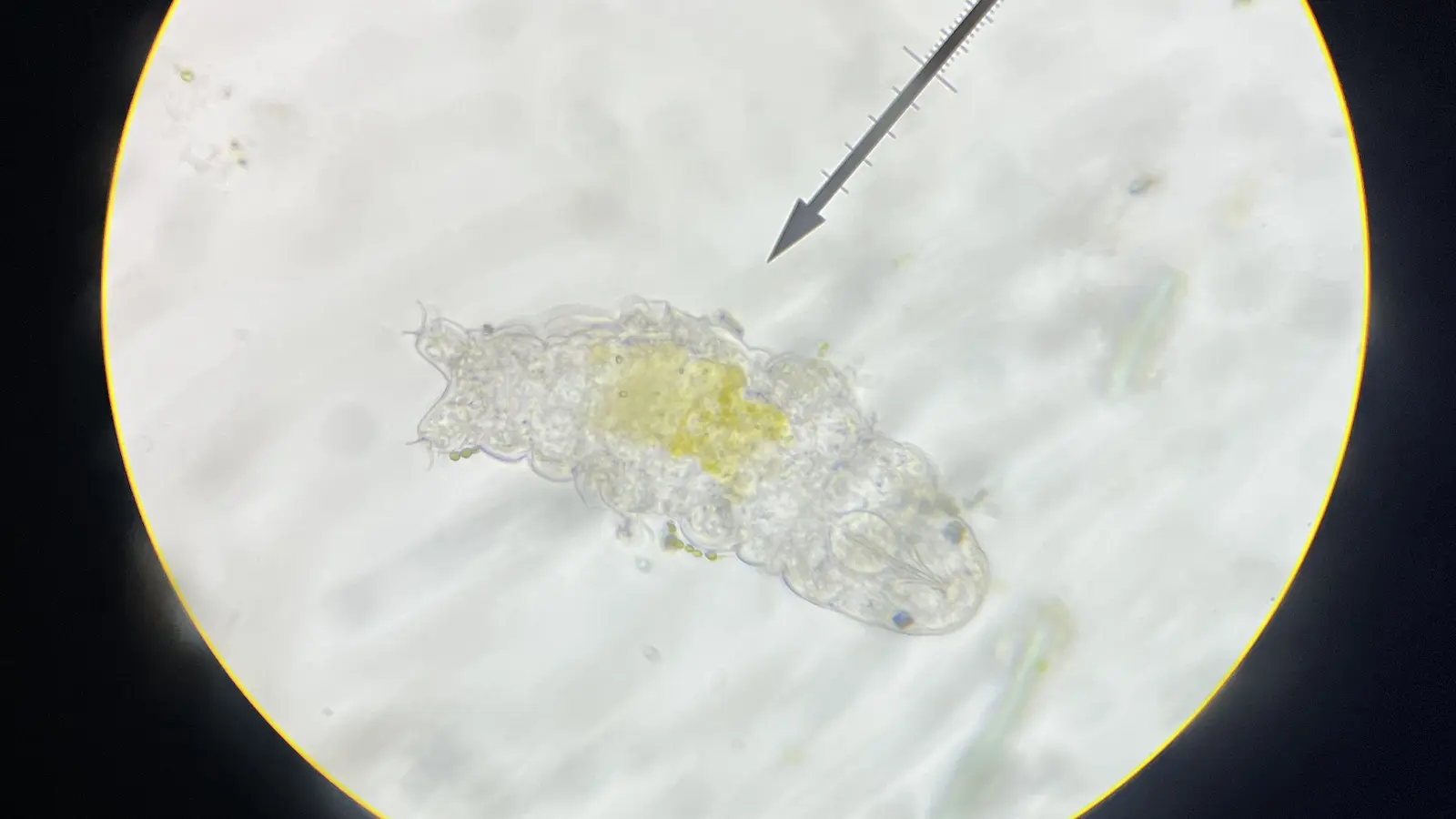
When many limno-terrestrial tardigrades dry slowly enough, they retract their legs, contract into a barrel-shaped tun and reduce measurable metabolism to extremely low levels.
How scientists know: Microscopy follows body contraction, while respirometry and survival tests compare hydrated animals, successfully dried tuns and animals dried too rapidly.
What it does—and does not—mean: A tun is not dead and it is not invulnerable; successful recovery depends on species, preparation, exposure and rehydration.
The useful question is not whether the tun is a reversible survival state sounds remarkable, but what observation would distinguish the proposed mechanism from its alternatives. That keeps explanation tied to evidence rather than analogy.
Cryptobiosis is an umbrella term
Cryptobiosis describes ametabolic or near-ametabolic states induced by environmental stress. Anhydrobiosis concerns drying; cryobiosis freezing; anoxybiosis oxygen shortage; osmobiosis high solute conditions.
How scientists know: Researchers define the inducing condition, measure activity and test recovery rather than using “cryptobiosis” as one undifferentiated superpower.
What it does—and does not—mean: Evidence for one form of dormancy does not prove tolerance of every other stress.
Cryptobiosis is an umbrella term also illustrates why scale and context matter. A mechanism demonstrated in one species, location or instrument cannot be transferred automatically to every case; researchers test where it applies and where it fails.
Drying must be controlled
Many species require time at high relative humidity before deep desiccation. This preconditioning activates protective processes and permits orderly tun formation.
How scientists know: Experiments vary humidity, drying rate and duration, then score movement, feeding and reproduction after rehydration.
What it does—and does not—mean: Dropping an active tardigrade instantly into extreme dryness may kill it; survival is a physiological transition, not a switch.
Independent methods strengthen this part of the story. When laboratory measurements, field observations and quantitative models converge on drying must be controlled, the conclusion becomes less dependent on any one instrument or assumption.
Water loss threatens every cellular structure
Drying concentrates salts, changes pH, crowds molecules and removes the hydration layers that stabilize membranes and proteins. Membranes can fuse or leak, and proteins can unfold or aggregate.
How scientists know: Biophysical studies measure membrane transitions and protein behavior during dehydration, then connect those changes with whole-animal recovery.
What it does—and does not—mean: The challenge is not simply “running out of water.” It is preserving organization while normal chemistry becomes impossible.
Uncertainty here is informative rather than embarrassing. Scientists can be confident about the central mechanism of water loss threatens every cellular structure while continuing to refine its limits, history and relative importance.
CAHS proteins form protective matrices
Cytoplasmic-abundant heat-soluble proteins in some tardigrades are intrinsically disordered when hydrated and can form filaments, gels or glass-like matrices as cells lose water.
How scientists know: Purified proteins, cell-expression experiments, structural methods and gene perturbations link CAHS behavior with improved desiccation tolerance.
What it does—and does not—mean: No single protein explains every species. Tardigrades use suites of protectants whose importance varies.
A careful headline should preserve that distinction: the evidence supports a defined claim about cahs proteins form protective matrices, not every broader interpretation that can be attached to it.
Vitrification can immobilize damage
A biological glass is an amorphous solid that limits molecular movement without forming damaging crystals. Tardigrade proteins and metabolites can contribute to vitrified states during drying.
How scientists know: Thermal and spectroscopic measurements detect glass transitions, and survival changes when protective components are altered.
What it does—and does not—mean: “Glass” here is a physical state at microscopic scale, not literal silica or a transparent shell.
The useful question is not whether vitrification can immobilize damage sounds remarkable, but what observation would distinguish the proposed mechanism from its alternatives. That keeps explanation tied to evidence rather than analogy.
Trehalose is not the universal answer
Some desiccation-tolerant organisms accumulate large amounts of the sugar trehalose. Certain tardigrades contain little or no trehalose, directing attention toward proteins and other compounds.
How scientists know: Chemical assays compare metabolites among taxa and conditions, while genomic studies examine synthesis pathways.
What it does—and does not—mean: A mechanism famous in yeast or brine shrimp should not automatically be assigned to tardigrades.
Trehalose is not the universal answer also illustrates why scale and context matter. A mechanism demonstrated in one species, location or instrument cannot be transferred automatically to every case; researchers test where it applies and where it fails.
Dsup is linked to DNA protection
The damage suppressor protein Dsup from Ramazzottius varieornatus associates with chromatin and can reduce some radiation-linked DNA damage when expressed in cultured cells.
How scientists know: Cell experiments compare DNA breaks and oxidative damage with and without Dsup; structural work investigates its interaction with nucleosomes.
What it does—and does not—mean: Dsup is not a force field, and it is absent or different in many tardigrades. Whole-animal survival involves more than one protein.
Independent methods strengthen this part of the story. When laboratory measurements, field observations and quantitative models converge on dsup is linked to dna protection, the conclusion becomes less dependent on any one instrument or assumption.
Radiation tolerance has several causes
Ionizing radiation can damage DNA directly and through reactive molecules produced from water. Low water content, antioxidants, chromatin-associated proteins and efficient repair may all contribute.
How scientists know: Dose-response experiments compare hydrated and desiccated animals, species and life stages, then assay DNA damage and recovery.
What it does—and does not—mean: Resistance to a high experimental dose does not make tardigrades immune to radiation or useful as casual human protection.
Uncertainty here is informative rather than embarrassing. Scientists can be confident about the central mechanism of radiation tolerance has several causes while continuing to refine its limits, history and relative importance.
Freezing is not the same as drying
Ice can remove liquid water from cells and concentrate solutes, creating stresses that overlap with dehydration. It also introduces crystal formation and mechanical injury.
How scientists know: Controlled cooling experiments vary temperature, rate, duration and ice nucleation before measuring revival and reproduction.
What it does—and does not—mean: A tardigrade that survives one freezing protocol may fail under colder, faster or longer exposure.
A careful headline should preserve that distinction: the evidence supports a defined claim about freezing is not the same as drying, not every broader interpretation that can be attached to it.
Vacuum survival depends on prior state
Space vacuum causes rapid water loss and exposes organisms to radiation. In orbital experiments, desiccated tuns have shown partial survival, especially when shielded from the strongest solar ultraviolet exposure.
How scientists know: The TARDIS experiment on ESA’s FOTON-M3 mission compared vacuum alone with combined vacuum and solar radiation and assessed survival after return.
What it does—and does not—mean: “Survived space” usually means a fraction revived after a defined exposure; it does not mean active animals lived normally in open space.
The useful question is not whether vacuum survival depends on prior state sounds remarkable, but what observation would distinguish the proposed mechanism from its alternatives. That keeps explanation tied to evidence rather than analogy.
Pressure tolerance has limits
Experiments have exposed tardigrades to pressures far above those at Earth’s surface, but survival declines with magnitude, duration and state.
How scientists know: High-pressure apparatus provides controlled treatments followed by recovery tests.
What it does—and does not—mean: Popular lists often combine records from different species and protocols into one fictional all-capable tardigrade.
Pressure tolerance has limits also illustrates why scale and context matter. A mechanism demonstrated in one species, location or instrument cannot be transferred automatically to every case; researchers test where it applies and where it fails.
Heat is often overstated
Tuns can outlast brief heat exposure better than hydrated animals, yet sustained high temperatures sharply reduce survival. Slow warming and humidity history matter.
How scientists know: Time-temperature experiments reveal that impressive short exposures do not predict endurance over hours or days.
What it does—and does not—mean: A maximum temperature without an exposure duration is scientifically incomplete.
Independent methods strengthen this part of the story. When laboratory measurements, field observations and quantitative models converge on heat is often overstated, the conclusion becomes less dependent on any one instrument or assumption.
Cold records also need duration
Tardigrades have revived after very low experimental temperatures and long frozen storage in some cases, but outcomes vary and successful revival is not guaranteed.
How scientists know: Cryobiology studies document temperature, storage time, cooling method and post-thaw reproduction.
What it does—and does not—mean: The coldest number is not a species-wide operating range.
Uncertainty here is informative rather than embarrassing. Scientists can be confident about the central mechanism of cold records also need duration while continuing to refine its limits, history and relative importance.
Recovery takes work
After water returns, a tun unfolds and coordinated movement resumes. Cells must restore membranes, clear damaged molecules, repair DNA and restart metabolism.
How scientists know: Researchers record time to movement and longer outcomes such as feeding, molting and reproduction rather than counting a twitch as complete recovery.
What it does—and does not—mean: Revival is a process, and delayed damage can appear after apparent short-term survival.
A careful headline should preserve that distinction: the evidence supports a defined claim about recovery takes work, not every broader interpretation that can be attached to it.
Reproduction is the stronger endpoint
An individual that moves after stress may still be unable to reproduce. Population persistence depends on fertility, development and viable offspring.
How scientists know: Rigorous studies track survival through days or life stages and compare egg production and hatching with controls.
What it does—and does not—mean: A headline based only on immediate movement can exaggerate biological success.
The useful question is not whether reproduction is the stronger endpoint sounds remarkable, but what observation would distinguish the proposed mechanism from its alternatives. That keeps explanation tied to evidence rather than analogy.
Species differ profoundly
Tardigrada contains more than a thousand described species living in marine, freshwater and terrestrial habitats. Not all form equally resistant tuns or share the same protective genes.
How scientists know: Comparative genomics, proteomics and standardized stress tests reveal multiple evolutionary solutions.
What it does—and does not—mean: “The tardigrade” is a misleading singular when discussing physiological limits.
Species differ profoundly also illustrates why scale and context matter. A mechanism demonstrated in one species, location or instrument cannot be transferred automatically to every case; researchers test where it applies and where it fails.
Laboratory culture shapes knowledge
A few species are easy to culture and dominate molecular research. Their mechanisms provide strong examples but can bias generalizations about the phylum.
How scientists know: Researchers broaden taxon sampling and compare field-collected species under matched protocols.
What it does—and does not—mean: The best-studied species is not necessarily the most typical.
Independent methods strengthen this part of the story. When laboratory measurements, field observations and quantitative models converge on laboratory culture shapes knowledge, the conclusion becomes less dependent on any one instrument or assumption.
Astrobiology uses them as boundary tests
Tardigrades help researchers ask how multicellular life responds to desiccation, radiation and vacuum, and how shielding changes survival during spaceflight.
How scientists know: Orbital exposures and ground simulations separate variables and establish quantitative survival limits.
What it does—and does not—mean: Their survival does not demonstrate that tardigrades live naturally on other planets or can seed worlds unaided.
Uncertainty here is informative rather than embarrassing. Scientists can be confident about the central mechanism of astrobiology uses them as boundary tests while continuing to refine its limits, history and relative importance.
Biotechnology lessons require caution
Protective proteins may inspire approaches for stabilizing enzymes, cells or medicines during drying. Translating a tardigrade molecule into another system requires toxicity, function and delivery testing.
How scientists know: Cell culture and purified-protein experiments identify promising mechanisms before animal or clinical applications are considered.
What it does—and does not—mean: A laboratory benefit is not a proven treatment, and this biology should not be used for do-it-yourself experimentation.
A careful headline should preserve that distinction: the evidence supports a defined claim about biotechnology lessons require caution, not every broader interpretation that can be attached to it.
Stress, strategy and limitation
| Stress | Protective response | Critical limitation |
|---|---|---|
| Desiccation | Tun formation, protective proteins and vitrification | Drying rate and species |
| Freezing | Metabolic suppression and control of water/ice stress | Cooling protocol and duration |
| Radiation | Protection, antioxidants and repair | Dose, hydration and taxon |
| Vacuum | Prior desiccation and shielding | Solar UV and exposure time |
The real animal is better than the myth
Tardigrades are compelling because they are limited organisms that evolved unusually effective ways to pause. Their proteins do not abolish chemistry; they manage the molecular consequences of losing water. Their radiation resistance is substantial but variable. Their spaceflight record is an experiment with exposure, shielding and partial survival, not a permanent home beyond Earth.
That precision opens more interesting questions. How many protective systems evolved independently? Which molecules form reversible glasses or filaments? How does a cell restart without losing its organization? Each answer may teach biologists about the boundary between active life and preserved potential. The tardigrade is not indestructible. It is a master of entering, enduring and escaping conditions that temporarily make ordinary life impossible.
The next advances will come from comparing more species under standardized conditions and connecting molecular changes with long-term survival. Genomes identify candidate proteins; structural experiments show what those proteins can do; gene perturbations test whether they are necessary; and whole-animal recovery reveals whether the mechanism matters in life. No single method is enough. Together they can replace a collection of endurance records with a coherent biology of reversible suspension.
How a survival claim should be reported
A meaningful record states the species, life stage, hydration state, temperature or dose, duration, preparation and recovery endpoint. Without those details, comparisons become deceptive. One study may count movement minutes after rehydration, while another follows reproduction for weeks. One may expose a carefully prepared tun; another may begin with an active animal. Those are different experiments.
Percentages matter too. If a small fraction revives, the finding may still reveal a remarkable mechanism, but the headline should not imply universal survival. Replication across laboratories is especially valuable because humidity, culture conditions and scoring can alter outcomes. The strongest reporting treats the experimental protocol as part of the result rather than hiding it behind a record number.
Why the shutdown must remain reversible
Ordinary protective solids would be useless if they trapped molecules permanently. A successful tun must stabilize structures during water loss and then release them when hydration returns. Reversible assembly is therefore central to research on CAHS proteins and vitrification. Scientists examine how concentration, acidity, salts and crowding influence the change from flexible proteins to networks and back again.
This reversibility separates preservation from simple hardening. The material must be strong enough to limit damaging motion but responsive enough to dissolve or reorganize without poisoning the cell. That combination is one reason tardigrade proteins interest biotechnology, though any application requires extensive testing outside the animal.
Sources and further reading
- Boothby et al. (2017), Tardigrade-specific intrinsically disordered proteins
- Hashimoto et al. (2016), Extremotolerant tardigrade genome and Dsup
- Tanaka et al. (2022), Reversible gel formation of tardigrade CAHS proteins
- Jönsson et al. (2008), Tardigrades survive exposure to space
- Møbjerg et al. (2011), Survival in extreme environments—on the current knowledge of adaptations in tardigrades
- Kaczmarek et al. (2019), Tardigrades in space research
How Barnakle selects and verifies sources · Corrections and updates
Keep exploring.
One remarkable idea at a time—nature, science, history and beyond.
Last reviewed September 15, 2026.

Barnakle Editorial Team
A member of the Barnakle editorial team, exploring remarkable ideas with clarity, curiosity and care.
More from this author →