
Scouts search with smell, memory and movement cues, then recruit nestmates with chemical trails
The short answer
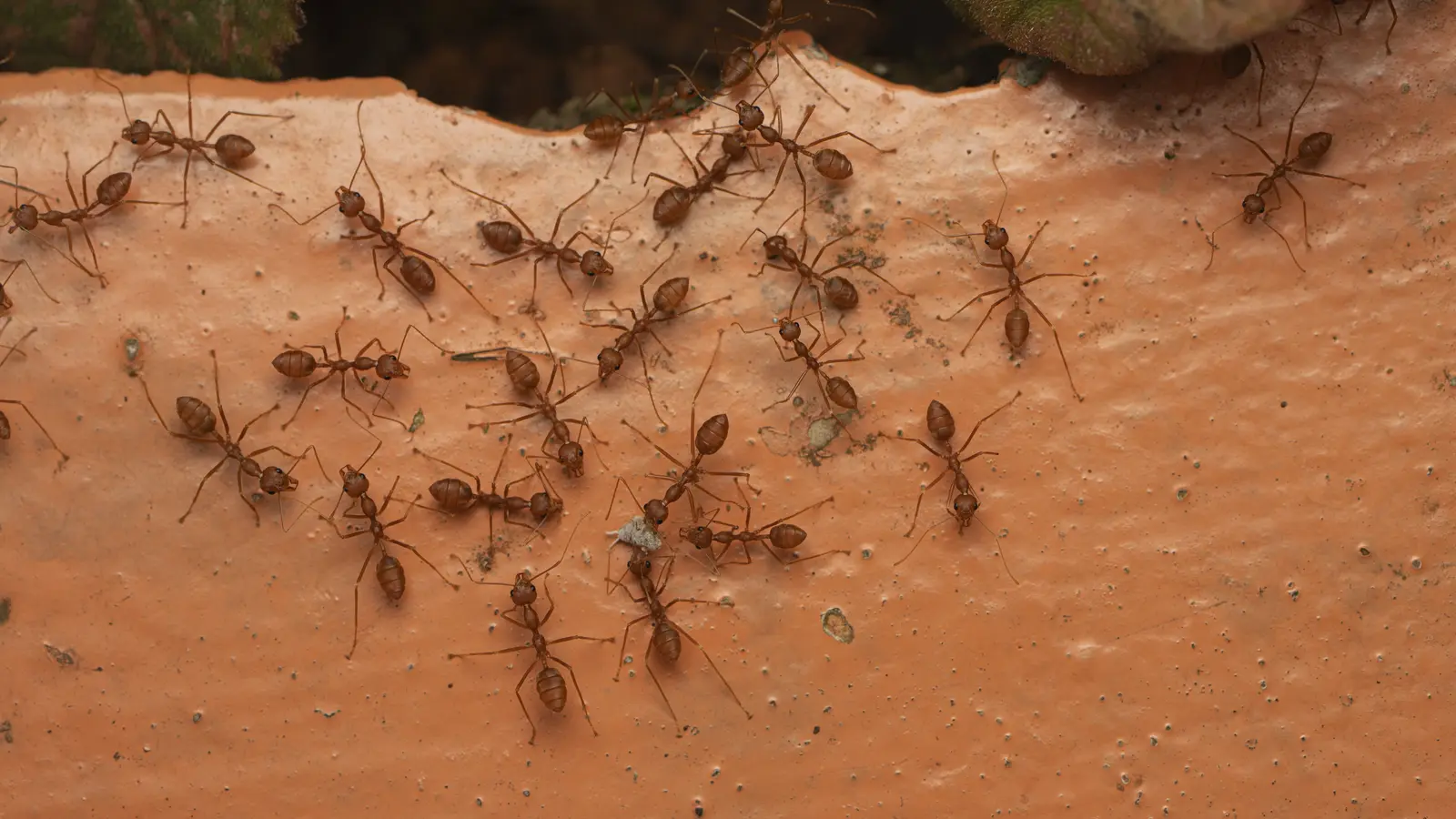
Ants find food through a combination of individual searching and colony communication. A scout explores using smell, touch, vision, path integration and local memory. After finding a useful resource, many species deposit trail pheromones while returning to the nest. Other workers detect the chemical with their antennae and reinforce a successful route. Because pheromones evaporate, an unrewarding path fades while busy routes can become stronger.
An ant colony solves a distributed information problem without a leader directing every worker. Each ant follows relatively simple rules based on local cues, yet positive feedback can produce organized foraging trails. The familiar line of ants is therefore the visible result of repeated discoveries, chemical messages and route choices—not proof that every species searches in exactly the same way.
Scouts begin with flexible search patterns
Foragers leave the nest and change direction as they explore. Search distance and persistence respond to hunger, recent success, temperature, risk and information from nestmates.
Understanding Scouts begin with flexible search patterns means separating the immediate mechanism from the conditions that change its strength, timing or visibility. Researchers measure those variables independently, compare natural examples and test whether the explanation predicts new observations. That turns a plausible story into an evidence-based account.
The evidence comes from methods that fail in different ways. Direct observation establishes what occurs, instruments quantify structure or timing, experiments isolate candidate causes and models test whether known physical or biological rules reproduce the pattern. Agreement among methods is stronger than repetition of one memorable example.
Context also matters. Scale, composition, temperature, geometry, environment and measurement limits can change an outcome without overturning the underlying process. Accurate reporting preserves this variation, states uncertainty and avoids turning a useful explanation into a universal rule.
A practical explanation should identify what would change the observation. Following that question reveals the limits of present evidence and the next measurement needed.
This mechanism connects a reader-level question with a broader scientific principle. Following matter, energy or information through each stage shows where the explanation is established, where natural variation enters and why a superficially similar event may have another cause.
Scientists also test alternatives rather than stopping at the first plausible account. A strong explanation predicts several linked observations, survives controlled comparison and specifies where it should fail. That approach keeps a clear answer accurate without hiding complexity.
Antennae sample a chemical landscape
Ant antennae contain many sensory receptors. Workers compare odours across space and time, touch surfaces and assess food quality at close range before recruiting others.
Understanding Antennae sample a chemical landscape means separating the immediate mechanism from the conditions that change its strength, timing or visibility. Researchers measure those variables independently, compare natural examples and test whether the explanation predicts new observations. That turns a plausible story into an evidence-based account.
The evidence comes from methods that fail in different ways. Direct observation establishes what occurs, instruments quantify structure or timing, experiments isolate candidate causes and models test whether known physical or biological rules reproduce the pattern. Agreement among methods is stronger than repetition of one memorable example.
Context also matters. Scale, composition, temperature, geometry, environment and measurement limits can change an outcome without overturning the underlying process. Accurate reporting preserves this variation, states uncertainty and avoids turning a useful explanation into a universal rule.
A practical explanation should identify what would change the observation. Following that question reveals the limits of present evidence and the next measurement needed.
This mechanism connects a reader-level question with a broader scientific principle. Following matter, energy or information through each stage shows where the explanation is established, where natural variation enters and why a superficially similar event may have another cause.
Scientists also test alternatives rather than stopping at the first plausible account. A strong explanation predicts several linked observations, survives controlled comparison and specifies where it should fail. That approach keeps a clear answer accurate without hiding complexity.
Trail pheromones mark a route
In many species, a successful ant touches its abdomen or sting region to the ground while returning. The deposited molecules form a directional path that nestmates can detect.
Understanding Trail pheromones mark a route means separating the immediate mechanism from the conditions that change its strength, timing or visibility. Researchers measure those variables independently, compare natural examples and test whether the explanation predicts new observations. That turns a plausible story into an evidence-based account.
The evidence comes from methods that fail in different ways. Direct observation establishes what occurs, instruments quantify structure or timing, experiments isolate candidate causes and models test whether known physical or biological rules reproduce the pattern. Agreement among methods is stronger than repetition of one memorable example.
Context also matters. Scale, composition, temperature, geometry, environment and measurement limits can change an outcome without overturning the underlying process. Accurate reporting preserves this variation, states uncertainty and avoids turning a useful explanation into a universal rule.
A practical explanation should identify what would change the observation. Following that question reveals the limits of present evidence and the next measurement needed.
This mechanism connects a reader-level question with a broader scientific principle. Following matter, energy or information through each stage shows where the explanation is established, where natural variation enters and why a superficially similar event may have another cause.
Scientists also test alternatives rather than stopping at the first plausible account. A strong explanation predicts several linked observations, survives controlled comparison and specifies where it should fail. That approach keeps a clear answer accurate without hiding complexity.
Recruitment amplifies good discoveries
Ants that reach rewarding food return and add pheromone, making that path more attractive. Repeated reinforcement can rapidly shift workers toward a rich or accessible source.
Understanding Recruitment amplifies good discoveries means separating the immediate mechanism from the conditions that change its strength, timing or visibility. Researchers measure those variables independently, compare natural examples and test whether the explanation predicts new observations. That turns a plausible story into an evidence-based account.
The evidence comes from methods that fail in different ways. Direct observation establishes what occurs, instruments quantify structure or timing, experiments isolate candidate causes and models test whether known physical or biological rules reproduce the pattern. Agreement among methods is stronger than repetition of one memorable example.
Context also matters. Scale, composition, temperature, geometry, environment and measurement limits can change an outcome without overturning the underlying process. Accurate reporting preserves this variation, states uncertainty and avoids turning a useful explanation into a universal rule.
A practical explanation should identify what would change the observation. Following that question reveals the limits of present evidence and the next measurement needed.
This mechanism connects a reader-level question with a broader scientific principle. Following matter, energy or information through each stage shows where the explanation is established, where natural variation enters and why a superficially similar event may have another cause.
Scientists also test alternatives rather than stopping at the first plausible account. A strong explanation predicts several linked observations, survives controlled comparison and specifies where it should fail. That approach keeps a clear answer accurate without hiding complexity.
Evaporation removes stale information
Trail chemicals are temporary. If food disappears, fewer ants reinforce the route and the signal decays, allowing the colony to redirect effort rather than following an obsolete path indefinitely.
Understanding Evaporation removes stale information means separating the immediate mechanism from the conditions that change its strength, timing or visibility. Researchers measure those variables independently, compare natural examples and test whether the explanation predicts new observations. That turns a plausible story into an evidence-based account.
The evidence comes from methods that fail in different ways. Direct observation establishes what occurs, instruments quantify structure or timing, experiments isolate candidate causes and models test whether known physical or biological rules reproduce the pattern. Agreement among methods is stronger than repetition of one memorable example.
Context also matters. Scale, composition, temperature, geometry, environment and measurement limits can change an outcome without overturning the underlying process. Accurate reporting preserves this variation, states uncertainty and avoids turning a useful explanation into a universal rule.
A practical explanation should identify what would change the observation. Following that question reveals the limits of present evidence and the next measurement needed.
This mechanism connects a reader-level question with a broader scientific principle. Following matter, energy or information through each stage shows where the explanation is established, where natural variation enters and why a superficially similar event may have another cause.
Scientists also test alternatives rather than stopping at the first plausible account. A strong explanation predicts several linked observations, survives controlled comparison and specifies where it should fail. That approach keeps a clear answer accurate without hiding complexity.
Colonies can favour shorter paths
When alternatives reach the same resource, ants on a shorter route complete trips sooner and reinforce it more often. Positive feedback can make the efficient path dominate without any worker measuring the entire network.
Understanding Colonies can favour shorter paths means separating the immediate mechanism from the conditions that change its strength, timing or visibility. Researchers measure those variables independently, compare natural examples and test whether the explanation predicts new observations. That turns a plausible story into an evidence-based account.
The evidence comes from methods that fail in different ways. Direct observation establishes what occurs, instruments quantify structure or timing, experiments isolate candidate causes and models test whether known physical or biological rules reproduce the pattern. Agreement among methods is stronger than repetition of one memorable example.
Context also matters. Scale, composition, temperature, geometry, environment and measurement limits can change an outcome without overturning the underlying process. Accurate reporting preserves this variation, states uncertainty and avoids turning a useful explanation into a universal rule.
A practical explanation should identify what would change the observation. Following that question reveals the limits of present evidence and the next measurement needed.
This mechanism connects a reader-level question with a broader scientific principle. Following matter, energy or information through each stage shows where the explanation is established, where natural variation enters and why a superficially similar event may have another cause.
Scientists also test alternatives rather than stopping at the first plausible account. A strong explanation predicts several linked observations, survives controlled comparison and specifies where it should fail. That approach keeps a clear answer accurate without hiding complexity.
Landmarks and memory also matter
Desert ants and other species learn visual scenes, count steps through path integration and use the Sun’s polarization pattern. Experienced workers may navigate even when a chemical trail is weak.
Understanding Landmarks and memory also matter means separating the immediate mechanism from the conditions that change its strength, timing or visibility. Researchers measure those variables independently, compare natural examples and test whether the explanation predicts new observations. That turns a plausible story into an evidence-based account.
The evidence comes from methods that fail in different ways. Direct observation establishes what occurs, instruments quantify structure or timing, experiments isolate candidate causes and models test whether known physical or biological rules reproduce the pattern. Agreement among methods is stronger than repetition of one memorable example.
Context also matters. Scale, composition, temperature, geometry, environment and measurement limits can change an outcome without overturning the underlying process. Accurate reporting preserves this variation, states uncertainty and avoids turning a useful explanation into a universal rule.
A practical explanation should identify what would change the observation. Following that question reveals the limits of present evidence and the next measurement needed.
This mechanism connects a reader-level question with a broader scientific principle. Following matter, energy or information through each stage shows where the explanation is established, where natural variation enters and why a superficially similar event may have another cause.
Scientists also test alternatives rather than stopping at the first plausible account. A strong explanation predicts several linked observations, survives controlled comparison and specifies where it should fail. That approach keeps a clear answer accurate without hiding complexity.
Different species use different systems
Some ants recruit in groups, lay trunk trails, carry nestmates or forage largely alone. Ecology, colony size, food type and habitat shape which signals are most important.
Understanding Different species use different systems means separating the immediate mechanism from the conditions that change its strength, timing or visibility. Researchers measure those variables independently, compare natural examples and test whether the explanation predicts new observations. That turns a plausible story into an evidence-based account.
The evidence comes from methods that fail in different ways. Direct observation establishes what occurs, instruments quantify structure or timing, experiments isolate candidate causes and models test whether known physical or biological rules reproduce the pattern. Agreement among methods is stronger than repetition of one memorable example.
Context also matters. Scale, composition, temperature, geometry, environment and measurement limits can change an outcome without overturning the underlying process. Accurate reporting preserves this variation, states uncertainty and avoids turning a useful explanation into a universal rule.
A practical explanation should identify what would change the observation. Following that question reveals the limits of present evidence and the next measurement needed.
This mechanism connects a reader-level question with a broader scientific principle. Following matter, energy or information through each stage shows where the explanation is established, where natural variation enters and why a superficially similar event may have another cause.
Scientists also test alternatives rather than stopping at the first plausible account. A strong explanation predicts several linked observations, survives controlled comparison and specifies where it should fail. That approach keeps a clear answer accurate without hiding complexity.
Food quality changes the message
Workers can vary pheromone deposition, recruitment intensity and acceptance according to sugar concentration, prey size, distance, competition and colony needs. The trail conveys value indirectly through behaviour.
Understanding Food quality changes the message means separating the immediate mechanism from the conditions that change its strength, timing or visibility. Researchers measure those variables independently, compare natural examples and test whether the explanation predicts new observations. That turns a plausible story into an evidence-based account.
The evidence comes from methods that fail in different ways. Direct observation establishes what occurs, instruments quantify structure or timing, experiments isolate candidate causes and models test whether known physical or biological rules reproduce the pattern. Agreement among methods is stronger than repetition of one memorable example.
Context also matters. Scale, composition, temperature, geometry, environment and measurement limits can change an outcome without overturning the underlying process. Accurate reporting preserves this variation, states uncertainty and avoids turning a useful explanation into a universal rule.
A practical explanation should identify what would change the observation. Following that question reveals the limits of present evidence and the next measurement needed.
This mechanism connects a reader-level question with a broader scientific principle. Following matter, energy or information through each stage shows where the explanation is established, where natural variation enters and why a superficially similar event may have another cause.
Scientists also test alternatives rather than stopping at the first plausible account. A strong explanation predicts several linked observations, survives controlled comparison and specifies where it should fail. That approach keeps a clear answer accurate without hiding complexity.
Common misconceptions
Ants do not merely smell food from any distance and march straight toward it. A scout often has to encounter the resource first. The colony also does not follow commands from a queen; her primary role is reproduction. Pheromone trails are powerful but are only one part of ant navigation, and individual workers can learn routes.
Clear shorthand is valuable only when it preserves the causal chain. It becomes misleading when it substitutes a label for a mechanism, confuses association with cause or extends evidence beyond tested conditions.
How scientists know
Entomologists place food at controlled distances, offer branching mazes, remove trails, change landmarks and record movements. Chemical analysis identifies pheromone compounds, electroantennography measures antennal responses and automated tracking reveals how individual decisions become colony-level patterns.
No single measurement carries the conclusion. Observations, experiments, theory and repeated records provide independent checks, while disagreement can reveal an uncontrolled variable or a question requiring a better test.
Frequently asked questions
Why do ants form a line?
Workers follow and reinforce a narrow chemical trail between the nest and a profitable resource.
What happens when the food is gone?
Reinforcement stops and volatile pheromone fades, so traffic gradually declines.
Can ants get lost?
Yes. Displaced workers may search, use landmarks or follow other cues, but navigation can fail.
Do all ants use pheromone trails?
No. Recruitment and navigation systems vary widely among species.
Why do ants appear so quickly in a kitchen?
Scouts regularly explore; once one finds concentrated food, chemical recruitment can multiply traffic.
Key takeaways
- Scouts discover resources through active search.
- Many species recruit nestmates with trail pheromones.
- Reinforcement favours productive routes while evaporation erases failures.
- Memory, vision and path integration complement chemical cues.
Continue exploring
Sources and further reading
Keep exploring.
One remarkable idea at a time—nature, science, history and beyond.
Sources and further reading
Barnakle uses credible primary and authoritative sources wherever possible.
- USDA Agricultural Research Service — Fire ant pheromone trails
- https://www.ars.usda.gov/news-events/news/research-news/2014/on-the-trail-of-fire-ant-pheromones/
- USDA ARS — Ant foraging and trail communication
- https://agresearchmag.ars.usda.gov/2014/apr/ants
- U.S. Forest Service — Leaf-cutting ant trail responses
- https://research.fs.usda.gov/treesearch/22376
- USDA ARS — Fire ant foraging behaviour
- https://www.ars.usda.gov/arsuserfiles/60360510/publications/Vander_Meer-1987%28M-1686%29.pdf
Last reviewed October 8, 2026.

Barnakle Editorial Team
A member of the Barnakle editorial team, exploring remarkable ideas with clarity, curiosity and care.
More from this author →