A leaf that senses touch, stores a signal and releases elastic energy
An insect walks across what looks like a small green mouth. Nothing happens at the first disturbance. Another movement follows, and the two halves of the leaf fold together so quickly that the change is difficult to follow. The trap has no muscles, nerves or brain. Its speed comes from a partnership between living signals and a mechanically prepared leaf.
To understand the movement, separate three questions: how the plant detects a visitor, how it decides to close, and what physically moves the lobes. Those questions have different answers. Solving one does not automatically solve the others, which is why this famous plant continues to produce new research.
The trap is a modified leaf
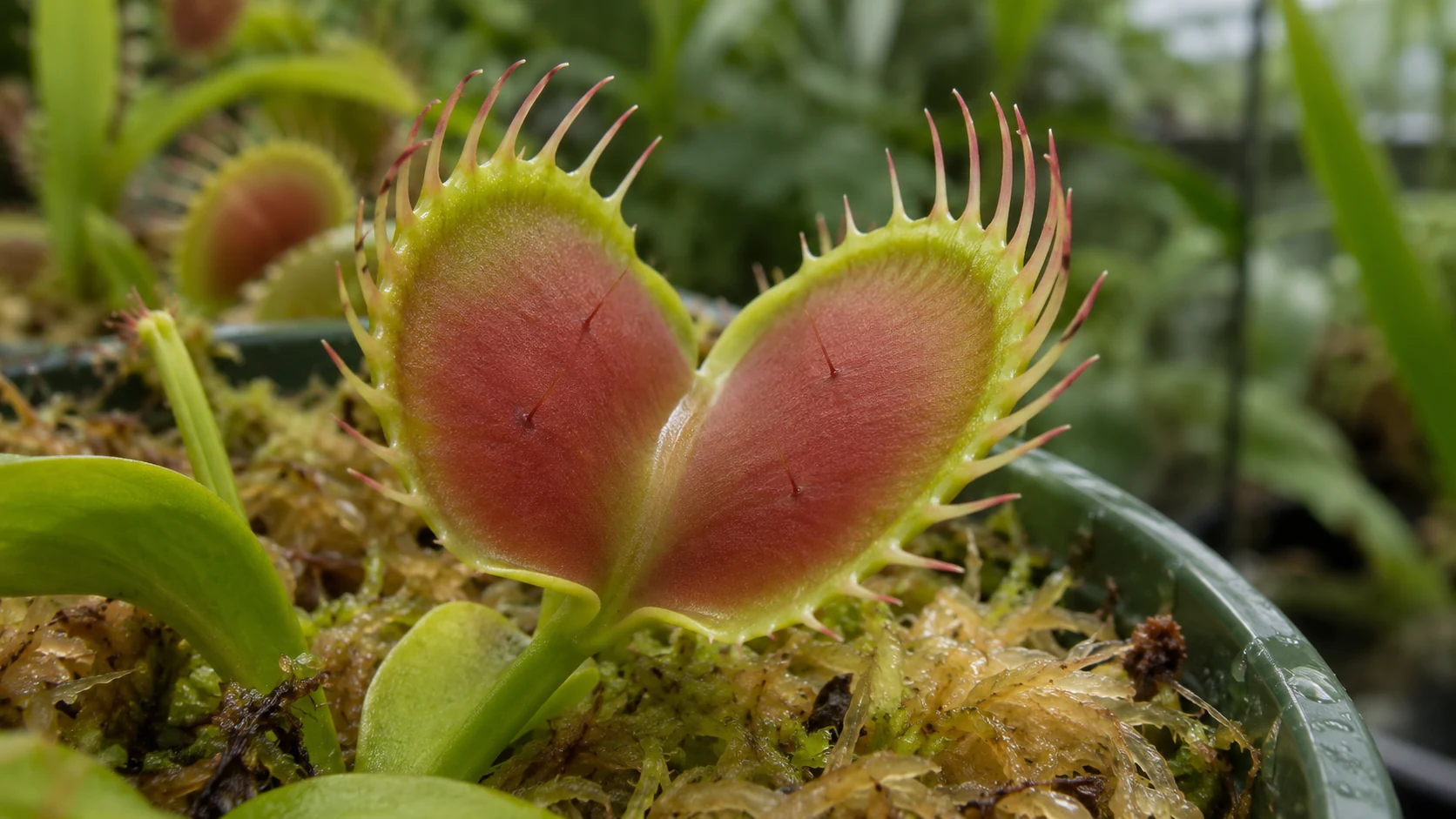
The Venus flytrap, Dionaea muscipula, has leaves whose ends form paired lobes. Slender structures project from their margins, while much smaller sensory hairs stand on the inner surfaces. Those two sets of structures have different jobs: the outer fringe helps confine a visitor; the sensory hairs detect mechanical disturbance.
North Carolina State University’s plant account describes the species as native to a small part of the coastal Carolinas. It is a plant adapted to a particular habitat, rather than a miniature animal disguised as vegetation. Its leaves still belong to a photosynthetic organism with roots, flowers and a seasonal life cycle. [1]
A helpful first observation is to look for the smaller hairs inside an open cultivated trap. They are easy to overlook beside the conspicuous fringe. A photograph of the plant’s outer “teeth” does not, by itself, show the structures that start the electrical response.
A bent hair becomes an electrical signal
Moving a sensory hair deforms living tissue at its base. A sufficiently effective mechanical stimulus can initiate an action potential: a brief change in electrical conditions across cell membranes that propagates through the trap. Plants use ion movements and membrane voltages even though they lack an animal nervous system.
Researchers studying the flytrap’s signalling distinguish the local sensory event from the signal travelling across the lobes. Recent work on mechanosensitive channels continues to refine that first stage. The existence of an electrical pulse does not mean the leaf contains a hidden nerve or a miniature brain. [2]
Think of the sensory hair as the entrance to a chain of events, rather than a mechanical lever that directly yanks the trap closed. Bending the hair and moving the entire leaf are separated by biological signalling. That distinction helps explain why not every incidental contact produces the same visible response.
Why two touches usually matter
The familiar description is that a flytrap needs two touches close together. More precisely, it responds to the signals those disturbances generate. In experiments, two action potentials arriving within a short interval commonly initiate closure. It need not be two different hairs: the important issue is the effective stimulation.
A 2020 study visualized calcium changes using plants engineered to produce a fluorescent calcium indicator. The first stimulus produced a temporary calcium response. Another arriving before that response had faded could push the system past the level associated with closure. If the gap was too long, the remaining signal was insufficient. [3]
This is a useful example of biological short-term memory. The first event leaves a changing chemical state that affects what happens next. Calling it “counting” describes that integration of signals; it does not imply the plant recognizes numbers in the human sense.
Nor should a popular rule such as “two touches in thirty seconds” be treated as a universal stopwatch specification for every trap. The published experiments describe particular plants, conditions and stimuli. The durable idea is a signal threshold with a limited memory, not a plant that obeys a printed countdown.
Snap-buckling provides the speed boost
A slowly changing force can produce a very fast movement if a structure becomes unstable. A curved object may resist deformation and then abruptly switch shape once it crosses a threshold. The flytrap uses this kind of elastic instability, known as snap-buckling, in its closing lobes.
The influential 2005 study combined high-speed imaging, microscopy and mechanical modelling to connect trap closure with that abrupt change in curvature. The result explained how a leaf could move faster than a simple picture of gradual bending would suggest. The plant controls when the instability is triggered; the structure supplies the rapid transition. [4]
A bent plastic lid can offer a rough mechanical analogy: it may change little while being pressed, then suddenly pop into another shape. The analogy illustrates stored elastic energy and instability only. A living trap also has sensors, signalling, layered tissues and the ability to restore itself.
What the June 2026 study changed
Knowing that the lobes snap left an important question: what actively drives them across the instability threshold? In June 2026, Ryu and colleagues reported hydraulic and mechanical measurements identifying rapid softening of the outer epidermal cell walls as that driver.
Their results indicated that closure was too fast to be powered by the proposed rapid redistribution of water. Instead, changing the stiffness of the outer tissue released elastic energy already stored in the trap. The softening developed on a timescale of roughly a second, while the subsequent snap could be much faster. [5]
The careful distinction is between preparing and releasing a loaded structure. Water remains essential to the living plant, but “the plant quickly pumps water from one side to the other” is no longer an adequate account of the closing motor described by this study. This updates the driver, rather than removing snap-buckling from the explanation.
Closure and digestion are different stages
The first snap is not the entire meal. A captured animal can continue disturbing the sensory system as it struggles. Research published in 2016 showed that repeated prey-induced electrical signals influence hormone signalling, digestive-enzyme production and the machinery that takes up nutrients.
That gives the plant a staged response. Capturing something and investing in digestion are not identical commitments. The study linked the amount of stimulation to molecular responses involved in processing prey, rather than describing a trap that automatically pours out the same digestive mixture after every touch. [6]
For a reader watching a time-lapse, this matters. A fraction-of-a-second snap, the later tightening of the trap and the much longer digestion period should not be presented as one continuous fast movement. They are different parts of a hunting cycle, with different physical and biochemical demands.
| Stage | What changes | What to avoid assuming |
|---|---|---|
| Detection | A sensory hair is mechanically disturbed. | The marginal fringe is the main trigger. |
| Signal integration | Electrical and calcium responses accumulate over a short interval. | The plant consciously counts. |
| Fast closure | A loaded leaf crosses an elastic instability. | Animal-like muscles pull the lobes together. |
| Processing prey | Further signals influence digestive and nutrient-uptake responses. | Everything is finished when the lobes first meet. |
Why catch insects if the plant has sunlight?
Insects supply nutrients that are scarce in the flytrap’s environment. They do not replace sunlight as the plant’s main energy source. The U.S. Fish and Wildlife Service explicitly distinguishes energy obtained through photosynthesis from nutrients obtained by digesting animals. [7]
This distinction changes the usual “plant that eats like an animal” story. The flytrap combines ordinary plant functions with an unusual route to supplementary nutrients. Understanding how plants move water provides another example of a familiar organism solving a physical problem without animal organs.
A trap is therefore not evidence that roots, water and light are optional. It is an adaptation within a plant’s whole way of living. Describing insects as its only food obscures that larger system.
Watch the plant without repeatedly triggering it
The most informative observation is often a patient one. Compare the shapes of open traps, note where the sensory hairs sit, and distinguish traps that are fully open from those at other stages. A reputable botanical display or a responsibly cultivated plant offers that opportunity without collecting specimens from the wild.
Repeatedly forcing traps shut for entertainment is unnecessary. It also produces a misleading impression that closure is the plant’s only interesting behaviour. Its leaves, flowers, habitat and seasonal changes belong to the same story. The North Carolina extension account warns against wild collection; local conservation rules and responsible sourcing matter. [1]
Questions readers ask
Does a Venus flytrap have a brain?
No. Its response uses signalling within plant cells and tissues. Short-lived chemical changes can preserve information about a recent stimulus without a nervous system.
Do two different hairs have to be touched?
No. The usual requirement concerns effective signals close together, not a rule that two distinct hairs must each be touched once.
Does it close by pumping water?
The June 2026 study challenged rapid water redistribution as the closing motor and identified fast softening of outer cell walls that releases stored elastic energy.
Are its insects a substitute for sunlight?
No. Photosynthesis remains the main energy source. Prey contributes nutrients that can be difficult to obtain from the surrounding habitat.
Is the first snap the same as digestion?
No. Capture is followed by further responses that can include sealing, digestive secretion and nutrient uptake.
A fast movement built from several slower-looking parts
The flytrap’s surprise is not simply that a leaf moves. It is that sensation, temporary memory, changing material properties and stored elastic energy work together. Follow that chain and the apparent “mouth” becomes something more interesting: a plant using its own tissues as both a sensor and a controlled mechanical structure.
Continue exploring
- How Trees Lift Water Hundreds of Feet Without a Pump
- Why Do Leaves Change Colour in Autumn?
- How Do Geckos Walk on Walls?
Sources and further reading
- NC State Extension — Dionaea muscipula
- Nature Communications (2025) — MSL10 is a high-sensitivity mechanosensor in the tactile sense of the Venus flytrap
- University of Würzburg — How the Venus Flytrap Counts (2020 calcium-imaging research)
- Forterre et al., Nature (2005) — How the Venus flytrap snaps
- Ryu et al., Science (2026) — Fast cell wall softening causes Venus flytrap closure (PubMed abstract)
- Böhm et al., Current Biology (2016) — The Venus Flytrap Dionaea muscipula Counts Prey-Induced Action Potentials to Induce Sodium Uptake
- U.S. Fish & Wildlife Service — Venus Fly Trap
Keep exploring.
One remarkable idea at a time—nature, science, history and beyond.
Last updated November 6, 2026.

Barnakle Editorial Team
Barnakle Editorial Team is the collective byline used for Barnakle’s editorial articles. The contributor profile explains the team identity and links to the publication’s editorial policies.
More from the editorial team →