Four wings form a coordinated aerodynamic and sensory system
A dragonfly can pause over water, dart sideways and return to a reed before its movement seems fully registered. The wings may appear as little more than a blur. Slowing that blur reveals a flying system with several adjustable parts rather than four identical paddles repeating one stroke.
The important question is how those parts cooperate. Making enough aerodynamic force to stay up is one problem, also explored in hummingbird hovering. Different animals solve the broader flight problem with different anatomy. Directing that force and keeping the body oriented are additional problems, solved through wing motion and sensory control.
Follow the mechanism
- Muscles change the motion and rotation of the four wings.
- Moving wings create aerodynamic forces and leave disturbed air behind.
- Wing timing and left-right differences alter the net force and turning effect.
- Sensory information helps the insect adjust as its body and surroundings change.
Four wings provide more than twice the surface area
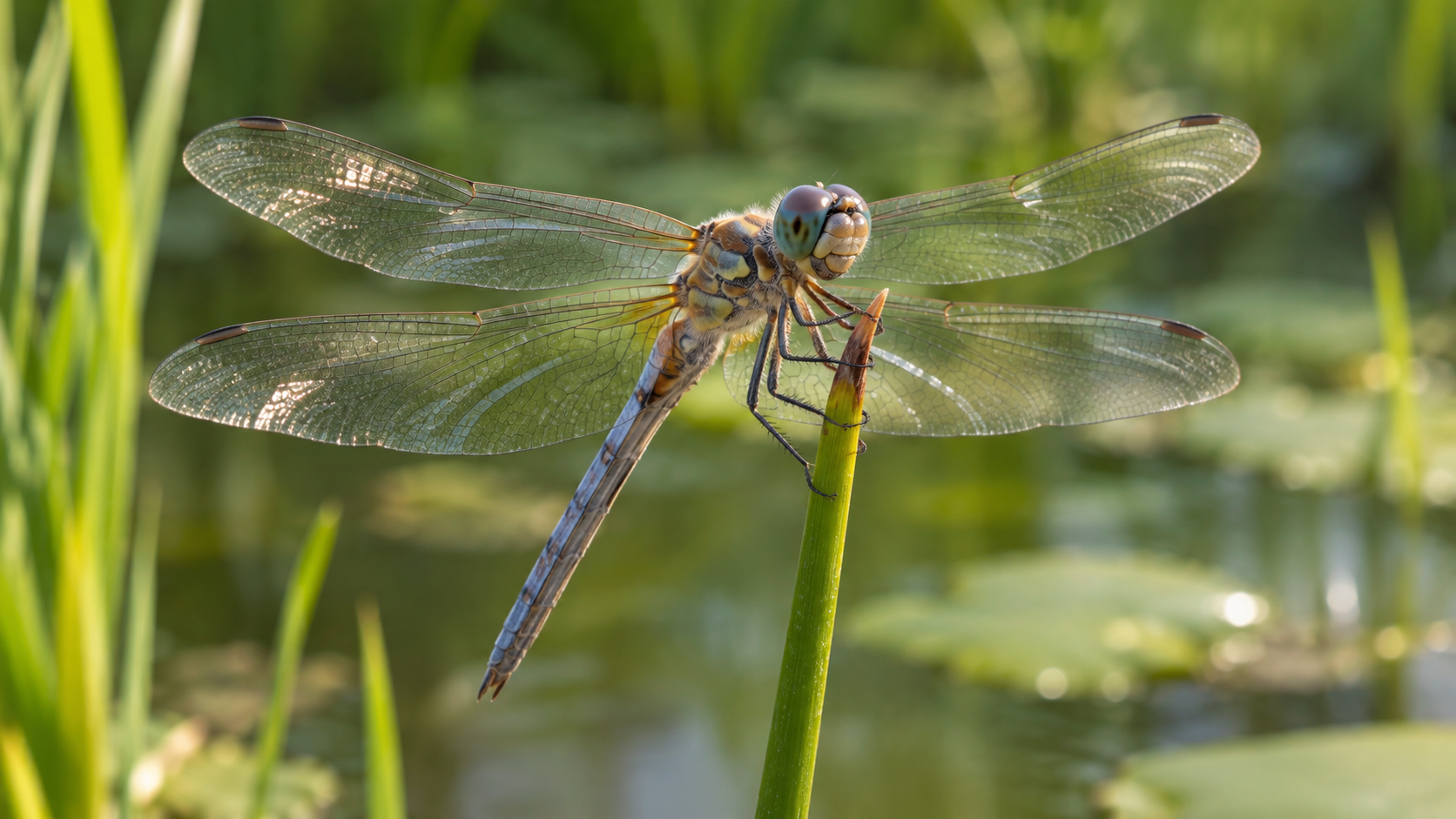
A dragonfly has a forewing and hindwing on each side. These pairs are not simply locked into one rigid panel. Researchers describe their independently controllable four-winged arrangement, with timing differences between the front and rear strokes.
That flexibility creates possibilities as well as complications. Each wing moves through air that may have already been affected by another wing. A rear wing does not always meet the same flow as an isolated wing in an undisturbed wind tunnel.
Imagine two people rowing one behind the other. Their timing matters partly because each acts on a moving fluid. The comparison does not make wings into oars, but it illustrates why duplicating a force-producing surface is not automatically equivalent to duplicating its isolated performance.
Sources: [1]
Flapping and wing rotation work together
A wing’s path through the air and its orientation influence the forces it produces. A dragonfly can alter the angle of a wing during the stroke, changing the aerodynamic result. The Natural History Museum’s account of wing-control research highlights this combination of movement and rotation.
The relevant angle is relative to the local flow, not just to the horizon in a photograph. That local flow includes the wing’s own motion and the surrounding air. A still image can therefore be misleading if treated as a complete aerodynamic explanation.
This is one reason a flapping wing is not a fixed aircraft wing merely tilted up and down. Its direction, speed and orientation change through a cycle. The surrounding flow also changes, so the sequence matters as much as one attractive frame.
Sources: [2]
Hovering means balancing average forces
A hovering insect remains near one location while its wings move rapidly. Over an appropriate interval, the upward aerodynamic contribution must balance its weight, while the net horizontal force must be compatible with its nearly stationary position.
Individual strokes do not have to produce identical forces at every instant. A cycle can contain changing accelerations and still give an appropriate average. The useful distinction is between the motion of the body and the much faster motion of the wings.
Consider a sequence of small pushes in opposing directions. They can average to little overall displacement while still involving substantial activity. A real hovering dragonfly is more complicated, but the thought experiment explains why an apparently motionless body is not evidence that its flight system is doing little work.
Sources: [1]
| Part or idea | What it does | Common misunderstanding |
|---|---|---|
| Wing path and speed | Change how the wings move through the surrounding air. | Wing area alone explains every flight mode. |
| Wing pitch | Changes the orientation of a wing relative to the flow. | A still photograph gives the complete angle of attack. |
| Forewing-hindwing timing | Changes interactions between the front and rear wing strokes. | The two pairs always beat in synchrony. |
| Left-right differences | Can create turning effects as well as changing support. | Every manoeuvre requires the entire insect to flap faster. |
The wake can be part of the next stroke’s environment
A moving wing leaves air with altered velocity and rotation. The next wing or stroke can encounter that disturbance. Studies of dragonfly-inspired tandem wings investigate these interactions rather than assuming that each wing acts alone.
The 2008 study “Phasing of dragonfly wings can improve aerodynamic efficiency by removing swirl” used a mechanical hovering model to measure forces and wakes. Changing the forewing-hindwing phase altered the aerodynamic power requirements under the tested conditions.
That finding should retain its scope. A controlled model can reveal a mechanism, but it does not establish one universal efficiency saving for every living dragonfly and manoeuvre. Its value is showing that coordination can change the fluid mechanics, not supplying a single percentage for all four-winged flight.
Sources: [1]
A turn requires a turning effect, not just forward speed
To rotate the body, a dragonfly needs an appropriate net moment, or turning effect. Differences in aerodynamic force and where those forces act can create that moment. Changing the left and right wings differently gives the animal a way to alter the balance.
A 2022 study of the righting reflex examined dragonflies released upside down. Kinematic analysis, physical modelling and three-dimensional simulations identified left-right wing-pitch asymmetry as a key part of their recovery roll.
The result makes a useful distinction: a manoeuvre can depend on a subtle difference between sides rather than a spectacular increase in wing motion. The visible body rotation is the outcome. The less obvious control action is hidden among rapid changes at the wings.
Sources: [3]
Vision helps trigger a recovery response
The righting study also investigated the role of the visual system. Experiments that blocked vision changed the insects’ recovery, supporting a pathway from visual information to the muscle actions that regulate wing pitch.
Cornell’s account of the work describes the use of three high-speed cameras and reconstructed body and wing motion. The researchers combined observations with modelling to infer which changes were mechanically important.
This does not mean the insect consciously calculates a roll angle. Nor does it establish that vision is the only sensory information involved in every aspect of dragonfly flight. It identifies a role for vision in a defined recovery behaviour under studied conditions.
Wings are also sensory structures
The Natural History Museum describes research into sensory neurons integrated with dragonfly wings. Such structures can provide information related to the wing and its mechanical environment, adding another dimension to the familiar picture of a thin transparent lifting surface.
This is different from treating a wing as a passive sheet moved by a central instruction. The flying system includes a material structure, muscles, sensors and feedback. The interactions among them matter when the airflow changes unexpectedly.
Engineers study these relationships because small flying machines face demanding control problems too. Biological inspiration is not a claim that copying a wing outline will reproduce an animal’s agility. The useful research question is which mechanical and feedback principles can be understood and tested.
Sources: [2]
How to watch without mistaking a glimpse for a measurement
At a pond or garden, watch from a suitable distance. Separate hovering, forward travel, turning and landing in your notes. A perched insect is useful for seeing wing arrangement, but it is not displaying the wing motions of flight.
Video can help identify the order of body movements. Ordinary phone footage may still blur or undersample the wing cycle, so an apparent wing position should not be treated as a precise stroke measurement. Repeated or missing frames can produce an incomplete impression.
The free-flight study of Sympetrum flaveolum illustrates why formal research measures kinematics carefully. Species, flight mode and the motion being analysed should be stated. A broad claim about “dragonfly flight” needs more than one dramatic photograph.
Sources: [5]
Questions readers ask
Can dragonflies hover?
Yes. Their flapping-wing forces can support a body that remains near one location. Hovering still requires active wing movement and control.
Do all four wings move together?
Not necessarily. Forewing-hindwing timing can vary, and their aerodynamic interactions depend on that timing and the flight conditions.
How do they turn over in mid-air?
Research on the righting reflex identified left-right wing-pitch asymmetry as a key mechanism in the studied recovery roll.
Are dragonfly wings just passive sheets?
No. Their mechanical structures and integrated sensory systems are part of the broader flight-control system.
Does a mechanical wing model prove exactly how every dragonfly flies?
No. Models isolate and test mechanisms under defined conditions. Their findings must be connected carefully to species and behaviours in living insects.
The agility comes from coordinating forces
The central idea is controlled variation. A dragonfly adjusts wing motion, orientation and timing to change the forces and moments acting on its body. Air left by one stroke becomes part of the environment encountered by another.
Its four wings are therefore one connected flight system. The apparent ease above a pond is the visible result of mechanics and sensory feedback working on a timescale that is difficult to follow with the naked eye.
Continue exploring
Sources and further reading
- Phasing of dragonfly wings can improve aerodynamic efficiency by removing swirl (2008)
- Natural History Museum — Dragonfly wings could inspire new aeroplane flight control
- Wang, Melfi and Leonardo (2022) — Recovery mechanisms in the dragonfly righting reflex
- Cornell University — Dragonflies use vision, subtle wing control to straighten up and fly right
- Dragonfly (Sympetrum flaveolum) flight: Kinematic measurement and modelling
Keep exploring.
One remarkable idea at a time—nature, science, history and beyond.
Last updated November 6, 2026.

Barnakle Editorial Team
Barnakle Editorial Team is the collective byline used for Barnakle’s editorial articles. The contributor profile explains the team identity and links to the publication’s editorial policies.
More from the editorial team →