
The living water column inside every tall tree
What to know
- Transpiration from leaves supplies the dominant driving force.
- Cohesion allows xylem water to remain connected under tension.
- Stomata trade carbon dioxide uptake against water loss.
- Drought can interrupt transport through cavitation and embolism.
A column of water hidden inside wood
A tall tree appears to violate common sense. Water enters through roots in dark soil, yet much of it eventually reaches leaves tens of metres above the ground. No heart beats inside the trunk and no mechanical pump pushes a continuous stream upward. Instead, the tree combines evaporation, the unusual physical properties of water, microscopic plumbing and active biological control. The result is not a single force but a linked system running from damp pores in soil to dry air around a leaf. Understanding that system explains why a forest can move enormous quantities of water, why hot windy days are demanding, and why drought can damage a tree even when its leaves initially remain green.
Roots begin the journey
Water first moves from soil into fine roots, especially through young regions covered with root hairs. These extensions greatly enlarge the surface available for exchange. Water crosses cell walls and membranes along gradients in water potential—a measure that combines concentration, pressure and gravity. Dissolved minerals matter because they change that potential, but roots do not simply “suck” water from any soil they touch. The films surrounding soil particles must connect with root surfaces, and the soil must be wet enough for water to move. Fungal partners called mycorrhizae can extend the effective reach of roots, helping plants explore tiny pores and acquire both water and nutrients.
Water potential is the useful map
Descriptions of water moving from “high” to “low” concentration are incomplete for a tree. Plant physiologists use water potential because water responds to several influences at once. Pure water at atmospheric pressure provides a reference. Solutes lower potential; positive pressure can raise it; tension makes it more negative; and height adds a gravitational term. In a transpiring tree, the atmosphere usually has a far more negative water potential than moist soil. The path from soil through root, stem and leaf therefore forms a descending energy gradient. Water moves down that gradient even while travelling upward against gravity, much as a ball can follow an energy slope that is not obvious from physical height alone.
Xylem is more than an empty pipe
The conducting tissue is xylem, built from elongated cells whose walls become reinforced and whose interiors are largely empty at maturity. In flowering plants, vessel elements join end to end into relatively wide conduits. Conifers rely mainly on narrower tracheids. Pits in cell walls allow water to pass sideways between conduits while helping limit the spread of gas bubbles. Lignin strengthens the walls so they resist collapsing under tension. A trunk is therefore not one giant straw. It is a vast network of parallel pathways, connections and safety features, surrounded by living tissues that store water, move sugars and maintain the system.
Leaves create the main pull
The strongest driver during active transpiration begins at wet cell walls inside leaves. Air spaces within a leaf are usually humid. When stomata are open, water vapour diffuses through these pores into drier outside air. Evaporation curves the microscopic air–water interfaces in cell walls, producing tension in the liquid. Because the water in xylem is connected, that tension is transmitted down through the plant. It does not pull each molecule individually like a rope hauled by a winch. Rather, it lowers pressure throughout a continuous hydraulic column, allowing water from roots and soil to replace what the leaf loses.
Why water molecules stay connected
Water molecules attract one another through hydrogen bonding. This cohesion allows liquid water to withstand substantial tension without immediately separating. Adhesion between water and xylem walls also helps stabilize the column, although capillary rise alone cannot explain water transport to the crowns of tall trees. The cohesion–tension theory joins these observations: evaporation generates negative pressure, cohesive water transmits it, and xylem provides the pathway. Many experiments support this framework, including measurements of sap flow, leaf water loss and pressure. Researchers still debate how best to measure extreme tensions without disturbing delicate conduits, but not the central role of transpiration-driven flow.
Gravity still sends a bill
Lifting water costs potential energy. Roughly speaking, each ten metres of height adds about one tenth of a megapascal to the water-potential challenge. Tall trees must also overcome resistance as water moves through narrow conduits and branching leaf veins. The upper crown consequently operates closer to hydraulic limits than foliage near the ground. Height can reduce leaf expansion, photosynthesis and growth even where light is abundant. This helps explain why tree height has biological limits. The exact ceiling varies with species, climate and structure, but the difficulty of supplying the highest leaves is a fundamental constraint, not simply a shortage of building material.
Stomata are adjustable valves
Stomata solve a difficult trade-off. Carbon dioxide must enter leaves for photosynthesis, but the same openings let water vapour escape. Pairs of guard cells change shape to widen or narrow each pore. Light, humidity, carbon dioxide, temperature, internal water status and chemical signals all influence the response. During water stress, the hormone abscisic acid helps promote closure. Closing stomata conserves water, yet also restricts carbon dioxide and can reduce photosynthesis and cooling. A tree continuously balances present carbon gain against the risk of future hydraulic damage. Different species make that trade-off differently, which is one reason forests respond unevenly to drought.
Transpiration also cools foliage
Evaporation absorbs energy, so transpiration can keep a sunlit leaf cooler than it would otherwise become. This matters because leaves intercept radiation and can warm above air temperature. Cooling is not free: it depends on a continuing water supply and open stomata. Under severe drought, stomatal closure conserves water but can increase leaf temperature. Wind can accelerate exchange by thinning the boundary layer of still air around a leaf, although very dry wind may force stomata to close. Leaf size, shape, hairs and orientation all modify these effects. The canopy is therefore an engineered surface that manages light, heat, carbon and water simultaneously.
Roots can add pressure, but not enough
At night or when transpiration is low, some plants accumulate ions in root xylem. Water follows osmotically, creating positive root pressure. That pressure can cause guttation—droplets emerging at leaf margins—or sap bleeding from a cut stem. Root pressure demonstrates that living roots influence plant hydraulics, but it is not the main mechanism lifting water through tall trees. Many large trees show little useful root pressure, and the pressures observed are generally insufficient for their height. The daytime stream in a forest canopy is overwhelmingly associated with tension generated by evaporation, with roots supplying access, selectivity and regulation at the lower end.
Gas bubbles create hydraulic danger
Liquid under tension is vulnerable to cavitation, the formation or expansion of gas bubbles. An embolized conduit can no longer carry water efficiently. Freezing and thawing, drought and physical damage can all contribute. Plants limit the problem through conduit dimensions, pit membranes, network redundancy and the ability to grow new xylem. Some species may refill certain conduits under favourable conditions, but the importance and mechanism of refilling under tension remain active research questions. Hydraulic failure becomes serious when too many pathways are blocked and the remaining network cannot supply leaves. This is one route by which intense drought can lead to canopy dieback.
Storage smooths the daily cycle
A trunk is not merely transport infrastructure. Living and dead tissues can store water that is released as transpiration rises after sunrise. Stem diameter may shrink slightly during the day and recover overnight as storage is replenished. Large trees can therefore buffer short mismatches between root uptake and leaf demand. Instruments such as dendrometers detect these tiny changes, while heat-based sensors estimate sap flow. Storage cannot compensate indefinitely for dry soil, but it helps a tree avoid abrupt pressure swings. The daily rhythm also reminds researchers that flow measured at the base may lag behind water loss from a distant crown.
Soil decides what roots can reach
Two soils with the same total water content may offer very different supplies to plants. Coarse sand drains quickly but releases remaining water relatively easily. Clay can hold more water, yet bind much of it tightly to particles. Compaction reduces pore space and root growth. Organic matter can improve structure and water retention. Roots also occupy an uneven three-dimensional landscape containing stones, channels, fungi and competing plants. As soil dries, hydraulic contact between soil and root may weaken before every pore is empty. Drought stress is therefore about accessible water and transport resistance, not simply whether moisture exists somewhere below the tree.
Forests return water to the atmosphere
Transpiration links tree physiology to regional climate. Water taken from soil becomes vapour, contributing to evapotranspiration alongside evaporation from soil and wet surfaces. That vapour can influence humidity, cloud formation and the transport of moisture downwind. Forest canopies also intercept rainfall, alter runoff and shade the ground. The size of each effect depends on vegetation, season, weather and scale; a forest is not a guaranteed rain-making machine. Still, land-cover change can alter how water and energy move between surface and atmosphere. Satellite observations, flux towers and watershed studies help researchers connect individual stomata to landscape-scale water cycles.
Different trees choose different strategies
Some species close stomata early as water potential falls, protecting xylem at the cost of carbon gain. Others continue operating closer to damaging tensions, potentially gaining more carbon during moderate stress but accepting greater risk. Wood anatomy reflects trade-offs too: wide conduits can transport water efficiently, while narrower conduits and certain pit structures may offer greater safety. These patterns are tendencies rather than simple rules. Roots, leaf area, stored water, phenology and local climate all matter. A species successful beside a stream may fail on a dry ridge, while another survives there by growing slowly and maintaining a conservative hydraulic margin.
How scientists measure an invisible stream
No single instrument captures the entire soil–plant–atmosphere pathway. Potometers measure water uptake in cut shoots but simplify natural conditions. Pressure chambers estimate leaf or twig water potential. Sap-flow sensors track heat movement through stems. Gas-exchange systems measure stomatal conductance, photosynthesis and transpiration on leaves. Isotopes can help identify water sources, while imaging techniques reveal embolism formation. Each method has assumptions and can disturb the system it measures. Strong conclusions emerge when several approaches agree across scales. The history of plant hydraulics is partly a history of learning how measurement itself can release pressure or introduce bubbles.
What drought changes first
As air becomes hotter and drier, vapour-pressure deficit rises, increasing atmospheric demand. If soil water cannot keep pace, leaves experience more negative water potential. Stomata often close, growth slows, and trees may shed leaves or alter fine-root activity. Prolonged stress can deplete carbon reserves, reduce defence, increase heat exposure and produce hydraulic damage. Insects and pathogens may exploit weakened trees. Researchers avoid treating every drought death as one universal mechanism because carbon balance, hydraulics and biotic attack interact. The sequence differs among species and events. What is clear is that the water column connects changes in weather directly to the functioning of cells throughout a tree.
Why fog and humidity matter
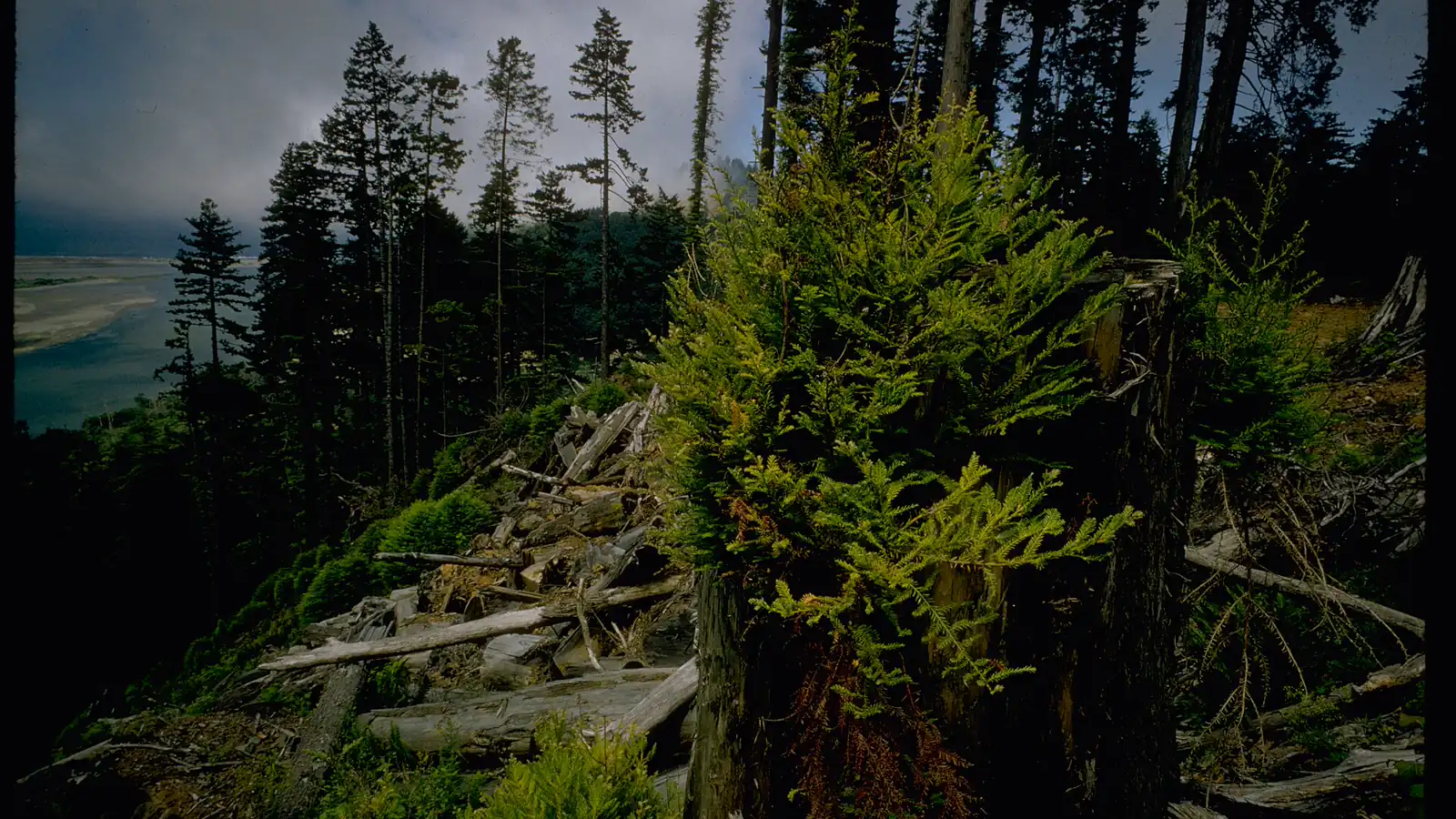
Humid air reduces the gradient driving water vapour from a leaf, lowering transpiration demand. Fog can also wet foliage and soil; some species absorb small amounts of water directly through leaves or benefit when droplets drip from crowns. Coastal redwoods live in a climate where summer fog can ease water stress even during a season with little rain. Fog does not cancel the challenge of height, and the contribution varies through time and canopy position. It does show why the same species may function differently under different atmospheres. Plant water use depends on the gradient between leaf and air, not temperature or rainfall considered alone.
A tree is a regulated hydraulic network
The familiar question—how does water get to the top?—has no single-word answer. Evaporation supplies the dominant pull, cohesion transmits tension, xylem confines the stream, roots connect it to soil, and stomata control the rate while trading water for carbon. Storage and anatomical redundancy make the network resilient, but gravity, friction and cavitation impose limits. The system operates without a central pump because energy enters at the leaf–air boundary and because water’s molecular behaviour allows that energy to be transmitted. A towering tree is therefore not defeating physics. It is an especially elegant expression of physics organized by living tissue.
Leaves are supplied by finer and finer veins
Water leaving a trunk must still cross branches, petioles and a branching network of leaf veins. Major veins provide transport and mechanical support; minor veins bring water close to photosynthetic cells. From there, water moves through and around cells before reaching evaporating surfaces. Vein density, leaf thickness and stomatal placement influence both capacity and vulnerability. Damage to a small part of the network need not shut down the entire leaf because alternate routes may remain. The final centimetres of the journey can account for substantial resistance, so hydraulic design continues all the way to the microscopic air spaces where liquid becomes vapour.
Night does not completely stop the system
Transpiration usually declines after dark because stomata close and air becomes cooler or more humid, but it does not always fall to zero. Some species retain measurable nighttime conductance. Water moving into tissues overnight can restore storage and relax daytime tension. Dew or fog may change the direction and size of local fluxes. Scientists study nighttime water loss because it affects whole-plant budgets and may have functions or costs that differ among environments. The common daytime diagram is therefore a useful simplification, not a complete schedule. Tree hydraulics operate continuously, with rates and dominant processes changing through each twenty-four-hour cycle.
Hydraulic knowledge helps forests survive change
Foresters and ecologists use hydraulic traits to evaluate vulnerability, but translating laboratory measurements into predictions remains difficult. A seedling in a pot does not experience the root volume, competition or microclimate of an old forest. Species can acclimate by changing leaf area, roots or wood growth, yet rapid extremes may exceed that flexibility. Long-term monitoring links physiology with mortality and recovery after drought. Models increasingly represent stomatal regulation, soil water and xylem damage rather than treating vegetation as a passive surface. Better forecasts can guide restoration and species selection, while uncertainty reminds managers that diversity and habitat protection are valuable forms of resilience.
The answer spans molecules to weather
No scale can explain tree water transport alone. Hydrogen bonding helps a liquid column persist; cell-wall architecture gives it a conduit; stomata expose it to atmospheric demand; roots connect it with a changing soil; and weather sets the gradients. A finding at one scale must remain consistent with the others. This is why tree hydraulics draws on chemistry, physics, anatomy, ecology and climate science. It is also why a simple classroom demonstration can illustrate only part of the phenomenon. The complete explanation is a connected system whose parts continually adjust to one another.
Sources and further reading
- U.S. Geological Survey, Water Science School: Evapotranspiration and the Water Cycle
- U.S. Forest Service, Tree Physiology and Forest Hydrology research
- Tyree and Zimmermann, Xylem Structure and the Ascent of Sap
- Sperry et al., Water deficits and hydraulic limits on vegetation
- Koch et al., The limits to tree height
- Choat et al., Global convergence in the vulnerability of forests to drought
How Barnakle selects and verifies sources · Corrections and updates
Keep exploring.
One remarkable idea at a time—nature, science, history and beyond.
Sources and further reading
Barnakle uses credible primary and authoritative sources wherever possible.
- U.S. Geological Survey, Water Science School: Evapotranspiration and the Water Cycle
- https://www.usgs.gov/special-topics/water-science-school/science/evapotranspiration-and-water-cycle
- U.S. Forest Service, Tree Physiology and Forest Hydrology research
- https://research.fs.usda.gov/
- Tyree and Zimmermann, Xylem Structure and the Ascent of Sap
- https://doi.org/10.1007/978-3-662-04931-0
- Sperry et al., Water deficits and hydraulic limits on vegetation
- https://doi.org/10.1111/pce.12412
- Koch et al., The limits to tree height
- https://doi.org/10.1038/nature02417
- Choat et al., Global convergence in the vulnerability of forests to drought
- https://doi.org/10.1038/nature11688
Last reviewed September 21, 2026.

Barnakle Editorial Team
A member of the Barnakle editorial team, exploring remarkable ideas with clarity, curiosity and care.
More from this author →