
Inside a corvid warning system built from memory and observation
What to know
- Mask experiments isolate facial appearance while controlling other cues.
- Recognition can persist for years and spread through a local population.
- Mobbing combines calls, attention and group movement around a perceived threat.
- Social learning does not mean every crow understands the same event in the same way.
A face in a crowded landscape
A city crow meets many people, most of whom are harmless. Yet repeated field observations show that some individuals react selectively to particular people. The important mechanism is visual features can be stored as part of an individual threat memory rather than merely as a general category such as “human.” Researchers test that account through controlled approaches in which researchers wear distinctive masks while keeping routes and behavior comparable. That combination matters because a striking observation is not enough on its own: the proposed process must also predict what should happen under a different condition.
The evidence has limits. Masks, posture, clothing, voice and location can become compound cues unless the design deliberately separates them. A careful interpretation therefore separates what was directly measured from what is inferred. The finding is best stated as visual discrimination supported by learning, not as evidence that a crow reads personality from a face. This is why the strongest explanation joins several independent measurements, reports uncertainty and remains open to revision when better data arrive.
Why masks are useful
Researchers cannot ethically create uncontrolled danger simply to see what birds remember. A standardized mask makes the threatening appearance repeatable. The important mechanism is the mask remains visually stable while different people can wear it, reducing the chance that gait or body shape alone explains the response. Researchers test that account through capture-and-release episodes followed by later walks through the same area in threatening and neutral masks. That combination matters because a striking observation is not enough on its own: the proposed process must also predict what should happen under a different condition.
The evidence has limits. No field control is perfect, and observers may influence bird behavior by where and how they move. A careful interpretation therefore separates what was directly measured from what is inferred. Replication across wearers and years makes the facial-cue interpretation stronger. This is why the strongest explanation joins several independent measurements, reports uncertainty and remains open to revision when better data arrive.
Learning during one encounter
Crows present during capture can associate the masked face with an intense event. Later they often scold or follow the same appearance. The important mechanism is attention, stress and reinforcement strengthen a memory that predicts risk. Researchers test that account through comparing responses before the event, shortly afterward and during later presentations. That combination matters because a striking observation is not enough on its own: the proposed process must also predict what should happen under a different condition.
The evidence has limits. The experiment measures behavior rather than the bird’s private experience, so words such as anger or revenge are misleading. A careful interpretation therefore separates what was directly measured from what is inferred. A durable change in selective response is enough to demonstrate learning. This is why the strongest explanation joins several independent measurements, reports uncertainty and remains open to revision when better data arrive.
Memory measured over years
The response to a threatening mask has persisted across repeated tests for multiple years in a studied population. The important mechanism is long-term recognition is refreshed when the face reappears and when group reactions reinforce attention to it. Researchers test that account through longitudinal counts of scolding and following along fixed routes. That combination matters because a striking observation is not enough on its own: the proposed process must also predict what should happen under a different condition.
The evidence has limits. Repeated testing can itself maintain the memory, and population membership changes through births, deaths and movement. A careful interpretation therefore separates what was directly measured from what is inferred. The result still shows that threat information can remain behaviorally relevant far beyond one encounter. This is why the strongest explanation joins several independent measurements, reports uncertainty and remains open to revision when better data arrive.
How uninvolved birds learn
Some crows that were not captured later join the alarm response. Juveniles may also respond after observing parents and neighbors. The important mechanism is social attention directs a learner toward the face while calls and mobbing supply information that others treat it as dangerous. Researchers test that account through tracking marked birds and comparing individuals with different opportunities to witness earlier events. That combination matters because a striking observation is not enough on its own: the proposed process must also predict what should happen under a different condition.
The evidence has limits. Joining a mob can reflect immediate social facilitation as well as a stored long-term association. A careful interpretation therefore separates what was directly measured from what is inferred. Later tests without the original demonstrators help reveal whether independent learning occurred. This is why the strongest explanation joins several independent measurements, reports uncertainty and remains open to revision when better data arrive.
Mobbing as public information
A crow that scolds does more than produce noise. Its calls orient nearby birds, which approach, watch and sometimes add their own calls. The important mechanism is many eyes reduce the cost of monitoring and can drive a predator or other threat away. Researchers test that account through recording callers, arrivals, distances and changes in group size during presentations. That combination matters because a striking observation is not enough on its own: the proposed process must also predict what should happen under a different condition.
The evidence has limits. Researchers cannot assume every call has a word-like meaning; context and sequence matter. A careful interpretation therefore separates what was directly measured from what is inferred. The defensible conclusion is that vocal and visual behavior coordinates group attention. This is why the strongest explanation joins several independent measurements, reports uncertainty and remains open to revision when better data arrive.
Families and neighborhood networks
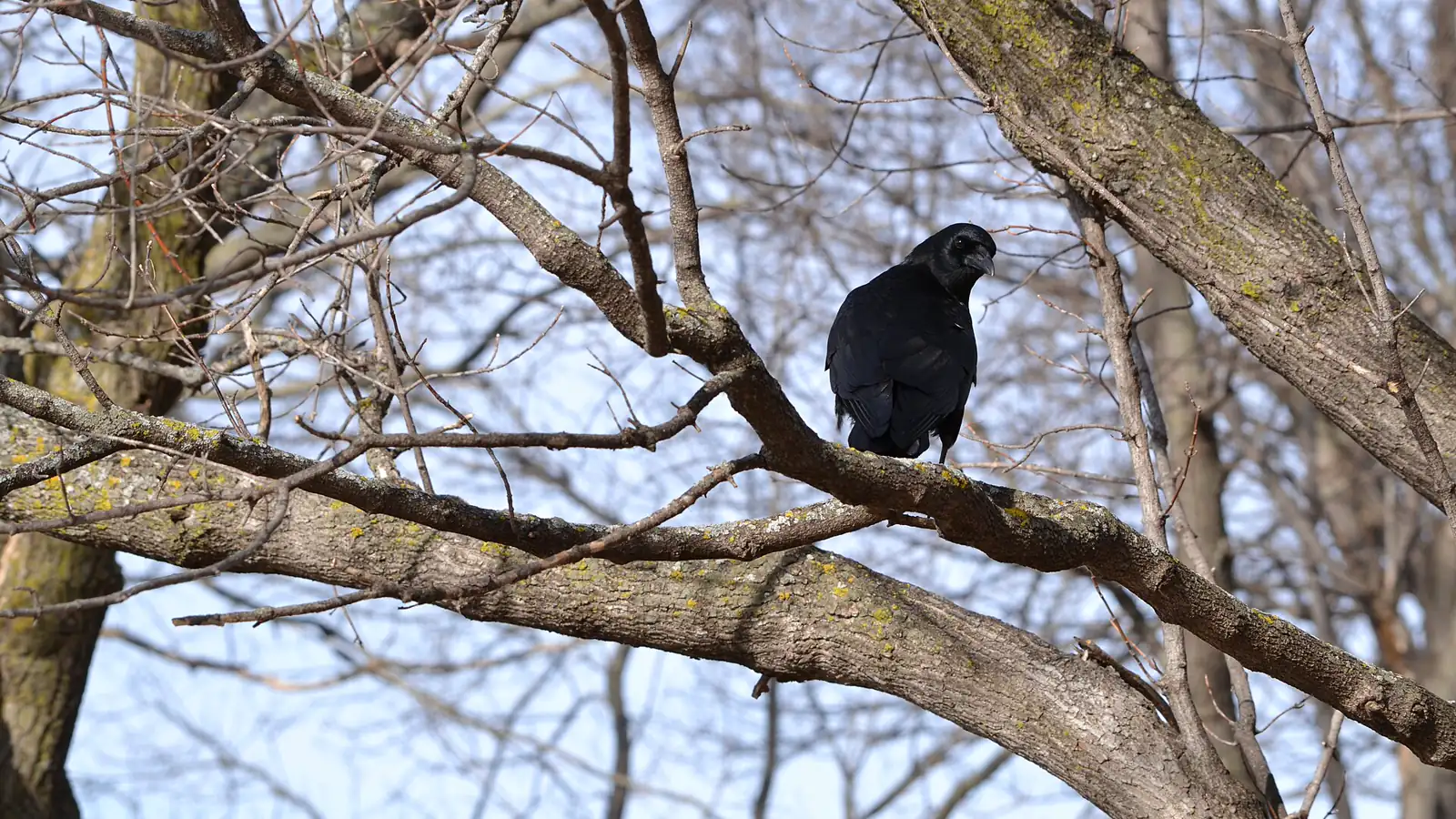
American crows often live in family groups, and young birds may remain with parents for years. Those relationships create repeated learning opportunities. The important mechanism is trusted or frequently encountered demonstrators can make a warning more influential than a signal from an unfamiliar bird. Researchers test that account through observations of marked families and local social associations. That combination matters because a striking observation is not enough on its own: the proposed process must also predict what should happen under a different condition.
The evidence has limits. Urban feeding sites and roosts mix birds from different relationships, making networks difficult to map completely. A careful interpretation therefore separates what was directly measured from what is inferred. Social structure helps explain why information spreads unevenly rather than instantly. This is why the strongest explanation joins several independent measurements, reports uncertainty and remains open to revision when better data arrive.
Recognition is not infallible
A remembered threat can be useful even when identification is imperfect. Natural selection does not require a photographic mental record. The important mechanism is birds may combine coarse facial geometry with hairstyle, movement, place and the reactions of companions. Researchers test that account through altering one cue at a time and presenting unfamiliar controls. That combination matters because a striking observation is not enough on its own: the proposed process must also predict what should happen under a different condition.
The evidence has limits. A laboratory-style separation of cues can be harder outdoors, where weather and human traffic vary. A careful interpretation therefore separates what was directly measured from what is inferred. Errors and generalization are part of an adaptive decision system, not proof that recognition is absent. This is why the strongest explanation joins several independent measurements, reports uncertainty and remains open to revision when better data arrive.
The cost of a false alarm
Scolding and following use time and energy and may reveal the bird’s location. Ignoring a real threat can be more costly. The important mechanism is decision thresholds shift with recent experience, distance, group size and the vulnerability of nests or young. Researchers test that account through comparing response intensity across contexts rather than recording only yes or no. That combination matters because a striking observation is not enough on its own: the proposed process must also predict what should happen under a different condition.
The evidence has limits. A strong response does not reveal the bird’s exact estimate of danger. A careful interpretation therefore separates what was directly measured from what is inferred. Risk-sensitive behavior explains why the same face can trigger different reactions on different days. This is why the strongest explanation joins several independent measurements, reports uncertainty and remains open to revision when better data arrive.
Crows are not miniature humans
Face learning, memory and social transmission are sophisticated, but they do not require human language or moral judgment. The important mechanism is animal cognition can solve an ecological problem with perceptual categories, associations and social cues. Researchers test that account through experiments that make narrow predictions instead of relying on anecdotes about cleverness. That combination matters because a striking observation is not enough on its own: the proposed process must also predict what should happen under a different condition.
The evidence has limits. Popular descriptions often add motives that the experiment did not test. A careful interpretation therefore separates what was directly measured from what is inferred. Respecting the boundary makes the birds more scientifically interesting, not less. This is why the strongest explanation joins several independent measurements, reports uncertainty and remains open to revision when better data arrive.
Differences among corvids
Ravens, jays, rooks and crows share evolutionary history but occupy different social and ecological settings. The important mechanism is similar cognitive building blocks can be tuned by diet, group structure and exposure to people. Researchers test that account through species comparisons using tasks adapted to each animal’s natural behavior. That combination matters because a striking observation is not enough on its own: the proposed process must also predict what should happen under a different condition.
The evidence has limits. A task designed for an urban crow may underestimate a species that solves different problems. A careful interpretation therefore separates what was directly measured from what is inferred. Claims should name the species and population actually studied. This is why the strongest explanation joins several independent measurements, reports uncertainty and remains open to revision when better data arrive.
Why cities are revealing
Urban crows repeatedly encounter individual humans, vehicles and changing food sources. That creates both learning opportunities and experimental complications. The important mechanism is long-lived birds can accumulate local knowledge and observe many demonstrations. Researchers test that account through field studies that preserve real-world complexity while adding standardized controls. That combination matters because a striking observation is not enough on its own: the proposed process must also predict what should happen under a different condition.
The evidence has limits. Habituation, feeding and local persecution may differ sharply between neighborhoods. A careful interpretation therefore separates what was directly measured from what is inferred. Cities function as natural laboratories only when researchers record those differences. This is why the strongest explanation joins several independent measurements, reports uncertainty and remains open to revision when better data arrive.
What brain research can add
Behavior shows what a bird distinguishes; neural measurements can investigate how visual and threat information is represented. The important mechanism is sensory regions, memory systems and action-selection circuits work as networks rather than a single “face center.” Researchers test that account through non-invasive imaging, comparative neuroanatomy and carefully designed behavioral tasks. That combination matters because a striking observation is not enough on its own: the proposed process must also predict what should happen under a different condition.
The evidence has limits. Neural activation is correlation unless the design establishes a causal role. A careful interpretation therefore separates what was directly measured from what is inferred. Brain evidence is most useful when it predicts a new behavioral result. This is why the strongest explanation joins several independent measurements, reports uncertainty and remains open to revision when better data arrive.
Living alongside observant birds
People sometimes ask how to make local crows like them or stop remembering them. The research supports a simpler lesson: avoid harassment and give wildlife space. The important mechanism is consistent non-threatening behavior reduces reasons for defensive learning. Researchers test that account through long-term observation of responses to ordinary human activity. That combination matters because a striking observation is not enough on its own: the proposed process must also predict what should happen under a different condition.
The evidence has limits. Feeding can create dependence, conflict or local restrictions and is not necessary for coexistence. A careful interpretation therefore separates what was directly measured from what is inferred. Understanding recognition should encourage responsible distance, not attempts to manipulate wild animals. This is why the strongest explanation joins several independent measurements, reports uncertainty and remains open to revision when better data arrive.
The larger lesson
Crow studies reveal intelligence as a practical ability distributed across perception, memory and social life. The important mechanism is information held by one animal can alter the behavior of others and outlast the original encounter. Researchers test that account through combining individual histories with population-level response maps. That combination matters because a striking observation is not enough on its own: the proposed process must also predict what should happen under a different condition.
The evidence has limits. The word culture has technical definitions and should be used cautiously for a single learned association. A careful interpretation therefore separates what was directly measured from what is inferred. The clear result is already remarkable: a local community of birds can preserve socially useful knowledge about danger. This is why the strongest explanation joins several independent measurements, reports uncertainty and remains open to revision when better data arrive.
How to read the evidence
This feature treats how crows recognize faces and share threat information as a question that can be investigated, not as a collection of impressive claims. A result is strongest when observations, a plausible mechanism and independent replication point in the same direction. Laboratory work can isolate a process; field evidence shows whether it matters under realistic conditions; models connect measurements that cannot be observed directly.
Dates, sample sizes, instruments and definitions also matter. A measurement may be precise without answering every version of the question. Researchers therefore compare alternative explanations, calibrate instruments, publish methods and allow other teams to challenge the result. Barnakle’s specialist-review flag remains open until an appropriately qualified reviewer checks the interpretation against the cited literature.
What remains uncertain
Scientific uncertainty is not the same as ignorance. It identifies the range within which an explanation is reliable and the conditions under which it may fail. The sources below include primary research and institutional background. They do not all carry equal weight, and later work can refine earlier conclusions. Readers should follow the linked records for methods, samples and qualifications that cannot be reproduced in a general-audience article.
Sources and further reading
- Marzluff et al., Lasting recognition of threatening people by wild American crows
- Cornell Lab of Ornithology, American Crow species account
- University of Washington, crow recognition research
- Cornell Lab, All About Bird Biology and behavior
How Barnakle selects and verifies sources · Corrections and updates
Keep exploring.
One remarkable idea at a time—nature, science, history and beyond.
Sources and further reading
Barnakle uses credible primary and authoritative sources wherever possible.
- Marzluff et al., Lasting recognition of threatening people by wild American crows
- https://doi.org/10.1016/j.anbehav.2010.03.022
- Cornell Lab of Ornithology, American Crow species account
- https://www.allaboutbirds.org/guide/American_Crow/overview
- University of Washington, crow recognition research
- https://www.washington.edu/news/2011/06/28/crows-never-forget-a-face/
- Cornell Lab, All About Bird Biology and behavior
- https://www.birds.cornell.edu/home/
Last reviewed September 19, 2026.

Barnakle Editorial Team
A member of the Barnakle editorial team, exploring remarkable ideas with clarity, curiosity and care.
More from this author →