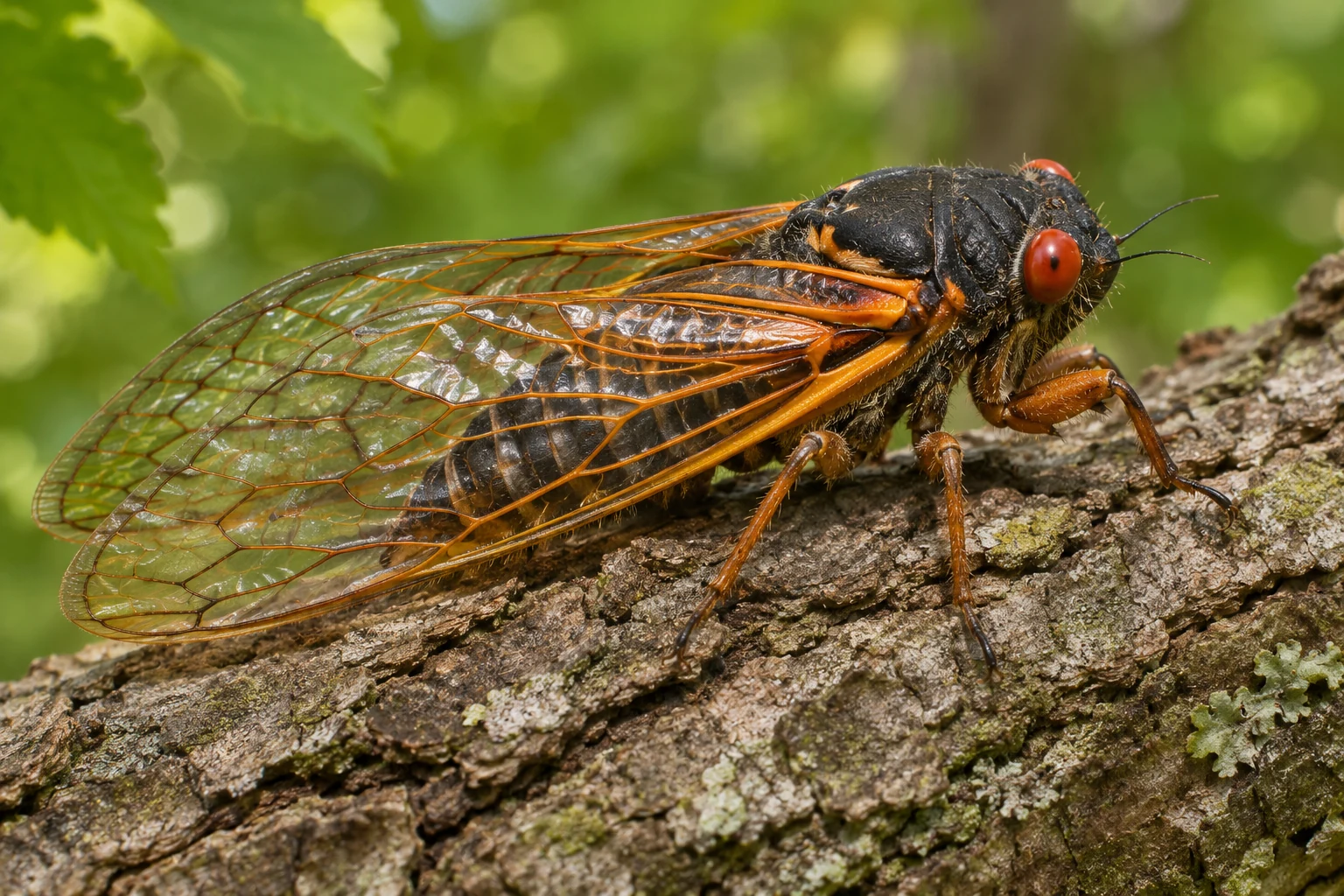
The summer buzz begins with a pair of tiny buckling membranes, not a voice box.
Quick answer
Most male cicadas make their loud calls using paired organs called tymbals near the front of the abdomen. Muscles deform the ribbed membranes, which snap through and produce rapid sound pulses. Vibrations interact with other body structures and air spaces. Repeated pulses and species-specific timing turn this mechanical action into the buzzing, whining or clicking calls we hear.
A single cicada can seem implausibly loud for its size. Find it on a trunk and the mystery deepens: the wings may be resting, the mouth is not singing, and no obvious loudspeaker is visible. The sound is produced by structures built into the insect’s body.
The most useful starting point is a distinction between making a vibration, shaping that vibration and arranging it into a signal. Cicadas do all three. A description that stops at “they have a hollow abdomen” misses the mechanism that supplies the sound in the first place.
Where is a cicada’s sound-producing organ?
Male periodical cicadas have a pair of ridged membranes, the tymbals, on the first abdominal segment. Large muscles act on them. Their hearing organs, called tympana, are different membranes located on the underside of the abdomen. Similar-sounding anatomical names can make the distinction surprisingly easy to miss. [1]
A tymbal is therefore not simply an insect eardrum. Its principal role in this explanation is to generate mechanical pulses. The tympanum belongs to the hearing system, although research on sound radiation can involve several connected structures.
Picture two flexible panels rather than a pair of miniature lungs. The relevant movement is deformation of the panels. Air is set vibrating by the moving structures; it is not necessary to imagine the insect blowing a sustained note through a throat.
The first click comes from buckling
A flexible structure can resist a gradual force and then change shape abruptly. Pressing the side of a thin plastic container gives a familiar, imperfect analogy: a slow push can produce a sudden pop. Cicada tymbals exploit controlled buckling rather than relying on a smooth back-and-forth stroke alone. [2]
In a 1971 study of two periodical cicada species, researchers described sequential buckling of stiff ribs embedded in the flexible tymbal. That observation matters because one muscle-driven action can involve several structural events, rather than one featureless movement. [4]
The analogy to a container has limits. A cicada is a living, controlled oscillator with specialized geometry and materials. Popping household plastic demonstrates an abrupt shape change; it does not reproduce the insect’s efficiency, acoustic pattern or anatomy.
It also explains why visual inspection at ordinary speed is insufficient. If a sequence happens rapidly, a viewer may see only a vague motion while a microphone records a complicated burst. Understanding the relationship requires resolving both movement and sound in time.
How clicks become a continuous buzz
A pulse is not necessarily a single perfectly clean note. A tymbal can vibrate after a buckling event, and repeated events create a patterned train of sound. An acoustics conference abstract by researchers studying cicada loudness describes closely spaced tone bursts and the relationship between vibrating tymbals and the abdominal air cavity. [3]
For a listener, sufficiently rapid events merge into a buzz or tone-like impression. This does not mean every cicada produces the same pulse rate or pitch. The rate at which bursts recur and the faster vibrations within a burst are distinct quantities.
Imagine tapping a table in groups of three. There is a rhythm between the groups and a quicker rhythm within each group. If the table rings after each tap, that adds another timescale. The example is deliberately slower than a cicada, but it separates three ideas that a single word such as “frequency” might otherwise collapse.
Consequently, counting visible contractions is not a reliable shortcut to the dominant pitch. Researchers examine the sound’s frequency spectrum and the timing of its envelope, as well as the mechanics of the body.
What the hollow abdomen contributes
The male abdomen includes air spaces that can participate in resonance. The University of Connecticut describes the abdomen of a male periodical cicada as hollow and potentially acting as a resonating chamber. The museum explanation likens its contribution to a musical soundbox. [1] [2]
Resonance does not create energy from nothing. The muscles supply mechanical work; the surrounding structures influence how vibrations develop and radiate. A useful distinction is between a source of energy and a system that channels that energy into sound.
Think of the difference between plucking a string and hearing an instrument body respond. The body can greatly change the sound without becoming an independent fuel source. A cicada is not a tiny guitar, but the comparison helps identify why the actuator and the resonating structures should be discussed separately.
Why there is no single universal cicada instrument
A 2025 study used high-speed imaging, sound recordings and mechanical modelling to investigate a dog-day cicada, Neotibicen canicularis. It followed a sequence of rib buckling and rebound, then represented coupled sound-generating structures with a simplified model. The authors also discussed the diversity of body structures and resonant contributions across cicadas. [5]
That study should not be read as a complete blueprint for every species. Its close-up observations involved a particular species and a particular recording situation, including a distress sound. A model designed to capture important mechanics is not proof that every courtship call follows an identical sequence.
This is a good example of how to read a mechanistic discovery. Ask what was observed directly, what was represented mathematically and which broader conclusions remain proposals. Those are related levels of explanation, but they are not interchangeable.
Why cicadas make different kinds of calls
For periodical cicadas, researchers distinguish calling songs associated with attracting insects to a chorus, courtship signals and alarm sounds. Acoustic differences among species groups can include pitch, timing and signal structure. Not every sound heard in an emergence serves the same immediate purpose. [1]
Consider a recording taken near one handled insect and another made under a tree full of undisturbed adults. Even before comparing species, the context differs. Describing both simply as “the cicada song” can hide the question the animals are responding to.
A chorus also combines many sources. A listener may hear one broad wall of sound while individual insects retain separate timing and locations. Loudness at a particular microphone depends on how many insects are contributing and where the microphone sits.
Do female cicadas make sounds?
The loud tymbal calls are primarily associated with males in most familiar cicada species. That does not justify saying that females are always acoustically silent. Female Magicicada can answer male calls with timed wing flicks that produce sounds and visible movements; timing helps make the exchange species-specific. [1]
The distinction is between lacking the male’s loud sound-producing apparatus and lacking any signalling behaviour. It is similar to distinguishing a principal instrument from the whole conversation. An animal can receive and respond to a call without producing the same kind of call itself.
Why “as loud as a power tool” needs context
The Hong Kong Science Museum notes that some cicadas can reach high sound levels. But a decibel figure without distance, measurement method and species is incomplete. A reading very near an animal cannot automatically describe what someone hears across a park. [2]
Decibels are logarithmic, so doubling an arbitrary number printed in decibels does not double the physical sound intensity. As a general acoustics example, adding two equally strong independent sources at the same measurement point increases their combined level by about three decibels, not by adding the two level numbers. Real choruses are more complicated because distances, directions and timing differ. [6]
The sensible scientific question is therefore not “what is the cicada’s one loudness?” It is “what level was recorded, from which animal or group, at what position, using which method?” That wording makes comparisons meaningful.
How scientists connect anatomy to sound
A microphone shows when sound arrives and which frequencies are present. High-speed imaging can show a membrane changing shape. Structural imaging and mechanical measurements help relate the visible movement to the underlying architecture. Agreement between these observations is stronger evidence than a recording or anatomical photograph alone.
Suppose, as a hypothetical experiment, a recorded pulse consistently follows a particular rib’s movement. That timing supports a connection. It does not by itself prove that every other body structure is irrelevant. A complete explanation must also account for how the vibration travels and reaches the surrounding air.
Frequently asked questions
Do cicadas rub their legs together?
The loud calls discussed here come from tymbal mechanics. Rubbing body parts together describes other insect sound mechanisms and should not replace the cicada explanation.
Are cicadas singing with their mouths?
No. “Song” describes the signal, not a human-like voice box. The relevant actuator is in the abdomen.
Does a bigger abdomen always mean a louder call?
Size alone does not specify the complete sound system. Structure, species, signal type and measurement conditions all matter.
Can a photograph show a cicada making sound?
It can show the animal’s posture, but a still picture cannot establish the pulse timing or prove which call was being produced.
More ways to make and use vibrations
Compare the cicada’s sound source with electric guitar pickups, which turn string motion into an electrical signal. Then explore why echoes occur and how bats use returning sounds.
Sources and further reading
Reference review: November 8, 2026.
- University of Connecticut, Periodical Cicada Information — Behavior
- Hong Kong Science Museum — Animals with a loud voice: Cicada
- Acoustical Society of America — Explanation of the loudness and other features of cicada sounds (conference abstract)
- Periodical cicada: mechanism of sound production (1971 research abstract)
- Ghoshal and colleagues — The tymbal of a cicada: nature’s sound-generating metastructure (2025 paper, PDF)
- OpenStax, University Physics Volume 1 — Sound intensity
Keep exploring.
One remarkable idea at a time—nature, science, history and beyond.
Sources and further reading
Barnakle uses credible primary and authoritative sources wherever possible.
- University of Connecticut, Periodical Cicada Information — Behavior
- https://draft.cicadas.uconn.edu/behavior/
- Hong Kong Science Museum — Animals with a loud voice: Cicada
- https://hk.science.museum/en/web/scm/online-explore/cb/awlv_2_c.html
- Acoustical Society of America — Explanation of the loudness and other features of cicada sounds (conference abstract)
- https://pubs.aip.org/asa/jasa/article/134/5_Supplement/4210/677597/Explanation-of-the-loudness-and-other-features-of
- Periodical cicada: mechanism of sound production (1971 research abstract)
- https://pubmed.ncbi.nlm.nih.gov/17816488/
- Ghoshal and colleagues — The tymbal of a cicada: nature’s sound-generating metastructure (2025 paper, PDF)
- https://www.nature.com/articles/s41467-025-65149-5.pdf
- OpenStax, University Physics Volume 1 — Sound intensity
- https://openstax.org/books/university-physics-volume-1/pages/17-3-sound-intensity
Last updated November 8, 2026.

Barnakle Editorial Team
Barnakle Editorial Team is the collective byline used for Barnakle’s editorial articles. The contributor profile explains the team identity and links to the publication’s editorial policies.
More from the editorial team →