The trick is not to keep the toes toasty. It is to protect living tissue while limiting the heat escaping from the rest of the bird.
Quick answer
Cold-adapted penguins conserve body heat partly by transferring warmth from outgoing arterial blood to returning venous blood in their legs. This countercurrent exchange lets the feet remain far cooler than the body core. Circulatory control, protective skin and changes in posture also help. Penguins still exchange heat with their surroundings; their feet are not immune to every possible cold injury.
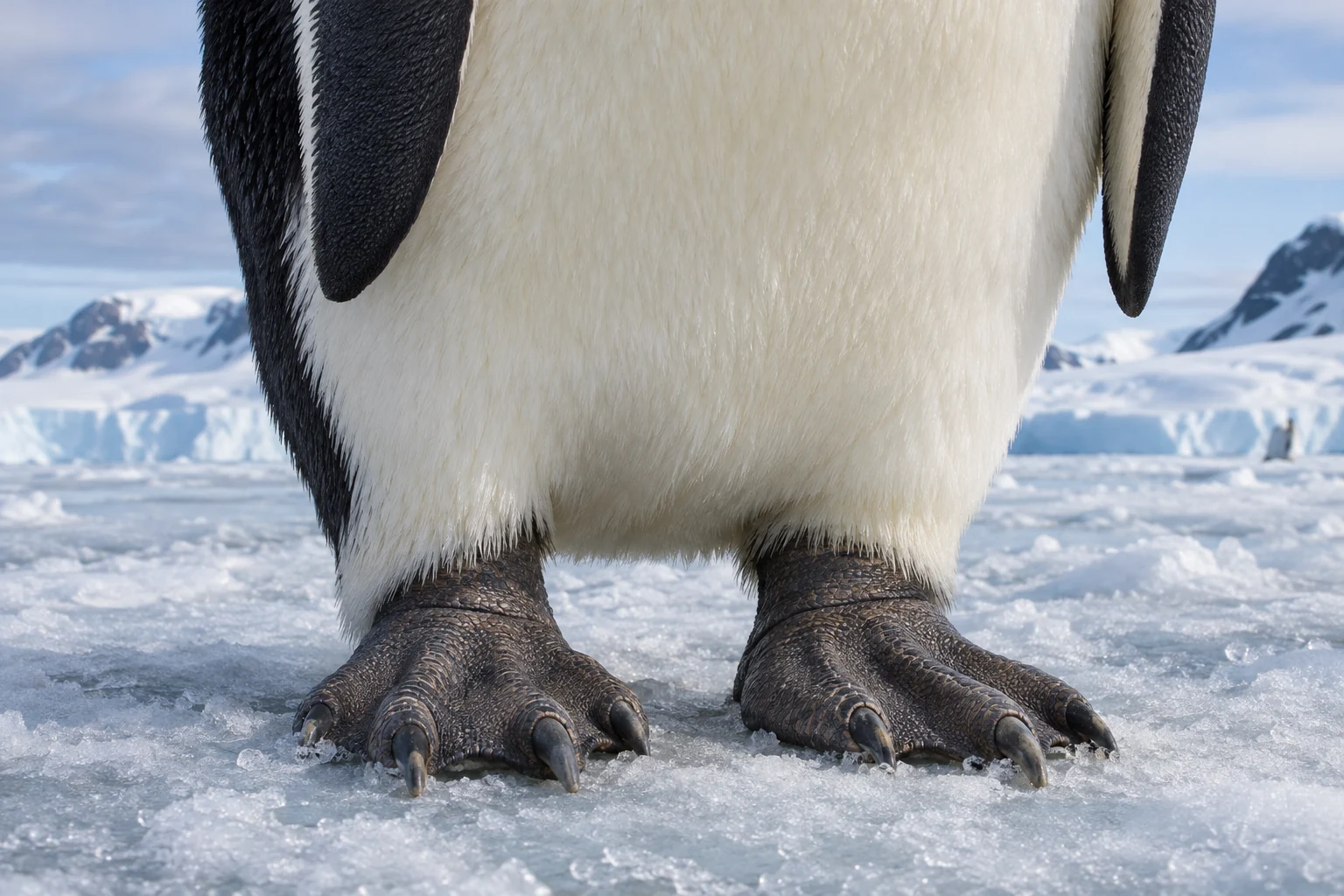
An emperor penguin can stand on ice while its body remains warm enough to support an active bird. The exposed feet seem to be the obvious weak point. They have no thick feather coat wrapped around every toe, yet they touch the cold surface directly.
The apparent puzzle comes from assuming that survival requires the same temperature everywhere. A penguin instead maintains a large difference between its insulated body and its extremities. The feet are part of a controlled thermal system, rather than small copies of the warm torso.
Why warming the feet too much would waste heat
Heat moves from warmer regions toward colder ones. Other things being equal, a larger temperature difference drives faster transfer. A warm foot against cold ice would therefore provide a route for energy to leave the bird.
Imagine two otherwise identical objects placed on the same cold surface. If one starts much warmer, it initially has the larger temperature contrast. That comparison does not supply a penguin’s exact heat-loss rate, because tissue, contact, blood flow and the environment all matter. It does explain why keeping a foot closer to environmental temperature can conserve energy.
Temperature alone is also not the same as heat flow. The texture and thermal properties of the contact surface affect the exchange. That is the same broad distinction behind the familiar experience of metal and wood feeling different despite being in the same room.
How countercurrent heat exchange works
Arteries bring blood from the body toward the feet, while veins return it. Where those vessels run close together, the warmer outgoing blood can transfer heat to the cooler returning blood. The returning flow carries recovered warmth inward instead of leaving all of it available to escape at the foot. The Australian Antarctic Program describes this arrangement as part of the emperor penguin’s heat-conservation system. [1]
“Countercurrent” refers to the opposite directions of flow. It is not a second heart or a source of new heat. Close contact between adjacent streams allows energy to move between them while the blood remains inside separate vessels.
A useful imaginary model is two narrow pipes placed side by side: one carrying warm liquid outward and the other cooler liquid inward. As heat passes between them, the inward stream warms before reaching the central reservoir. The outgoing stream arrives at the exposed end cooler than when it left the reservoir. The model illustrates the direction of transfer; actual anatomy is much more intricate.
A network of vessels, not just one pair of pipes
Penguin legs contain a blood-vessel network known as the rete tibiotarsale. A 2017 study used anatomy chiefly based on Humboldt penguins to model its thermal effect, comparing that arrangement with a scaled human-like configuration. The abstract reports a substantial heat-conservation advantage in the penguin configuration. [5]
That finding is evidence about a model with specified assumptions, not a universal percentage applying to every wild penguin. The comparison is still informative: rearranging the path of blood can change the thermal consequences even when the same general materials and physical laws are involved.
This is an elegant feature of biological engineering. An animal need not insulate every surface equally if it can control where warmth travels. Geometry and circulation complement the insulation surrounding the main body.
Blood flow changes with the bird’s needs
Circulation can conserve heat or help release it. Changes in blood-vessel diameter affect how much warm blood reaches exposed areas. SeaWorld’s animal-information account describes both heat recovery in the legs and flippers and increased surface blood flow when a bird needs to lose heat. [2]
This flexibility matters because a penguin does not face one unchanging thermal problem. Swimming, resting, fasting and returning to shore impose different demands. A system permanently locked into maximum conservation would have drawbacks when excess heat needs to escape.
A 2020 study followed surface rewarming in king penguins under laboratory and field conditions. The results showed that warming of appendages depended on internal state and environmental conditions, supporting a flexible role for peripheral circulation. Those observations concern king penguins during rewarming; they should not be treated as direct measurements of emperor penguins standing through an Antarctic winter. [4]
Posture reduces contact with the ice
King and emperor penguins can tip their feet upward and use the heel region and tail for support, reducing the area contacting the frozen surface. Body posture therefore changes one route of heat loss without requiring a new layer of insulation. [2]
Think about the difference between resting an entire palm on a tabletop and touching it with a much smaller area. In a controlled comparison, changing the contact changes the conductive pathway. For a living animal, posture works alongside circulation and the insulating features of its body.
The feet must still serve as feet. They support weight, grip the surface and work in water. Evolutionary adaptations involve compromises among functions; an extremity optimized only to minimize heat transfer might perform poorly as a swimming or walking structure.
What thermal cameras can—and cannot—tell us
Thermal-imaging work on emperor penguins found strikingly cold external surfaces, including exposed regions, while emphasizing the insulating role of plumage and heat-conserving vascular arrangements. A surface reading is not a measurement of the temperature of every tissue beneath it. [3]
This is an important distinction when looking at colourful thermal images online. The camera shows emitted infrared radiation interpreted as a surface temperature. It does not see straight through feathers, skin and vessels to provide a complete map of internal physiology.
A cold outside and a warm inside can coexist if heat transfer between them is limited. A winter coat offers an everyday analogy: the outer fabric need not feel like the wearer’s skin. The penguin’s arrangement is more complex, but the same basic distinction between surface conditions and internal conditions applies.
Not all penguins live in the same cold
Species and habitats matter. The emperor penguin’s winter environment differs from that of a Humboldt penguin. Body size, insulation, behaviour and local conditions influence the overall heat budget. The Australian Antarctic Program describes feathers, body reserves and huddling among the emperor’s complementary adaptations. [1]
Huddling helps the whole animal conserve energy; countercurrent exchange limits particular internal-to-external losses. Neither explanation replaces the other. Asking how feet cope with ice opens a window onto a coordinated system rather than one miraculous feature.
Frequently asked questions
Are penguin feet as warm as their bodies?
No. Keeping extremities cooler helps reduce heat loss. Their temperatures vary with the species, body state and environmental conditions. [4]
Do penguins manufacture extra heat in the exchange network?
No. The vessel arrangement recovers heat already carried by blood. Energy still has to come from the bird’s metabolism; heat exchange reduces how much is lost.
Does a very cold surface prove the living foot is frozen solid?
No. Surface measurements and the thermal state of internal tissues are different observations. The external reading cannot establish that all the tissue beneath it has frozen. [3]
Is this the same strategy sea otters use?
Both animals must balance heat production and loss, but their anatomy and major insulation systems differ. Similar environmental challenges can be met with different combinations of structural and physiological adaptations.
Keep exploring
Sources and further reading
- Australian Antarctic Program — Emperor penguin
- SeaWorld animal information — Penguin adaptations
- McCafferty and colleagues (2013) — Emperor penguin body surfaces cool below air temperature
- Lewden and colleagues (2020) — Body surface rewarming in fully and partially hypothermic king penguins
- Kazas and colleagues (2017) — The Humboldt penguin rete tibiotarsale: a biological heat exchanger (abstract)
Reference review: November 9, 2026.
Keep exploring.
One remarkable idea at a time—nature, science, history and beyond.
Last updated November 9, 2026.

Barnakle Editorial Team
Barnakle Editorial Team is the collective byline used for Barnakle’s editorial articles. The contributor profile explains the team identity and links to the publication’s editorial policies.
More from the editorial team →