The short answer
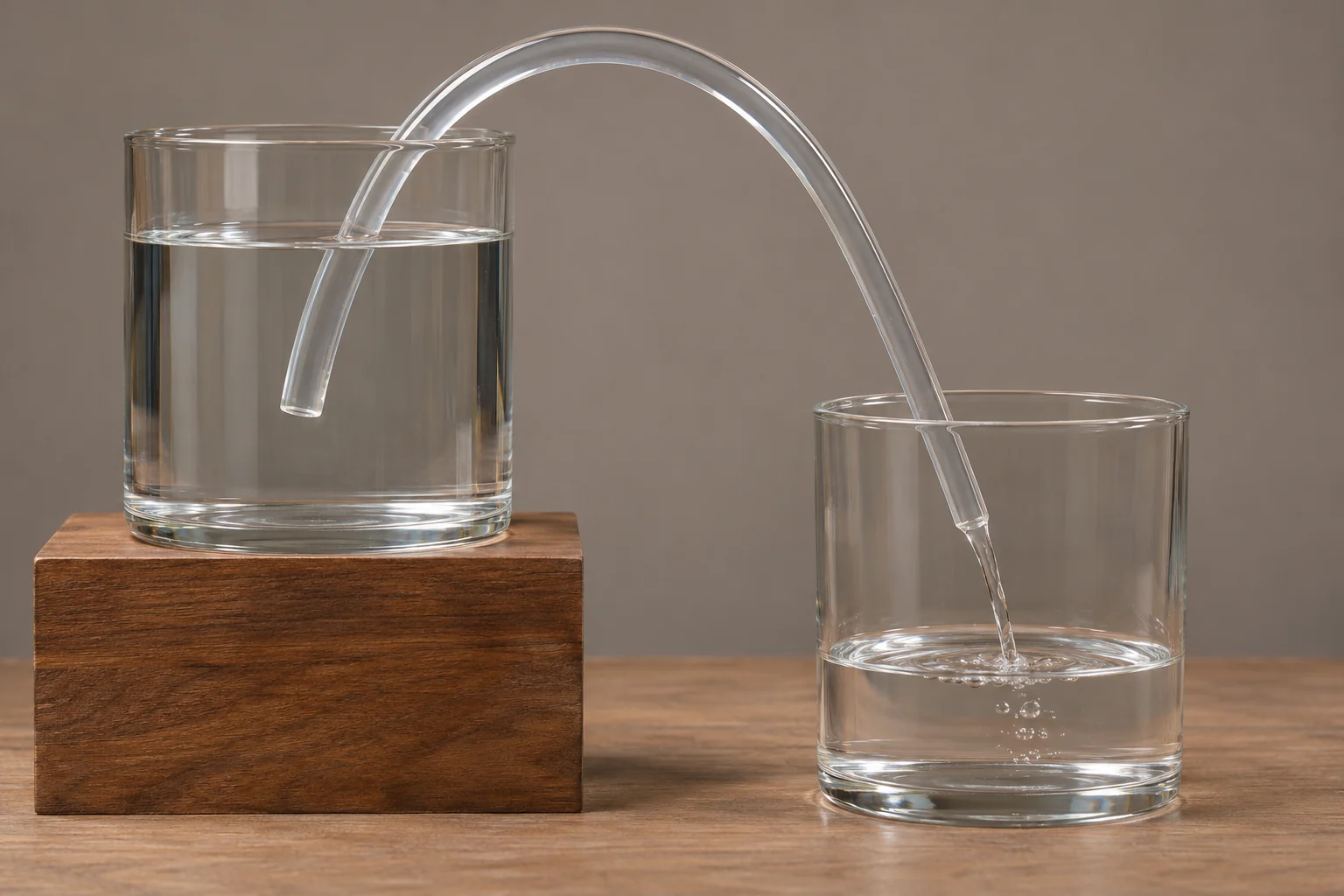
A normal siphon moves water from a higher reservoir to a lower outlet through a filled tube that passes over a high point. Although some water rises inside the tube, the overall flow loses gravitational potential energy. Pressure varies along the moving liquid, allowing it to climb the first section and descend the second. The lower destination and the connected liquid path are central to the familiar arrangement. [1][3]
There is no contradiction in water travelling upward during part of its journey. A road can climb over a low hill while ending in a valley below its starting point. The important question is the complete path and energy balance, not the direction of one short section of tube.
Follow the whole liquid path
Consider an upper vessel open to the atmosphere, a tube arching above its rim and an outlet below the upper water surface. Once the tube contains a suitable continuous water column, water can leave through the lower end while more enters from the upper vessel.
The height difference provides energy for motion and for losses within the flowing system. Along the rising section, water gains height while its pressure changes. Along the descending section, gravitational potential energy decreases again.
A siphon is therefore not a device that continuously delivers water to a higher final reservoir without an energy source. Its useful trick is to pass a local obstacle on the way to a lower destination. Confusing the crest with the destination creates the apparent paradox.
What pressure contributes
Pressure is force per unit area. A pressure difference can exert a net force on a portion of liquid. In a flowing siphon, the pressure at the crest is commonly lower than the pressure at the upper reservoir’s exposed surface.
Bernoulli’s equation links pressure, height and speed for an idealized steady flow. Real tubing also introduces energy losses, but the relationship is a useful framework for understanding how a connected stream can rise in one place while gaining energy from a larger overall drop. [1]
Saying “gravity does it” does not make pressure irrelevant. Saying “low pressure pulls it over” is also incomplete unless the explanation accounts for how that pressure distribution is maintained. The motion, the height difference and the pressure field belong to one system.
Why the tube usually needs priming
An empty tube does not automatically behave like a water-filled siphon. Air inside the arch can interrupt the required liquid path, so a normal setup needs a way to establish flow. This preparation is called priming.
Some specialized arrangements can start themselves under particular conditions. Their geometry and initial conditions matter. They do not mean that any dry hose placed over a vessel will immediately begin carrying water uphill.
The distinction is between starting the flow and maintaining it. Energy or an action used to establish a connected column is not necessarily the continuing energy supply. During the ordinary running stage, water descending to a lower level supplies the energy that the system releases.
Is the longer side the reason it works?
A common sketch shows a short rising leg and a long falling leg. It is tempting to conclude that the total length or weight of water in the longer leg is the decisive variable. That shortcut can fail.
For an ordinary open-reservoir siphon, the relevant driving difference is the height available between the source surface and the outlet conditions. Adding loops or horizontal tubing can make a hose longer without adding useful gravitational head. It usually adds resistance instead. [3]
Tube shape still matters to losses, possible trapped gas and practical operation. But a length comparison is not a replacement for the energy and pressure balance. The same overall height difference can be connected by tubes with different flow resistance.
Flow rate and water speed are not identical
Volume flow rate measures how much liquid passes a cross-section per unit time. Speed describes how fast the liquid moves at that location. For an incompressible steady flow, the volume entering a segment must match the volume leaving it.
In a narrower section, the same volume flow rate corresponds to a higher average speed. This continuity relationship is separate from the question of what pressure differences and losses the system can support. [2]
A wider tube can therefore change a siphon’s behaviour, but “twice the diameter means twice the flow” is not a general rule. Diameter affects area and resistance, while the available height difference and the entire tube arrangement also contribute.
Does atmospheric pressure drive every siphon?
Atmospheric pressure influences an ordinary water siphon operating in air. It helps set the absolute pressures available in the system. But the claim that positive atmospheric pressure is an unavoidable requirement for every siphon is too strong.
Experiments have demonstrated siphon operation under high-vacuum conditions with appropriately prepared liquids and apparatus. Such results show that a complete explanation must consider gravity and the liquid’s ability to sustain a connected state, rather than treating the atmosphere as the sole possible driver. [4]
That does not turn the pressure of the surroundings into an irrelevant detail. Research in a low-pressure chamber explores how siphon behaviour and the static behaviour of a barometer connect. Conditions that allow one liquid column to persist do not guarantee that every ordinary water setup will keep running. [5]
Why a high crest can cause trouble
As the tube rises above the source surface, pressure near the crest becomes lower. Under ordinary conditions, sufficiently low pressure can allow vapour or gas bubbles to develop and disrupt the liquid column. Temperature, dissolved gas and the condition of the liquid affect that behaviour.
The often-quoted water-siphon limit near ten metres is therefore an ordinary-condition approximation associated with pressure constraints, not an absolute law covering every prepared liquid. A published experiment reported a degassed-water siphon operating above that familiar height. [6]
The useful lesson is to separate a practical limit from a universal one. It would be equally wrong to claim that every garden hose can exceed the usual limit or that no carefully prepared experiment ever can. The setup and the state of the liquid are part of the evidence.
What makes an ordinary siphon stop?
A siphon can stop when the upper inlet admits enough air to interrupt the flow, when the available height or pressure conditions no longer support it, or when a blockage changes the path. If both ends discharge into connected open reservoirs, the changing water levels alter the driving conditions.
As a source vessel empties, its free surface falls. That changes the available gravitational head even if the physical tube remains fixed. A siphon is a changing system unless its reservoir conditions are held constant.
The same reasoning explains why returning the discharged water to its starting height requires energy. A loop cannot indefinitely recover more energy than the water loses. The crest is not a source of power, and the tubing does not provide a route around conservation of energy.
Common questions
### Is a siphon just capillary action? No. Capillarity can influence liquids in narrow spaces, but the sustained flow of an ordinary siphon between levels is a different problem. Its overall operation involves gravity, pressure and the connected liquid path.
Does water stop feeling gravity inside the upward section?
Gravity acts there too. Pressure forces and the rest of the moving liquid help account for the upward motion. A force can oppose gravity without removing it.
Can the outlet be below the crest but above the source surface?
That geometry alone does not provide the driving head of an ordinary open-air gravity siphon. The crest’s height is not the relevant reference for deciding whether the overall transfer loses gravitational energy.
What should the simple explanation retain?
Track the source surface, crest, outlet and pressure conditions together. Water can climb locally because the complete flow is driven toward a lower-energy destination; the local upward motion is only one part of that process.
Keep exploring
Sources and further reading
- OpenStax University Physics — Bernoulli’s equation and energy conservation
- OpenStax University Physics — Fluid dynamics and continuity
- Hughes (2011) — The secret siphon (research abstract)
- Research study (2011) — Can a Siphon Work In Vacuo? (abstract)
- Research study (2014) — Exploring the boundary between a siphon and barometer in a hypobaric chamber (abstract)
- Research study (2015) — The height limit of a siphon (abstract)
Reference review: November 12, 2026.
Keep exploring.
One remarkable idea at a time—nature, science, history and beyond.
Last updated November 14, 2026.

Barnakle Editorial Team
Barnakle Editorial Team is the collective byline used for Barnakle’s editorial articles. The contributor profile explains the team identity and links to the publication’s editorial policies.
More from the editorial team →