A geyser needs more than hot water: it needs an underground arrangement that stores energy and releases it in a rush.
Quick answer
A geyser erupts when heated groundwater in a constrained underground system begins a rapid transition into steam. Pressure allows deep water to remain liquid above its surface boiling temperature. As water escapes and pressure falls, more water can boil, driving an expanding mixture out of the vent. Heat, water recharge and suitable plumbing must all be present.
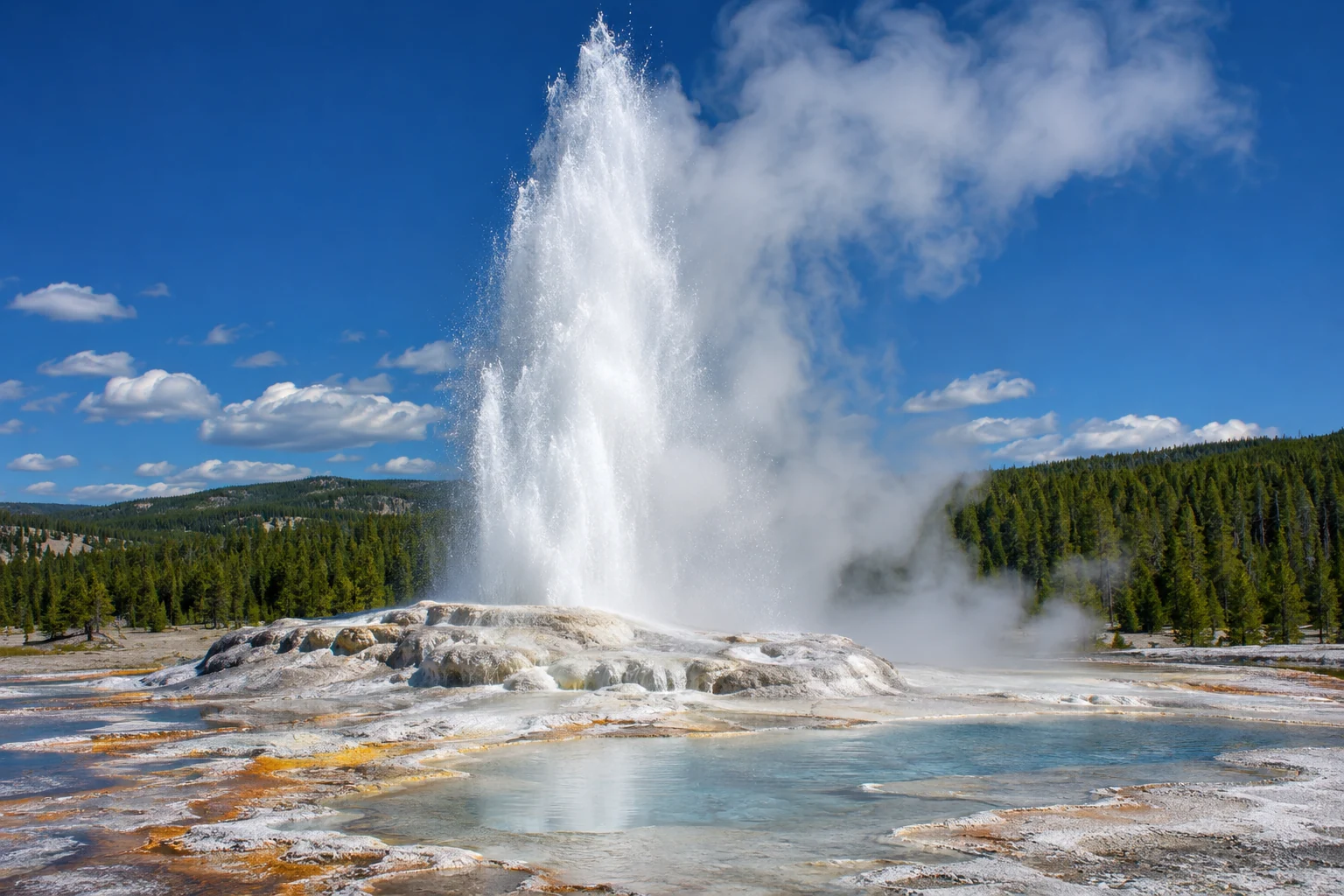
The dramatic part of a geyser happens above ground: a column of water, a cloud of mist and the sudden roar of an eruption. Most of the preparation takes place out of sight, in a network of hot rock, water-filled fractures and underground cavities.
Calling a geyser a natural fountain is visually accurate but mechanically incomplete. An ornamental fountain relies on a pump. A geyser uses stored thermal energy and changing pressure to turn a relatively quiet supply of groundwater into a brief, forceful discharge.
The three ingredients: heat, water and plumbing
The National Park Service identifies three essentials: a heat source, water and an appropriate plumbing system. In volcanic regions, hot rock supplies heat to water that has worked underground. Constrictions in the flow paths help distinguish erupting geysers from more freely circulating hot springs. [1]
None of the ingredients alone is enough. Dry hot rock does not automatically produce a water eruption. A plentiful water supply without sufficient heat stays ordinary groundwater. A hot, well-supplied system can discharge continuously if its geometry does not permit the necessary build-up and release.
This combination explains why geysers are special. They require a particular way of organizing familiar materials, rather than an unfamiliar kind of water. The details of the connections matter as much as the existence of a warm underground reservoir.
Where does the water come from?
At Yellowstone, rain and snow recharge the groundwater system. Water circulates through rocks above the magma-storage region, exchanges heat and dissolved substances with its surroundings, and returns toward the surface. The erupting water is therefore part of a hydrothermal circulation system; it need not be freshly released from magma. [2]
The distinction is useful because heat and water can arrive by different routes. A heating element warms water in a kettle without being the source of that water. Likewise, hot geological surroundings supply energy to a circulating fluid that originally entered the ground elsewhere.
Why deep water can be hotter than boiling water at the surface
Boiling is not fixed at one universal temperature. It occurs when conditions allow vapour bubbles to grow within a liquid. Higher surrounding pressure raises the temperature needed for sustained boiling. A deep water column can therefore remain liquid at a temperature that would make it boil nearer the surface. [5]
This is the central connection between depth, pressure and eruption. The water has acquired energy, but pressure affects whether that energy produces liquid water at a high temperature or rapid formation of vapour.
Think of a boundary that moves when conditions change. The same water can cross from one behaviour to another without receiving a new burst of heat at that instant. Reducing pressure can be the event that makes its stored heat available to drive boiling.
How a small discharge can become a large eruption
A simplified cycle starts with heating and accumulation. Steam formation or movement within the plumbing displaces some water. Removing part of the overlying water reduces pressure below, allowing additional hot water to boil. The growing vapour volume pushes out more liquid, extending the pressure drop through the system. [5]
This is a feedback process: initial discharge changes the conditions that had been restraining further discharge. The visible jet is the surface expression of a rapid expansion happening along the connected flow paths.
The sequence is a teaching model rather than a blueprint for every geyser. Underground cavities, side passages and the location of steam accumulation differ among systems. A single straight tube drawn in a school diagram should not be mistaken for a universal geological arrangement.
Is the white cloud actually steam?
Water vapour itself is invisible. The visible white cloud around a geyser includes tiny liquid droplets produced as vapour cools and condenses, along with droplets thrown from the erupting water. Everyday speech often calls the whole cloud “steam,” but the optical distinction is helpful.
You see a cloud because suspended droplets scatter light toward your eyes. A stretch of hot, transparent vapour close to a vent can be less visible than the cooler mist farther away. Appearance alone is therefore a poor measure of how hot a particular part of an eruption is.
Why the eruption eventually stops
The eruption draws on a finite local supply of hot fluid and stored energy. As discharge proceeds, conditions no longer sustain the same expanding flow. Recharge and heating prepare the system for another event. The timing depends on how water and energy move through that particular plumbing network. [5]
It resembles a reservoir being depleted and restored, but not a tank with a simple mechanical timer. The refill rate, heat exchange and connections to surrounding groundwater can all influence when the next eruption becomes possible.
Why Old Faithful is predictable but most geysers are not
Predictions draw on observations of previous eruptions and intervals, rather than a hidden clock. The National Park Service notes that many geysers have too many changing influences for reliable timing: water and heat supply fluctuate, channels evolve and connected features affect one another. [4]
A useful analogy is estimating how long a familiar task usually takes. Repeated observations can support a helpful forecast even though the task has no fixed-duration mechanism. Changing the starting conditions changes the usefulness of the old estimate.
“Predictable” also does not mean “identical.” An estimated eruption window has uncertainty. A missed prediction can reflect a changing natural system, not a geyser being early or late according to a human schedule.
Can earthquakes change a geyser?
USGS describes observed changes in geyser behaviour following regional and distant earthquakes. It also emphasizes the complexity of the systems and the value of long-term observations. Changes in eruption intervals can reveal a response without making the precise underground cause obvious. [3]
That distinction matters when a dramatic eruption attracts attention online. An altered pattern does not, by itself, establish that a volcano is about to erupt. Interpreting geological activity requires several kinds of evidence, gathered in context.
How researchers study something they cannot fully see
Scientists combine timing records, measurements in accessible conduits, geophysical monitoring, laboratory models and numerical simulations. Each method samples a different aspect of the process. Together they help test explanations for hidden fluid movement and energy release. [3]
A model that reproduces one eruption feature is useful evidence, but it may not uniquely identify the entire plumbing network. Multiple hidden arrangements can produce superficially similar jets. That is why the quiet intervals, as well as the spectacular bursts, belong in the scientific record.
Frequently asked questions
Is a geyser a volcano?
No. A geyser erupts hot water and vapour from a hydrothermal system. Volcanic heat can power that system without magma itself being expelled from the geyser vent. [1]
Why do nearby hot springs not all erupt?
The available flow paths matter. A system that permits freer circulation can release hot water without building the same intermittent discharge cycle. [2]
Does every geyser erupt regularly?
No. Some have useful forecasting patterns; many have irregular activity or long pauses. Past timing is evidence for a prediction, not a guarantee. [4]
Does the water touch molten lava?
Direct contact is not required. Heat can move through rock and circulating fluids above a magmatic region. The heat source and the water source are different parts of the system. [2]
Keep exploring
Sources and further reading
- National Park Service — How geysers work
- USGS — Yellowstone’s active hydrothermal system
- USGS — The complex dynamics of geyser eruptions
- National Park Service — Predicting geysers
- USGS — Hot springs and geysers, Bulletin 1347 (PDF)
Reference review: November 9, 2026.
Keep exploring.
One remarkable idea at a time—nature, science, history and beyond.
Last updated November 10, 2026.

Barnakle Editorial Team
Barnakle Editorial Team is the collective byline used for Barnakle’s editorial articles. The contributor profile explains the team identity and links to the publication’s editorial policies.
More from the editorial team →