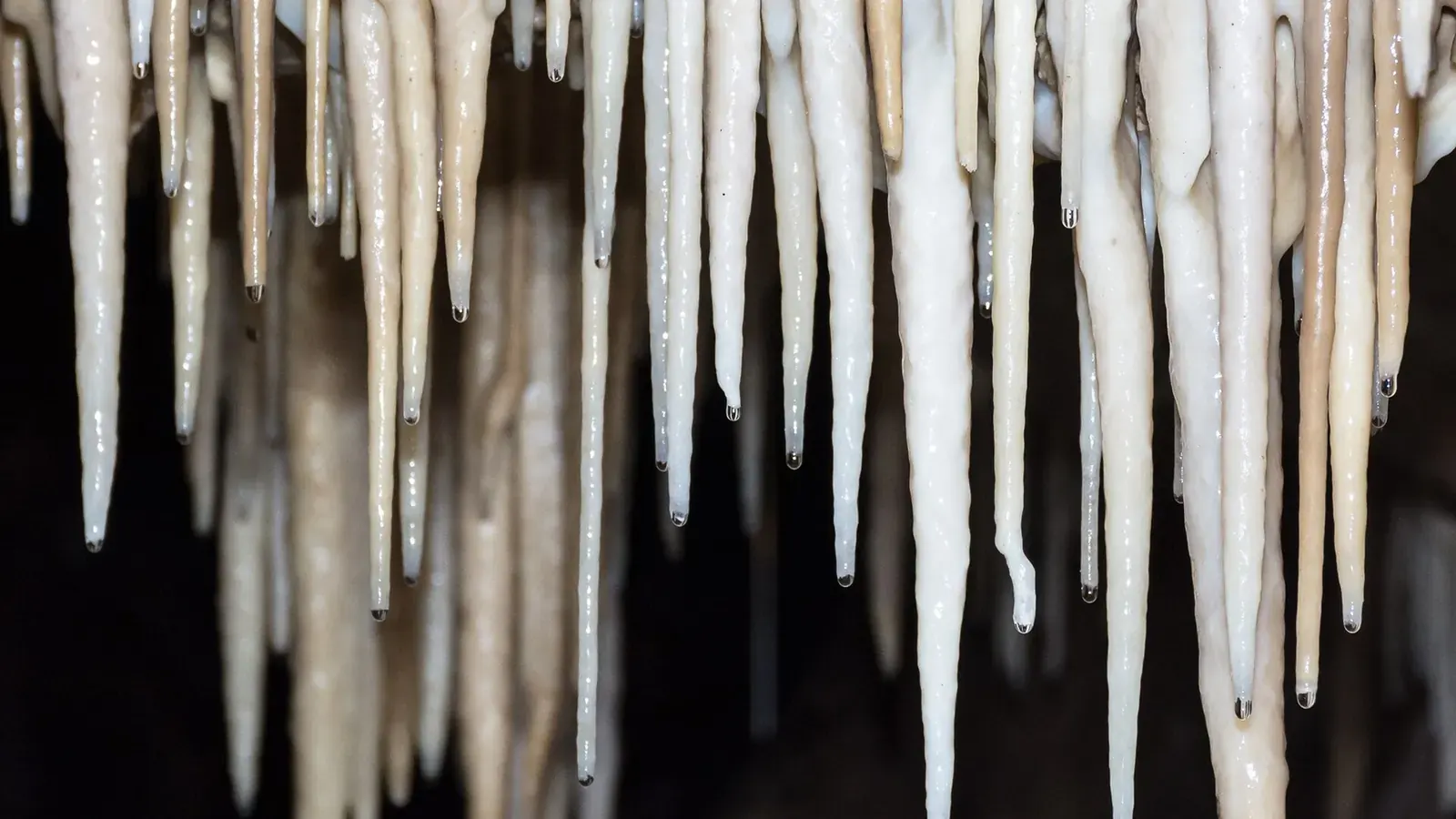
Stalactites, stalagmites and related cave deposits can preserve information about past environmental conditions. These mineral formations, collectively called speleothems, grow as water deposits material inside a cave. Their chemistry and structure can retain changes associated with the water and landscape above.
A speleothem is therefore both a physical object and a potential archive. Reading it requires an age model and an explanation of how the recorded signal formed.
Water builds the archive
Water moving through soil and rock can dissolve calcium carbonate and later deposit it in a cave under suitable conditions. Stalactites grow down from ceilings; stalagmites grow up from the floor beneath deposition sites.
The rate is not constant everywhere or through all periods. A formation may grow quickly, slowly or stop altogether as water supply and cave conditions change. Height alone cannot provide a reliable universal age.
Dating anchors the layers in time
Uranium–thorium dating is widely used for suitable calcium-carbonate deposits. Researchers measure isotopic relationships that develop through radioactive decay, while accounting for assumptions and potential complications in the sample.
The dated positions constrain when parts of the formation grew. Interpolating between them creates an age model with uncertainty. Counting visible bands without establishing their timing is a different procedure and cannot automatically be treated as annual dating.
Chemistry records a chain of processes
Oxygen isotopes, trace elements and growth characteristics can carry environmental information. NOAA's speleothem archive includes records used to investigate past climate conditions.
Yet rainfall is only one part of the route from atmosphere to mineral. Soil processes, water storage, evaporation, temperature and deposition can influence the final signal. The same numerical change should not be translated into an identical rainfall amount in every cave.
Local monitoring helps explain the signal
Researchers can compare modern drip water and cave conditions with the wider environment. That work helps identify which processes are likely to control a particular record.
The UCAR climate-data guide emphasises both the value of speleothems and the care needed in interpreting proxies. A proxy is an indirect indicator whose environmental meaning must be established, not an ancient instrument displaying rainfall in millimetres.
Different archives make a stronger reconstruction
Comparing several formations and independent climate records helps test whether a pattern is local or widespread. Dating uncertainty must be considered before claiming that events in distant regions happened simultaneously.
Speleothems extend environmental history into periods with no written observations. Their strength comes from combining mineral growth, isotopic dating and cave-system research. Their beauty alone, or a neat sequence of bands in a cut surface, is not sufficient to turn them into an exact year-by-year weather diary.
Explore a related question
How Radiocarbon Dating Turns Decay Into a Clock
Sources and further reading
Keep exploring.
One remarkable idea at a time—nature, science, history and beyond.
Last updated October 27, 2026.

Barnakle Editorial Team
Barnakle Editorial Team is the collective byline used for Barnakle’s editorial articles. The contributor profile explains the team identity and links to the publication’s editorial policies.
More from the editorial team →