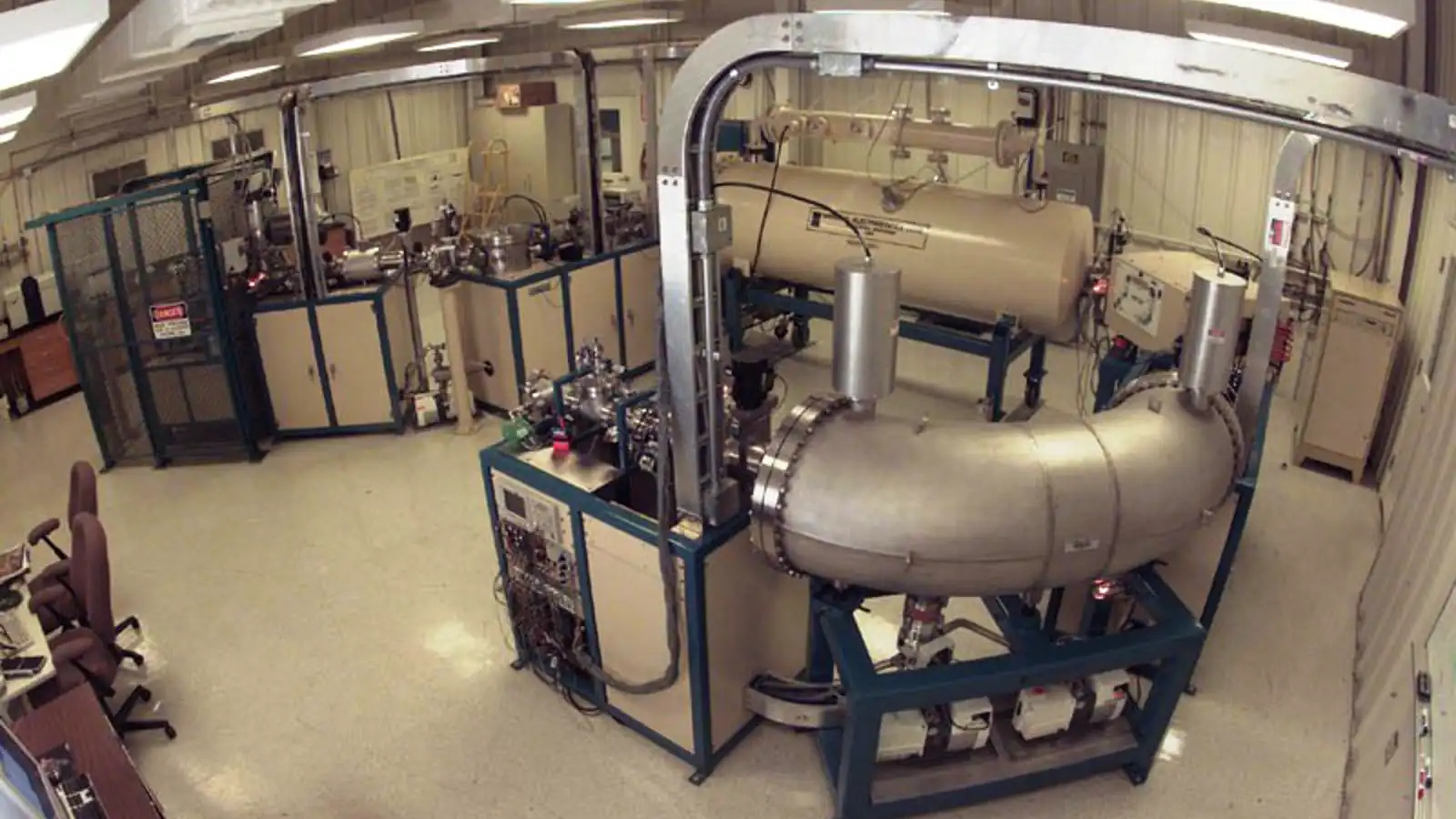
Radiocarbon dating uses the radioactive decay of carbon-14 to investigate the age of carbon-bearing material. Living organisms take part in carbon exchange with their environment. After that exchange stops, the carbon-14 already present continues to decay, changing its abundance relative to stable carbon isotopes.
The measurement dates the sampled carbon's history. Connecting it to an archaeological event requires knowing what the sample is and how it entered the site.
A half-life describes a statistical clock
Carbon-14 has a physical half-life of about 5,730 years. After one half-life, roughly half of an initial population of carbon-14 atoms remains; after two, roughly a quarter remains. This does not mean individual atoms decay on a predictable appointment.
Laboratories measure isotopic quantities and use reporting conventions to calculate a radiocarbon age. The conventional calculation retains a historical half-life value, so a laboratory's reported radiocarbon years should not be read as an uncalibrated calendar date.
The starting concentration has varied
The amount of carbon-14 in atmospheric carbon has changed over time. Assuming one fixed starting concentration would therefore produce calendar errors even with an excellent measurement of the sample.
Calibration compares radiocarbon measurements with independently dated records. Tree rings are especially useful where their calendar ages are established. Other archives extend the record further, with their own uncertainties that must be incorporated.
A calibrated result may have several ranges
Oxford's calibration guidance explains why the relationship between radiocarbon age and calendar age is not a straight line. Wiggles and flatter sections in a calibration curve can give a measurement more than one plausible calendar interval.
A calibrated distribution therefore contains more information than a rounded single year. The IntCal20 research documents a Northern Hemisphere atmospheric calibration framework; other settings and sample sources can require different curves or additional corrections.
Carbon sources can shift the answer
Marine organisms and some freshwater settings can acquire carbon with a different apparent radiocarbon age from the contemporary atmosphere. Reservoir effects need appropriate treatment rather than assuming every organism starts the clock at the same isotopic value.
Contamination introduces another problem. Newer or older carbon mixed into a sample can shift its measured composition. Sampling, chemical pretreatment and documentation help determine whether the result addresses the intended material.
Age is not the same as archaeological meaning
A piece of charcoal may come from wood that grew long before it was burned. Material can also be redeposited into a later layer. A precise laboratory result does not remove those contextual questions.
Radiocarbon dating is most powerful when measurement, calibration and site interpretation work together. It supplies a constrained estimate about sampled carbon, which can then be tested against stratigraphy, other dates and the history of the object or deposit.
Explore a related question
How Stalactites and Stalagmites Record Underground Time
Sources and further reading
Keep exploring.
One remarkable idea at a time—nature, science, history and beyond.
Last updated October 27, 2026.

Barnakle Editorial Team
Barnakle Editorial Team is the collective byline used for Barnakle’s editorial articles. The contributor profile explains the team identity and links to the publication’s editorial policies.
More from the editorial team →